





Algeria’s Hidden Caves Preserve 17,000 Years of History
Hidden beneath Algeria's mountains, Aokas and Gueldaman caves reveal prehistoric life, towering limestone chambers, and 17,000 years of history carved into stone near the coastline for ages.

Along the road connecting Algeria’s Béjaïa to the small town of Aokas, the Mediterranean appears and disappears between the cliffs in flashes of blue. The highway cuts tightly through the mountains, where limestone rises on either side as if the land has been pushed upward and forgotten. Then, almost without warning, the rock opens into a narrow dark mouth set directly into the cliff face. This is the entrance to Aokas Cave, known locally as the “Cave of the Genie.”
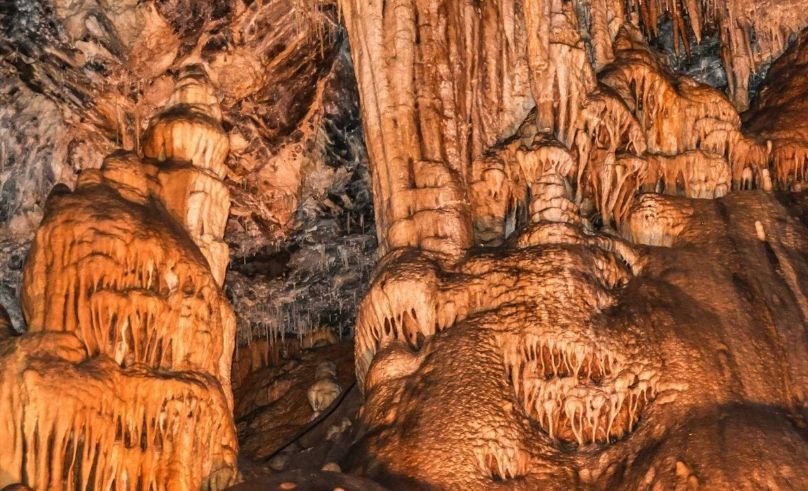
Discovered accidentally in 1963 during the construction of a nearby tunnel, the cave unfolds underground in sudden shifts of space and silence. Air cools instantly. Water echoes somewhere out of sight, marking time in slow, patient drops. The limestone here doesn’t sit still; it pauses mid-motion, forming ridges, folds, and mineral shapes that look less like geology and more like something still becoming.
-c7e1640f-5056-435b-a156-d2fa5d04fbdb.jpg) Deeper inside, the cave moves between narrow corridors and vast chambers without warning. Stalactites hang like stone threads from the ceiling, while columns rise from the ground as if the earth were pushing upward through itself. Light, when it finds its way in, breaks into soft shades of amber and grey across wet stone surfaces. At points, the passage tightens so sharply it feels as though the mountain has folded back onto itself, before suddenly releasing you again into open silence.
But Aokas is only the beginning of what the limestone remembers here.
Across the same mountainous spine of Kabylia, other caves hold a different kind of memory; not just of water and stone, but of people. Of hands that shaped tools, of fires that once burned in the dark.
Further west, high above the Soummam Valley, the Adrar Gueldaman caves carry traces of one of Algeria’s oldest known human occupations. Archaeologists have dated activity here to roughly 17,000 years ago; long before roads, towns, or even the idea of borders existed in this landscape.
Deeper inside, the cave moves between narrow corridors and vast chambers without warning. Stalactites hang like stone threads from the ceiling, while columns rise from the ground as if the earth were pushing upward through itself. Light, when it finds its way in, breaks into soft shades of amber and grey across wet stone surfaces. At points, the passage tightens so sharply it feels as though the mountain has folded back onto itself, before suddenly releasing you again into open silence.
But Aokas is only the beginning of what the limestone remembers here.
Across the same mountainous spine of Kabylia, other caves hold a different kind of memory; not just of water and stone, but of people. Of hands that shaped tools, of fires that once burned in the dark.
Further west, high above the Soummam Valley, the Adrar Gueldaman caves carry traces of one of Algeria’s oldest known human occupations. Archaeologists have dated activity here to roughly 17,000 years ago; long before roads, towns, or even the idea of borders existed in this landscape.
-03f3fe6e-2a4a-41a9-9db9-6a077f5b7c05.jpg) Inside these shelters, fragments of daily life document the gradual shift from hunter-gatherer life toward more settled communities in North Africa: pottery, bone tools, ornaments, animal remains, and evidence of early domestication. Nothing spectacular in isolation, but together they point to something more layered. A repeated return, seasonal movement, the slow shaping of a relationship between people and land. These were not accidental shelters. They were used, revisited, and remembered.
What makes Gueldaman unsettling is not its age, but its setting.
Inside these shelters, fragments of daily life document the gradual shift from hunter-gatherer life toward more settled communities in North Africa: pottery, bone tools, ornaments, animal remains, and evidence of early domestication. Nothing spectacular in isolation, but together they point to something more layered. A repeated return, seasonal movement, the slow shaping of a relationship between people and land. These were not accidental shelters. They were used, revisited, and remembered.
What makes Gueldaman unsettling is not its age, but its setting.
-54618cb0-3d66-4534-a214-f2b4c94765dc.jpg) This is not the Sahara that often dominates imagined prehistory. In Béjaïa, the past sits between green ridgelines, forested slopes, and a coastline that still feels active. Mist moves through the valleys in the morning; the sea keeps breaking against the cliffs just beyond the mountains. The landscape refuses to flatten into a single image of “ancientness.” It stays alive.
This is not the Sahara that often dominates imagined prehistory. In Béjaïa, the past sits between green ridgelines, forested slopes, and a coastline that still feels active. Mist moves through the valleys in the morning; the sea keeps breaking against the cliffs just beyond the mountains. The landscape refuses to flatten into a single image of “ancientness.” It stays alive.
- Previous Article SceneNoise x Amsterdam Dance Event Present CROSSFADE: Egypt
- Next Article The Abandoned Architecture of Villa Badran by Gamal Bakry