






Cairo’s Street Dogs Aren’t Going Anywhere. Here is Egypt’s New Plan.
Millions of Baladi dogs roam Egypt's streets. As authorities expand shelters and sterilisation programs, the debate over how to manage Cairo’s street dogs is only growing.
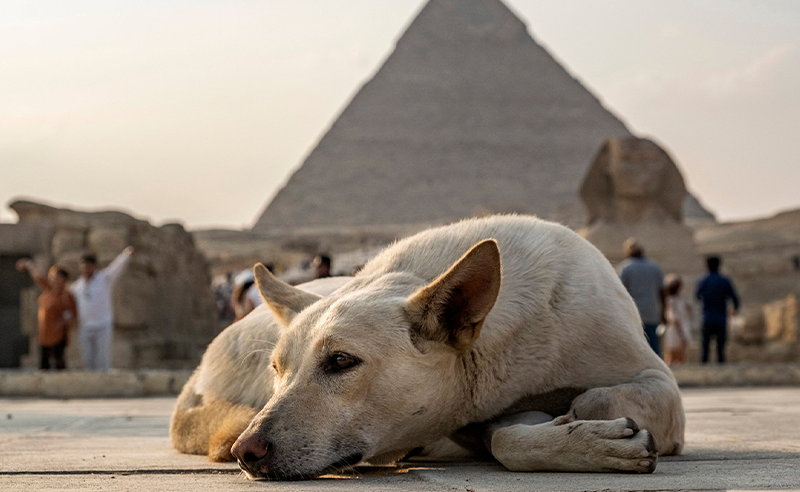
An estimated 10 to 40 million Baladi dogs roam Egypt’s streets each day, and as their population booms, the government is working to implement solutions.
The Ministry of Health reported around 1.4 million stray dog bites in 2025 alone. Egyptian billionaire Naguib Sawiris has proposed exporting stray dogs instead of killing them, a possibility parliament was already exploring, while the Cairo Governorate recently announced the launch of its first integrated shelter, equipped to house, treat, vaccinate and sterilise street dogs.
When a woman poisoned stray dogs in a 6th of October City compound in May 2026, she was arrested, promptnig the head of the General Authority for Veterinary Services Hamed al-Aqnas to comment against both poisoning and feeding dogs at the same time.
-72939fb0-d7a6-464a-9f5e-3e561ab97493.png) So, what should be done about Cairo’s street dogs?
So, what should be done about Cairo’s street dogs?
It seems that public opinion is divided into two camps: “One doesn’t want the dogs. They see Baladi dogs as a bad image for Egypt, threatening our children, biting people, looking in the trash," says Maha Gamal, co-owner of nonprofit My New Life Rescue. "And the other is that we love the dogs, even if we don’t want a huge number.”
In online comment sections, this debate comes alive, with posts echoing such sentiments as, "I want to take them home" or "Someone will poison them"; "We should sterilise them" and "Overpopulation is not cute"; "The dogs are dangerous" versus "Baladi dogs are our guards."
Whether the public agrees or not, the official consensus has moved towards more humane treatment, with the government adopting a catch-neuter-vaccinate-return (CNVR) approach that had already been used by animal welfare groups in Cairo.
The Case for Coexistence
My New Life Rescue is a civil society organisation that shelters dogs who cannot survive in the streets, currently providing permanent housing for 76 dogs. “From my 20 to 25 years of experience of dealing with Baladi dogs, I can tell you that they are the most smart, friendly, loyal and exciting creatures,” says Gamal.
Another organisation, the Animal Protection Foundation (APF), works to rescue, rehabilitate, rehome and humanely manage the population of street dogs. Most of their emergency rescues are for dogs that have been hit by cars, poisoned or abused. “Our goal is not only to save their lives but to restore their health and trust in people,” says APF founder Hanan Deebes. Since its founding in 2013, APF has successfully rehomed more than 2,500 dogs and currently provides lifelong care for nearly 4,000 rescued dogs at its shelter.
“Most are peaceful animals that have adapted to living alongside people, but the lack of a consistent nationwide management program over many years has led to uncontrolled population growth in some areas,” Deebes says. This, in turn, has raised fears about dog attacks and rabies.
Gamal is a firm believer that dogs are not dangerous unless provoked first. When they are chased or hit with stones, they become afraid and defensive. “Many people complain that street dogs run after people and bite them, but no one attacks without a threat,” she says.
Egypt’s New Strategy
Deebes explains why the CNVR approach is the only feasible solution to Cairo’s dog problem: “Removing dogs from one area creates a vacuum that is quickly filled by unsterilised dogs from surrounding areas, allowing the cycle to continue."
This, she explains, is why the response of poisoning, shooting or relocating dogs has failed for so long.
Gamal says the current situation for dogs in Egypt is particularly bad, but she sees hope in new government programs. “We can get the dogs back to where they live, but their number will not increase anymore,” she says.
The new rules introduced earlier this year to address Cairo’s dog problem range from a joint technical committee led by the General Authority for Veterinary Services to a sterilisation and vaccination campaign. The stated goal is to reduce reproduction and reach a rabies-free Egypt by 2030.
As part of that mission, every governorate is also expected to establish dedicated shelters where stray dogs can be housed, vaccinated and sterilised, located away from densely populated residential areas. Plots of land have already been allocated for this purpose in Cairo, Giza, Qalyubia and Alexandria.
Construction has already begun in several governorates, with some shelters nearing completion.
One of the largest projects is Tebbin’s new shelter, built by the Cairo Governorate in a 5,000 square metre plot, designed to house up to 700 dogs in 112 rooms. It includes a feeding unit, administrative offices and a veterinary pharmacy, among other services.
-30c19433-a27e-416e-a3dd-ccd76fb4ede7.png) Similar local initiatives are also emerging, including a community-funded shelter in Al Shorouk, where the city reached an agreement with Badr University to carry out sterilisation and vaccination of street dogs.
Similar local initiatives are also emerging, including a community-funded shelter in Al Shorouk, where the city reached an agreement with Badr University to carry out sterilisation and vaccination of street dogs.
Deebes praises the recent government initiatives to address Cairo’s dog overpopulation. “Over the past few months, and especially in recent weeks, there has been a significant and encouraging shift in Egypt’s approach. Egypt now has a real opportunity to reduce the street dog population humanely while improving public health and animal welfare,” she says.
‘Baladis Are Survivors’
Gamal believes the solution lies in compassionate treatment. “These dogs are voiceless, but we want to speak on their behalf. If you treat them with mercy and love, they will not be aggressive — it’s not their nature,” Gamal adds.
The Baladi dog is indigenous to Egypt, shaped by thousands of years of natural selection rather than selective breeding.
“Baladis have evolved to thrive in Egypt’s harsh climate, making them exceptionally intelligent, resilient, adaptable and generally healthier than many pedigree breeds,” says Deebes.
APF also commissioned DNA testing on one rescued Baladi dog, which revealed a diverse genetic background and genetic adaptations associated with surviving low-oxygen environments. For Deebes, the findings reinforced what rescuers already observe: “Baladis are survivors.”
Dogs have held an important place in Egyptian history since the time of the pharaohs, from Anubis — the jackal-headed god associated with the afterlife — to hunting dogs depicted in pharaonic tombs.
Despite that, Baladi dogs today are often overlooked simply because they are street dogs. “We believe they deserve to be valued for what they truly are: an ancient, naturally evolved dog with remarkable intelligence, resilience, and an enormous capacity to love,” she says.
For centuries, the Baladi dog has been part of Cairo’s landscape and history. As Egypt seeks to bring its street dog population under control, the challenge will be finding a solution that protects both the public and the animals that have long shared the city’s streets.
- Previous Article SceneNoise x Amsterdam Dance Event Present CROSSFADE: Egypt
- Next Article The Intricate Beauty of Ben Youssef Madrasa