





The Man Petitioning to get Saudi Arabian Heritage Preserved in Lego
Noel Cabacungan is petitioning to have his 5,000-brick replica of a Jeddah Rawashin House turned into an official LEGO set.
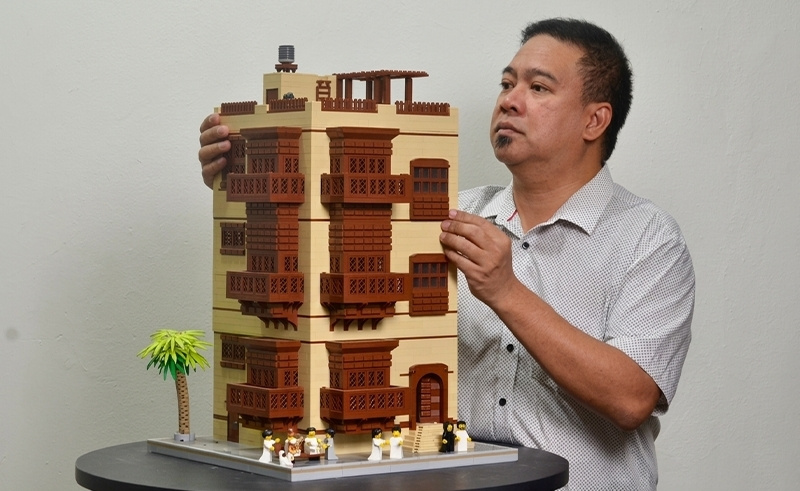
By day, Noel Cabacungan inspects air-conditioning units at a manufacturing plant in Jeddah. By night, he builds centuries-old architecture out of plastic bricks. His latest project - a nearly 5,000-piece LEGO recreation of a traditional Saudi Arabian house in the historic Al Balad area - is being petitioned to become an official LEGO set representing Saudi culture on a global stage.
Cabacungan moved to Jeddah from the Philippines in 2011 as an electrical engineer. His true passion, however, lies elsewhere: in literature, arts and architecture. LEGO, of all things, became the medium that brought those interests together.
He first encountered the buildings of Al Balad out of necessity - it was where he would go to send money home to the Philippines. But in 2014, when UNESCO listed the district as a World Heritage Site, something shifted, and the streets he walked daily suddenly demanded a closer look.
“I love heritage sites and old architecture,” Cabacungan says. It's an interest that takes him out of Jeddah every year, to the mud houses and stone structures of Al Bahah and Abha. When the quiet inspiration of Al Balad crept up on him, he wielded a collection of beige LEGO bricks and 15 years of accumulated affection for his adopted city to create The Roshan House.
The Rawashin houses of Jeddah’s Historic District, Al Balad, are defined by their coral stone structure and intricate wooden balconies. This style of architecture dates back hundreds of years. The coral stone, harvested from the Red Sea, forms the bones of the structure - dense, textured walls built to absorb and deflect the punishing coastal heat. Projecting from them is the rawashin themselves: ornate wooden balconies fitted with carved lattice screens called mashrabiya, which filter sunlight, channel airflow, and shield the interior from the street. Long before the air conditioning systems Cabacungan spends his days maintaining now, this was a natural system of cooling down houses.
Cabacungan's model captures all of this. The LEGO Roshan House rises across three floors and seven levels, each one detachable to reveal the interior life of the building. This includes a miniature replica of a majlis - the communal reception room that sits at the social heart of any traditional Saudi home.
Composed of 4,998 LEGO bricks, nine characters, and three animals, the detail of The Roshan House is a testament to Cabacungan’s careful observation. To make his LEGO rendering as accurate as he could, he even embarked on a guided tour of one of the historic houses to learn about each room and its function.
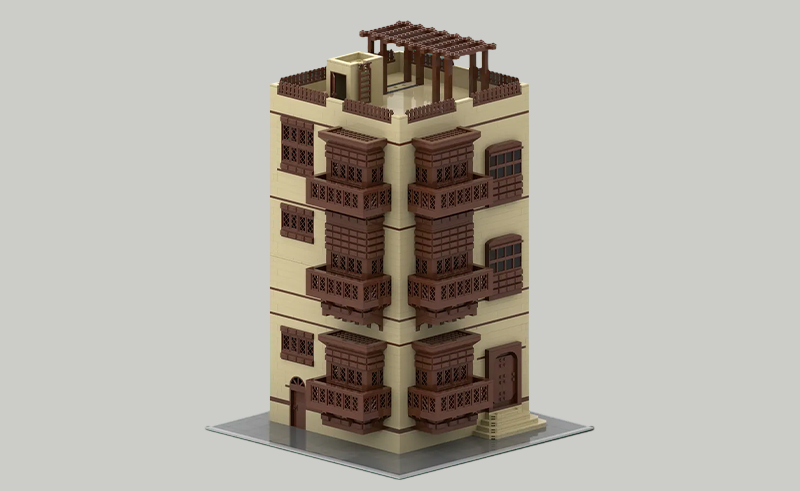
“If I’m presenting a piece of history to the world,” he explains, “I’d like to capture even the smallest details as much as possible.” This comes across clearly in its structure: a secondary door offering privacy to family members when guests are being received in the majlis can be found. There is a LEGO version of a rooftop drainage system in place. The children’s room is even positioned so that its corresponding staircase is met by a watchful father sitting below it - miniature architectural expressions of how the home was lived in.
Underlying this attention to detail is a borrowed philosophy, one that comes from Cabacungan's love of literature. The philosophy, 'Forza, utilità, bellezza', is a line from Elif Shafak’s book, ‘The Architect’s Apprentice’. It describes three fundamentals of architecture, and the warning that abandoning any one of them costs you all three. In his Roshan House, Cabacungan sees all three working in harmony.
“The coral stones provided the structure capable of withstanding the hot and humid coastal climate of the Red Sea coast. That’s Forza, or strength,” he explains. Air being filtered and cooled through the wooden balconies, or the particular arrangements of the staircases and rooms reflecting certain socio-economic contexts. “That’s utilità, function.” Finally, “The intricated wooden balconies protruding from contrasting coral stones are screaming belleza - beauty.”
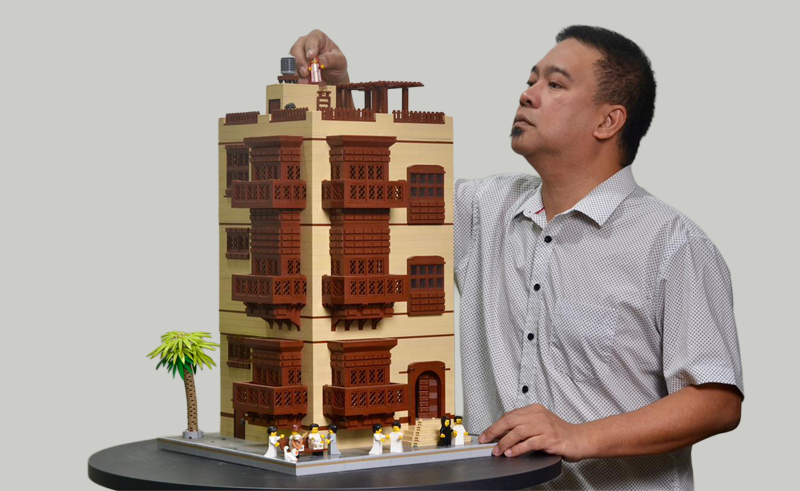
Cabacungan didn’t want the historic house to lose anything in the process of becoming a LEGO set. “I wanted to show how the rawashin houses embodied all the fundamentals of architecture. Even in LEGO form, it should be able to tell a history,” Cabacungan says.
The model was submitted to LEGO Ideas - a platform where designers pitch concepts to the public, and LEGO's team reviews any project that reaches 10,000 supporters. Cabacungan hit 100 supporters within two days, and 1,000 within a week. He currently sits at around 2,135, with 589 days left to reach the 5,000-supporter milestone that unlocks the next stage.
Initially, that support came from family and friends, but after sharing his design and mission across his social media pages, Saudi communities across the Hejaz region began vocalising their support for his idea.
If the set ever makes it to production, Cabacungan wishes its effects will go beyond sales. He believes a foreigner's genuine investment in Saudi heritage could rekindle local pride in it too. “It is my way of giving back to my second home, to the country and the people who nurtured me for the past 15 years despite me being an outsider," he says.
"The Roshan House represents an era that highlighted human adaptability, resourcefulness, and ingenuity - even before the advent of modern technology," he adds. And his ambitions are steadily growing beyond this historic house as well. Soon, Cabacungan will be travelling to Diriyah to study the mudbrick architecture of At-Turaif, another UNESCO site, and is looking to study traditional houses across the country and honour them in a similar way.
To support The Roshan House's bid to become an official LEGO set, visit the petition linked in @bababrick25's Instagram bio.