





This Palestinian Family Lives in an RV & Travels Across the US
Diana and Naseer Mansour swapped a traditional house for a forty-three-foot home on wheels, travelling America in search of more time together, adventure and memories.
We spend years trying to build permanence. Accumulating furniture, kitchen gadgets, decorative cushions, and enough miscellaneous cables to wire a small nation. Home, we are told, is something you settle into; like a good armchair. And yet, for a growing number of people, the entire concept has begun to feel suspect. As more and more of us work remotely from beach cafés and maintain friendships through voice notes, the notion that home must remain rooted to a single patch of land feels oddly outdated. Why stay put when the horizon keeps moving?
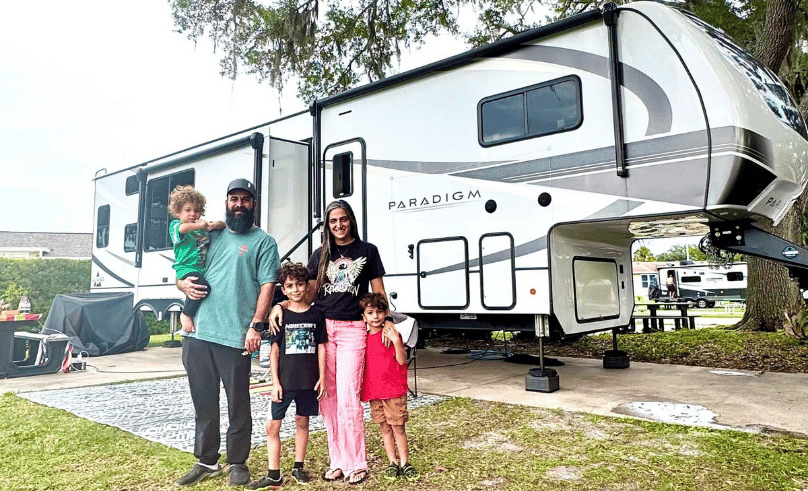
Palestinian couple Diana and Naseer Mansour decided not to argue with the question. Instead, they did what most people only half-jokingly threaten to do after a difficult week involving a leaking faucet and a PTA meeting: they packed up their lives into drawers and storage bins, gathered their three boys—Saif, Shams, and Nour—and their ten-year-old dog Mika, and traded a traditional house for an RV they now tow across the US.
-4f29c39b-d4bd-400c-b197-e3ae46430723.png) “We realised life moves fast and we didn’t want to keep waiting for ‘one day,’” Diana tells SceneTraveller. “We had rented RVs before and we just knew we could do this full time. So, we ended up trading space for experiences.”
Their must-haves were simple: space for three kids and a proper kitchen. "We wanted something that felt like a home, not just a camper." What they found, on Facebook Marketplace, was a fifth wheel. A forty-three foot trailer hauled by a truck, containing two bedrooms, a loft, two bathrooms, and enough kitchen space to feed a family of five comfortably. "Once you do it long enough, it doesn't feel small," Diana says "It's just home." The cleaning takes a few hours, maximum, where the house used to demand days. The organisation is military: bins everywhere, repurposed as wardrobes, toy boxes, school supply stations, snack depots. "RV families understand. You can never have enough bins."
“We realised life moves fast and we didn’t want to keep waiting for ‘one day,’” Diana tells SceneTraveller. “We had rented RVs before and we just knew we could do this full time. So, we ended up trading space for experiences.”
Their must-haves were simple: space for three kids and a proper kitchen. "We wanted something that felt like a home, not just a camper." What they found, on Facebook Marketplace, was a fifth wheel. A forty-three foot trailer hauled by a truck, containing two bedrooms, a loft, two bathrooms, and enough kitchen space to feed a family of five comfortably. "Once you do it long enough, it doesn't feel small," Diana says "It's just home." The cleaning takes a few hours, maximum, where the house used to demand days. The organisation is military: bins everywhere, repurposed as wardrobes, toy boxes, school supply stations, snack depots. "RV families understand. You can never have enough bins."
-c44d118a-4a83-414c-92f5-52e2f82bf0d7.png) Diana and Naseer met as children, stomping through a dabke line in Palestine—hands clasped, feet pounding. After getting married, they moved to the US with their law and accounting degrees respectively, now filed somewhere unreachable and apparently unmissable. Instead, they run a remote business, and homeschool three kids. On Instagram, they document the whole unruly, beautiful experiment: the sunsets and the bear sightings, the food blogging attempts and the very candid footage of Naseer taking a work call in the bathroom while Diana films him from the doorway with barely concealed delight.
Mornings are what she calls "organised chaos." The boys wake up hungry so breakfast comes first. Then coffee, slow and deliberate, a small daily act of resistance against the idea that life on the road must mean life at speed. Naseer handles the logistics: the weather apps, the route-planning, the reversing of a 43-foot trailer into a campsite while Diana spots from outside. This last task, she says diplomatically, "did test our patience a few times." But they figure it out, the way families do: through trial, error, and the occasional shouted instruction that means nothing and everything.
Diana and Naseer met as children, stomping through a dabke line in Palestine—hands clasped, feet pounding. After getting married, they moved to the US with their law and accounting degrees respectively, now filed somewhere unreachable and apparently unmissable. Instead, they run a remote business, and homeschool three kids. On Instagram, they document the whole unruly, beautiful experiment: the sunsets and the bear sightings, the food blogging attempts and the very candid footage of Naseer taking a work call in the bathroom while Diana films him from the doorway with barely concealed delight.
Mornings are what she calls "organised chaos." The boys wake up hungry so breakfast comes first. Then coffee, slow and deliberate, a small daily act of resistance against the idea that life on the road must mean life at speed. Naseer handles the logistics: the weather apps, the route-planning, the reversing of a 43-foot trailer into a campsite while Diana spots from outside. This last task, she says diplomatically, "did test our patience a few times." But they figure it out, the way families do: through trial, error, and the occasional shouted instruction that means nothing and everything.
-128b72c4-ede7-4614-9c5b-f926833a2af4.png) The route itself is loosely structured. A start point, an end point, and a middle that stays open as long as possible. Some parks book out months ahead, so those get secured early; everything else is deliberately left to chance and mood. On off-grid days they look for silence and zero bars of service. When deadlines loom, they hunt for campgrounds with reliable Wi-Fi, or find a lodge where they can spread out laptops and work undisturbed while the boys run outside. "We don't have a typical day," Diana says. "Owning a business, you never know what it brings." Some days someone is in the office for eight hours. Some days it's thirty minutes. Routine, as a concept, has been quietly retired.
The road has taken them to farms via an app called Harvest Hosts, where strangers open their land and somehow become friends. "You can feel the love in the land from all the hard work they put in." There was a baby bear on a hiking trail, close enough to be alarming for the adults and entirely wonderful for the boys, who received that afternoon an impromptu education in bears, in wilderness, in the basic decency of being a guest in a habitat that was never yours to begin with.
"We don't like to book too much in advance," Diana says. "If we get somewhere and we like it, we stay longer." That flexibility is the whole point. Adventure for this family is about waking up in Mount Shasta; a single overnight stop in Northern California, chosen almost arbitrarily en route to somewhere else, that turned out to be one of those places that gets in through the ribcage before you've understood why. A small city in the shadow of a dormant volcano. "The energy and nature made us feel so peaceful," Diana says. "Truly a gem to find." It's on the list to return to, a list that is growing faster than the roads can accommodate. Life on the go has gifted them friends like an Afghan family met at a California playground who became like kin, reunions scattered across state lines. "We don't know how long we'll do this," Diana says. "And honestly, we're okay not knowing."
The route itself is loosely structured. A start point, an end point, and a middle that stays open as long as possible. Some parks book out months ahead, so those get secured early; everything else is deliberately left to chance and mood. On off-grid days they look for silence and zero bars of service. When deadlines loom, they hunt for campgrounds with reliable Wi-Fi, or find a lodge where they can spread out laptops and work undisturbed while the boys run outside. "We don't have a typical day," Diana says. "Owning a business, you never know what it brings." Some days someone is in the office for eight hours. Some days it's thirty minutes. Routine, as a concept, has been quietly retired.
The road has taken them to farms via an app called Harvest Hosts, where strangers open their land and somehow become friends. "You can feel the love in the land from all the hard work they put in." There was a baby bear on a hiking trail, close enough to be alarming for the adults and entirely wonderful for the boys, who received that afternoon an impromptu education in bears, in wilderness, in the basic decency of being a guest in a habitat that was never yours to begin with.
"We don't like to book too much in advance," Diana says. "If we get somewhere and we like it, we stay longer." That flexibility is the whole point. Adventure for this family is about waking up in Mount Shasta; a single overnight stop in Northern California, chosen almost arbitrarily en route to somewhere else, that turned out to be one of those places that gets in through the ribcage before you've understood why. A small city in the shadow of a dormant volcano. "The energy and nature made us feel so peaceful," Diana says. "Truly a gem to find." It's on the list to return to, a list that is growing faster than the roads can accommodate. Life on the go has gifted them friends like an Afghan family met at a California playground who became like kin, reunions scattered across state lines. "We don't know how long we'll do this," Diana says. "And honestly, we're okay not knowing."
-c7655918-be79-4dba-8a0d-c1398ba3a1d0.png) Then again, life on wheels comes with its own kind of tuition, and turns out the romance of the open road has a wicked sense of timing. They experienced a flood. Naseer had been filling the water tanks and then, entirely reasonably, forgot about it while they were hanging outside with friends. An hour later Diana walked inside to find their bedroom floor under an inch and a half of water. Every towel in the trailer was conscripted into service. Sections of wooden flooring had to come up before the rot set in. “It was genuinely awful. But now we think of it and laugh."
The question people always ask, according to Diana, is the wrong one. "How do you live in such a small space?" They want to know about the logistics, the confinement, the inevitable fraying of nerves when five people share two hundred and fifty square feet. And she understands the curiosity, but what she wishes more people would ask is: Was it worth it? "Yes. A thousand times yes," Diana says “One day our kids won't remember how many square feet they lived in. But they'll have the memories we made together. And we hope this experience will shape them to be really good humans."
It is, when you think about it, a reasonable wager. The furniture can wait. The horizon won't.
Then again, life on wheels comes with its own kind of tuition, and turns out the romance of the open road has a wicked sense of timing. They experienced a flood. Naseer had been filling the water tanks and then, entirely reasonably, forgot about it while they were hanging outside with friends. An hour later Diana walked inside to find their bedroom floor under an inch and a half of water. Every towel in the trailer was conscripted into service. Sections of wooden flooring had to come up before the rot set in. “It was genuinely awful. But now we think of it and laugh."
The question people always ask, according to Diana, is the wrong one. "How do you live in such a small space?" They want to know about the logistics, the confinement, the inevitable fraying of nerves when five people share two hundred and fifty square feet. And she understands the curiosity, but what she wishes more people would ask is: Was it worth it? "Yes. A thousand times yes," Diana says “One day our kids won't remember how many square feet they lived in. But they'll have the memories we made together. And we hope this experience will shape them to be really good humans."
It is, when you think about it, a reasonable wager. The furniture can wait. The horizon won't.