





Inside MTRNM’s Unconventional House Music Universe
Lebanese-Jordanian MTRNM co-founder Michael Sabbagh on taking house music events to the places you’d least expect.

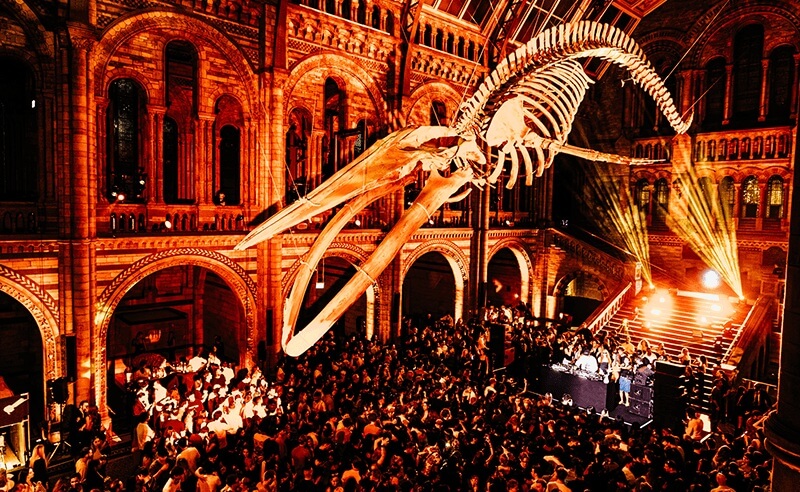
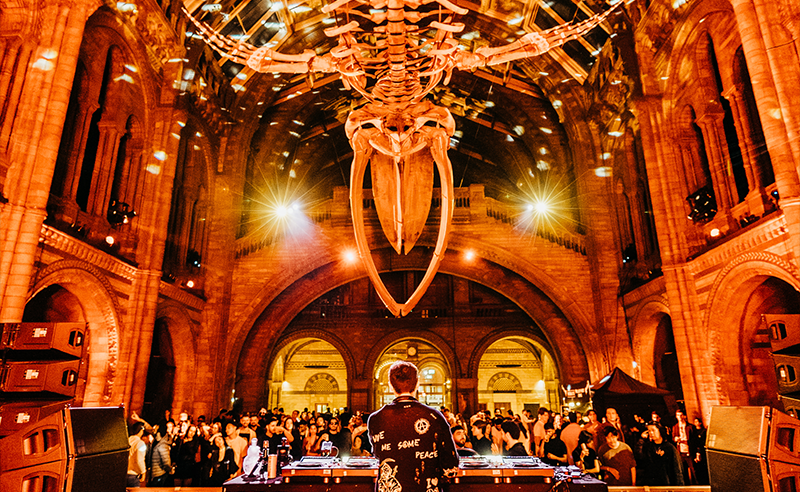
Beneath the suspended blue whale of London’s Natural History Museum, where schoolchildren usually look up in silence and tourists move through the grandeur of Hintze Hall with cameras raised, the room was moving differently.
Bass rolled across the stone floor as lights caught the Romanesque arches for five hours. The grand staircase became a backdrop, the museum became a dancefloor, and for one night, MTRNM’s Night at the Museum concept turned one of Britain’s most recognisable cultural institutions into a house music cathedral.
For Michael Sabbagh, the 24-year-old Lebanese-Jordanian co-founder of MTRNM, that sense of improbability has always been part of the point.
“MTRNM has always been about creating experiences in places people would never expect,” he says, adding that they have done events in museums in London and Los Angeles, palm tree farms by the Dead Sea, Japanese temples in LA and mountain sites in Malibu. “Always unusual spaces with very intentional curation,” he says. “The crowd is curated, the sound is curated, and there’s a huge amount of care put into the experience itself.”
On paper, the premise had obvious spectacle: house music under a whale skeleton; a dancefloor where tourists normally pass through with cameras; the past and present colliding under museum lighting with Antony Rahbani, OSCAAR and Marten Lou.
-86b45436-b254-4de2-8f13-f1a851c9d121.png)
MTRNM - pronounced Metronome - describes itself as a global house music platform that combines curated live experiences with a media engine and a brand ecosystem. The collective sits somewhere between an event label, a cultural curator, a lifestyle brand and a travelling community, built around high-production-value house music events in spaces that feel more cinematic and neater than conventional club rooms. Its press kit frames the mission simply: “curating unforgettable house music experiences.”
But behind the clean branding is a more restless idea – that nightlife can become more powerful when it is moved into spaces where it is not supposed to belong. Sabbagh says that it was not born from easy access.
“We genuinely brute-forced our way into the first venue,” he says. “We kept showing up every week until eventually they said yes – probably because they got sick of seeing us. Once you have something like that on your résumé, it changes everything.”
That persistence has become part of MTRNM’s mythology. From early events in Los Angeles, the brand grew through New York, London, Amman, Paris, Athens, Beirut and beyond. MTRNM has now staged more than 70 events across 17 cities and 11 countries. Its past venues include the Natural History Museum in both London and Los Angeles, Palais de Tokyo in Paris, AHM in Beirut, the Ritz-Carlton in Amman, 77 in London, Yamashiro in Los Angeles and Gospël in New York.
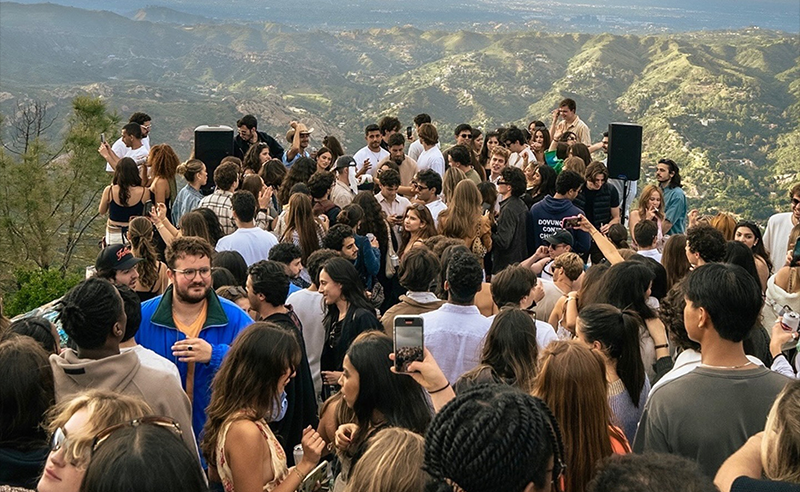
“What really helped us grow was organic word of mouth,” Sabbagh says. “We realised people were telling each other about the events across cities and countries. We’d host in LA, then in New York, and suddenly friends from university or work were bringing entire groups with them. A lot of that growth came from the audience itself.”
The London event also marked a natural evolution of the Night at the Museum concept, which MTRNM had already tested in Los Angeles. In 2025, the collective hosted sold-out public music events inside the Natural History Museum of Los Angeles, staging music beneath dinosaur skeletons and immersive lighting. The speed of that evolution is part of a broader strategy.
“I always compare it to chess - it’s pattern recognition,” he adds. “You keep repeating what works while experimenting with new locations and formats. It took us 23 events to reach the museum in LA, but only eight events to reach the museum in London. The goal is shortening the lifecycle between launching in a city and scaling there.”
The evening opened with Antony Rahbani, whose presence gave the night an important regional undertone on a lineup otherwise anchored by the international house circuit. There was something quietly powerful about seeing a Middle Eastern artist open a night of this scale inside one of London’s most prestigious cultural spaces.
Rahbani speaks about electronic music less as a closed genre than as the endpoint of a much wider musical lineage. While his own tastes were shaped by house, trance and progressive music, he sees electronic music as something built on earlier traditions: jazz, funk, soul, rock, blues and classical composition.
“If you trace electronic music back far enough,” he says, “you inevitably arrive at pioneers like Wendy Carlos, Giorgio Moroder and Kraftwerk, who helped lay the foundations for everything that followed.”
His own obsession began early, during childhood summers in Paris. “My aunt’s husband used to take me to Virgin Megastore, where I’d spend hours at the listening stations with those massive headphones on, jumping from one genre to another.”
He eventually built a CD collection of more than 2,000 records, with early influences ranging from Étienne de Crécy and Daft Punk to DJ Mehdi, Alan Braxe, Fred Falke, Martin Solveig and Philippe Zdar. Later, Beirut’s electronic scene, its record shops, DJs, festivals and visiting international acts deepened his understanding of the music.
At the time, it was either physical records or downloading music through those platforms,” he says. That period gradually drew him deeper into Beirut’s electronic scene during what he describes as one of the city’s most exciting eras.
Ironically, much of the music he still buys and plays today predates 2015.
“You can usually tell when music was created with real vision, taste and personality rather than purely following trends. I never really cared much about genre boundaries,” Rahbani says. “What mattered to me was whether the music felt unique, memorable and emotionally convincing.”
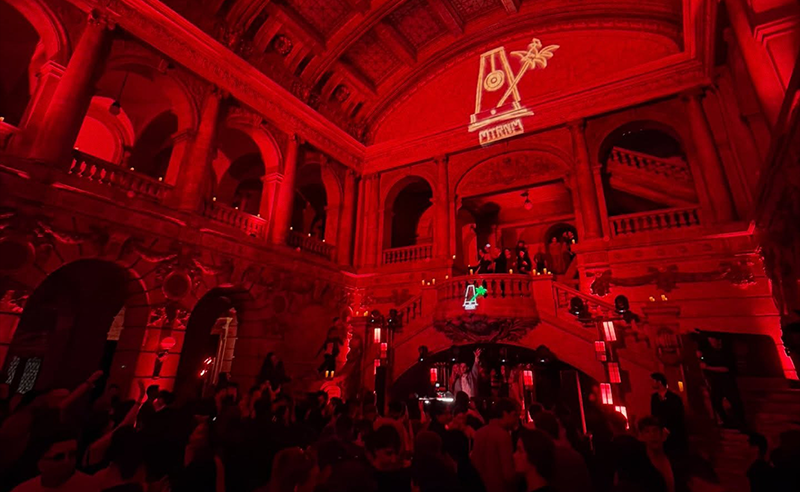
The challenge with a venue like Hintze Hall is that awe can overpower intimacy. The room is vast, vertical and visually dominant; people arrive already looking up. A good set has to bring their attention back down to the floor. Rahbani helped open that space, while OSCAAR tightened the transition between arrival and peak-time movement. By the time Marten Lou took over, the event had settled into an unforgettable movement.
By the end of the night, Hintze Hall returned to itself. The lights came up and the beat disappeared; the whale remained suspended overhead, still and ancient. But for a few hours, MTRNM had managed to make one of London’s most familiar institutions feel unfamiliar by simply placing rhythm inside it.