





Hany Abd El-Kader Stitches Khayamiya Into the Walls of the V&A Museum
The living craft of Egyptian Khayamiya found a new audience at the Victoria & Albert Museum in May 2026.
Hany Abd El-Kader speaks of his hand in the first person. It is an entity that exists separate from himself, capable of imagination and artistry. “What my hand has to say is more important than my mouth,” El-Kader says with a laugh. For a man who has spent over 50 years stitching fabric in Cairo’s historic Sharia al-Khayamiya, this is not an empty boast.
In 2011, those hands responded to history. As the Arab Spring unfolded in front of him, El-Kader channelled the movement of Tahrir into fabric, producing two khayamiyas that captured the spirit and emotions of the revolution with nothing but fabric from his home and the view from his balcony.
That piece of art, titled ‘Revolution Khayamiya’, has found its permanent home on the walls of the Victoria & Albert Museum in London, and in May of 2026, El-Kader and his learned hands travelled to London to lead a talk and workshop in those same halls.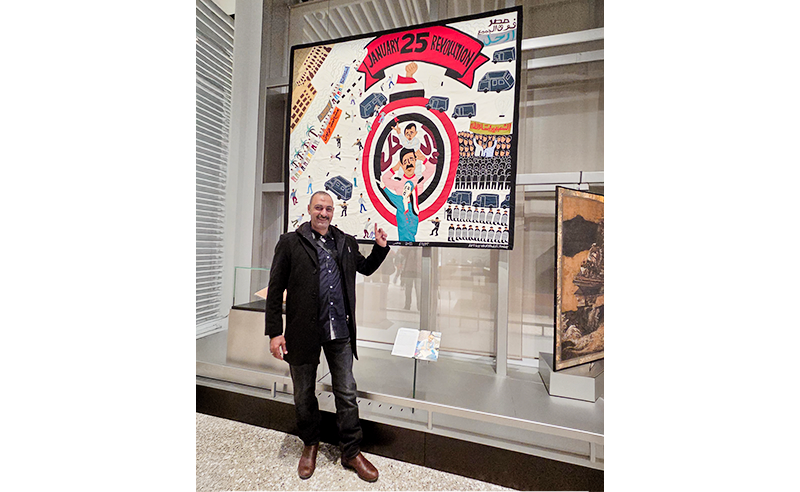 Khayamiya has been practised in Egypt for centuries. Historically clustered in Cairo's Sharia al-Khayamiya - the Street of the Tentmakers - the craft involves the intricate layering and hand-stitching of cotton fabrics into richly coloured geometric and arabesque designs, traditionally used to decorate ceremonial tents and the great processions of religious festivals. El-Kader has worked on that street for much of his life and entire career. It is a craft he learned first from his uncle, who, before that, learned from his father: a khayamiya artisan for over 70 years.
Today, El-Kader is carrying this family legacy internationally. The V&A Museum had recently put one of his four Egyptian Revolution pieces on permanent display at the newly opened V&A East, a decade after acquiring it. To celebrate this, Mariam Rosser-Owen, Curator in the Middle East section of the V&A, invited El-Kader to London to speak to the display in person. Art historian Seif El Rashidi, who has worked closely with El-Kader and other tentmakers in Cairo for years, tells Cairoscene, "Hany was the obvious choice."
For much of his career, El-Kader has been bringing the art of Egyptian khayamiya to international audiences. This happened first in 2005, when an American journalist approached his stall on Sharia al-Khayamiya about illustrating a beloved Egyptian classic, ‘Goha the Wise Fool’, with his textile appliqué. Six years later, his revolutionary khayamiyas travelled internationally, finding permanent homes in Durham and London.
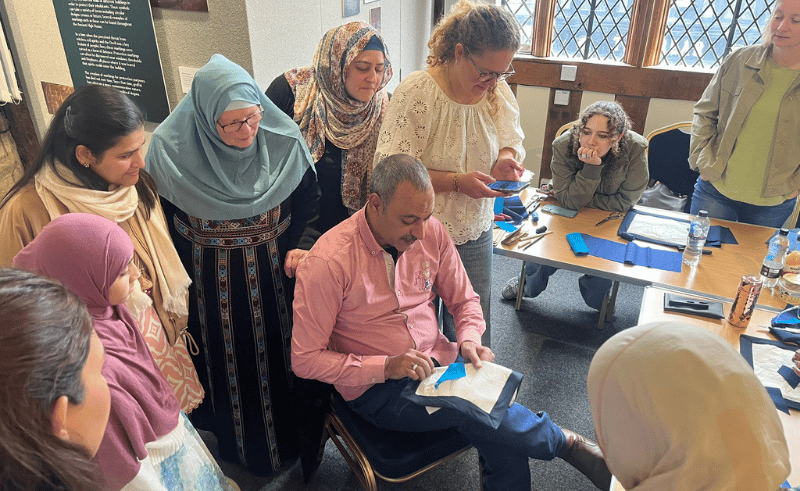
However, it is one thing to see a work of khayamiya displayed on a wall, and another to craft one yourself. On May 16th, 2026, El-Kader led a discussion and hands-on workshop at the V&A Museum, in collaboration with El Rashidi and Mariam Rosser-Owen, curator of the Middle East collection at the museum.
The day began with an introductory talk led by El Rashidi, followed by an in-depth conversation with El-Kader. Afterwards, as El-Kader says jokingly, “My hand talked,” and the artist led an intimate workshop with a mix of Egyptian, Moroccan, Saudi Arabian, and English guests.
“The workshop went very well,” El-Kader says with a smile. “Everybody appreciated the work so much. I think many were surprised to see that everything is made by hand.”
During the workshop, guests each made their own lotus flower design: an image rooted in Egyptian visual tradition, and easily approachable for Egyptians and foreigners alike.
Across the discussion and workshop, El-Kader says visitors asked him around two hundred questions. Something that might have exhausted another person. "But for me," he says, "it was easy. This is my work, and I love my work. It is my life." Khayamiya is a natural extension of himself: his hands can create textured scenes without him even realising. What he loved the most, he says, was simply seeing people’s reactions to his craft and seeing appreciation for it.
For El Rashidi, who has spent years studying and advocating for the craft, seeing khayamiya celebrated in an institution of the V&A's scale carried real weight. "Such exposure raises awareness," he says. "It was also nice to present it as a living heritage craft."
The Victoria & Albert Museum is celebrated internationally for its vast collections and seemingly endless displays - including nearly 800 Egyptian objects. They are, by definition, artefacts of the past, displayed behind glass, their makers long gone. What El-Kader showed was a contemporary example of Egyptian craft: one that lives and breathes and is undeniably present in Egypt today. Hany designs from memory - walking through Cairo's mosques with what he calls “the computer in my mind," absorbing geometric patterns he later reconstructs on paper back at his workshop.
It is a craft that is in constant dialogue with the past and present, absorbing what came before, and threading it into something new. It is also a craft, through such displays and workshops, that celebrates living Egyptian techniques - as capable of capturing a revolution as it is of decorating a ceremonial tent.
After returning to Egypt from London, El-Kader laughingly describes himself as “gracious and famous,” rejuvenated by the admiration and interest he saw in his new students at the V&A. He hopes to do more workshops in Egypt, in England, and wherever his imaginative hand takes him.
- Previous Article SceneNoise x Amsterdam Dance Event Present CROSSFADE: Egypt
- Next Article Saudi Arabia Ranked Safest Amongst G20 Countries in 2025