



Abdulnasser Gharem Always Finds a Way to Say What He Wants
The sale of a single artwork funded five years of Gharem’s mission to open up arts in Saudi. Now, he prepares for what’s next.
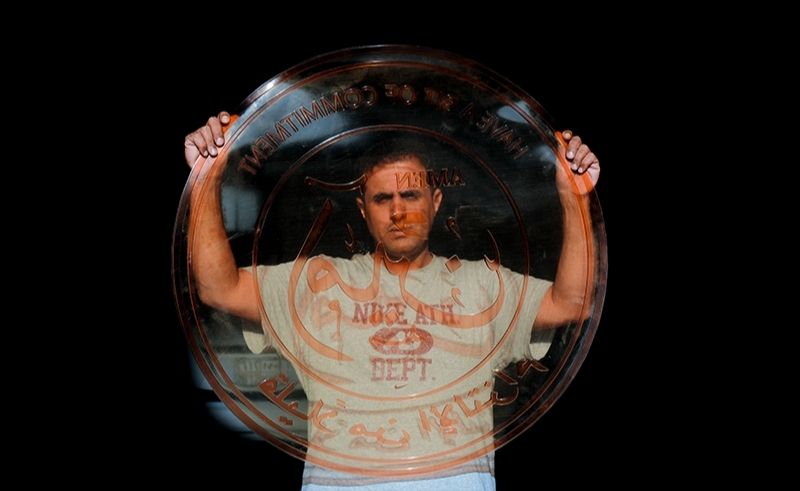
If the artist is a force for change, as history so often necessitates them to be, then Abdulnasser Gharem is one of Saudi Arabia’s most successful artists. This is not because his artwork has sold for record-shattering prices or because he’s exhibited in biennales around the world, nor is it because his work has been collected by the British Museum, LACMA, and Saudi’s Ministry of Culture, but because the changes he envisioned and catalyzed in the Kingdom’s art scene alongside fellow vanguard artists like Ahmed Mater have—by many measures—become reality.
“There are things you can’t deny,” Gharem says over video call, cigarette in hand. “The infrastructure, the museums, the residencies and the opening up itself is amazing,” he says, referring to the changes witnessed in Saudi Arabia in the past decade. A former officer in the Saudi Arabian army, Gharem witnessed much of that change from within Saudi’s military establishment after joining fresh out of high school. “There was nothing called being an artist,” Gharem says of his coming of age in 1980s Saudi Arabia. “In the southern region, everyone you know knows someone who’s in the military, so I entered the military too.”
Having spent 23 years in the Saudi Arabian army and risen to the rank of lieutenant colonel, Gharem’s art developed alongside his military career, and was often based on what he saw. “For many years when I was in the army I conducted patrols along the border, and I was always alone. The best investment I made was bringing with me sketchbooks, because from those encounters you would get ideas that no one would ordinarily get.” For Gharem, it was akin to a blessing and a curse: “You might die, but you have good work in terms of the art you get out of it.”
Intricate and often provocative, Gharem’s art spans multiple mediums but is unshy of overt political symbols and imagery, tackling issues ranging from the hyperlocal to the global, such as the US invasion of Iraq in the aftermath of 9/11. (Two of Gharem’s classmates were among the hijackers of 9/11, which has triggered from Gharem much artistic reflection and output.) But Gharem has also excelled in tiptoe-ing around topics that, until recently, were not open for discussion in the Kingdom. He does so in a way the viewer will be sure not to miss, and which has always left him walking a tightrope between what he’s allowed to say and what would land him in trouble.
“There’s a group of philosophers called the jadalayeen [Sophists],” Gharem says, referring to philosophers like Socrates who specialized in rhetoric, argument, and persuasion to engage with complex issues. “I liked the concept but didn’t want to engage people in this way literally, so I resorted to visual jadal."
One example of this is Aniconism, produced in 2015, which came about when he purchased a mannequin in Dubai and was unable to bring it back to the Kingdom due its nude form. In response, Gharem cut apart the mannequin and transported it discreetly across the border, where it was then reassembled. The mannequin, and the absurdity of the process, became the basis of the performance piece Aniconism. Another early work titled Flora & Fauna was Gharem’s response to the government’s introduction of an invasive plant species for landscaping. Blurring art into activism, Gharem went to the village and wrapped the tree–as well as himself–in plastic, inviting discourse without having to utter a single word.
Another notable example was his piece Message / Messenger, which, when it sold for $842,500 at a Christie’s Middle East auction in Dubai in 2011, broke the price record for the sale of an artwork by a living Arab artist. Created with copper, gold, and steel, Message / Messenger is a large installation piece consisting of a dome propped open at one end by a crescent attached to a rope. Inside the dome, a dove is suspended in mid-air, transforming the meaning of the piece entirely: pull the rope, and the gorgeous, gold-sheeted dome falls on the dove, like a trap.
“That piece was born simply from the amount of hate I was breathing since I was a child against Christians and against religions I did not even know, concise courses of hate that were being taught in society,” Gharem says. Underground with the military at the time of the auction, Gharem only learned about the sale a week later.
Gharem used all the proceeds from that sale to fund his artist collective Edge of Arabia and its mission of fostering art education across the Kingdom. It is a part of Gharem’s story that marks his impact just as importantly as his art does. Edge of Arabia, which Gharem co-founded in 2003 with Ahmed Mater and artist and social entrepreneur Stephen Stapleton, has since hosted more than 50 international exhibitions for its artists.
In 2013, after the sale of Message / Messenger, Gharem also established Gharem Studio in Riyadh as a non-profit arts organization and a space where young artists in the Kingdom could express themselves freely. Co-owned by Halla Bint Khaled, the non-profit organized Saudi Arabia’s largest ever exhibition tour in the United States, a programme which included 10 museum shows and attracted half a million visitors, giving Saudi artists more visibility abroad and their profession more legitimacy at home.
Although he did not stop creating new artworks in this period, his focus necessarily shifted away from what he now looks back upon as being a “pure artist” and towards becoming a convener and educator of art. But, with the massive changes that have occurred in the Kingdom since 2017, changes that have validated Gharem’s decades-long mission and efforts, he has once again begun creating full-time. He also appears to be gearing up to take on his most challenging topics yet.
“I always teach our artists the difference between freedom of thought and freedom of expression. There’s a big difference. We want people who have the freedom to think, and so our studio is like a think tank. But if you want freedom of expression,” Gharem says with a strained laugh, “you’ll end in disaster. It’s informed suicide."
The eternal struggle for artists to express themselves freely is not only national or regional; Gharem points to Europe, where the war in Gaza has harshly revealed the limitations of freedom of speech in societies that have long claimed to champion it. Nonetheless, in the contexts in which even an artist as successful as Gharem operates, there are unique pitfalls.
Whatever Gharem has in mind, his upcoming show titled ‘Alternative Loyalty’, will be his first foray into this new chapter in his career. Taking place in Berlin’s Galerie Nagel Draxler in September, ‘Alternative Loyalty’ will also see the artist step into a relatively new medium for him: glass.
“There is always a way to say what you want. The dangerous thing is to be invisible. You have to find a way.”
Related Articles
Trending This Week
-
-
 Sep 10, 2026
 -
 Sep 10, 2026
 -