





Inside Farida Osman’s Vision for Egypt's New Generation of Swimmers
Record-breaking swimmer and champion Farida Osman is blending science, resilience, and mentorship for the next generation.

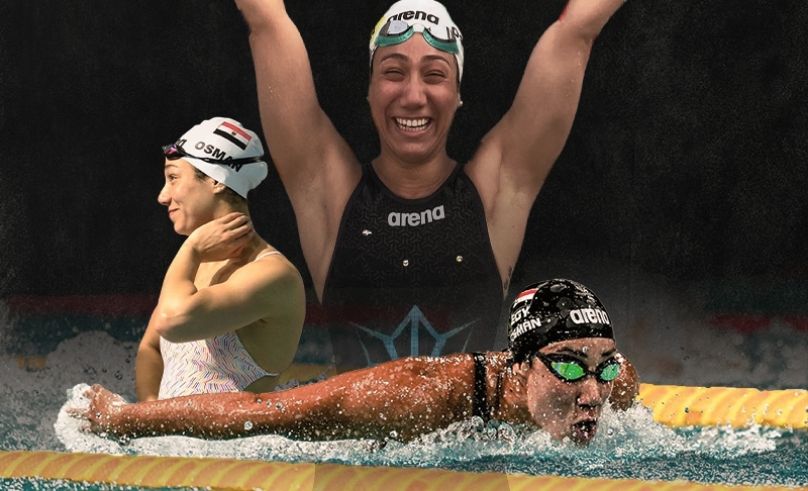
As Egypt’s most decorated female swimmer and one of Africa’s greatest sprint champions, Farida Osman has built a legacy that extends far beyond medals. A three-time Olympian, she transformed Arab and African representation in global swimming while redefining what elite athletic success can look like. Osman's using her platform not only to break records but also to advocate for a more holistic vision of athlete development.
Born in Indianapolis, Indiana, in 1995 to Egyptian dentists Hesham Osman and Randa El-Sallawy, Farida Osman was raised in Cairo, where her swimming journey began at Gezira Sporting Club alongside her brother Ahmed. She graduated from Cairo American College (CAC) before moving to California to attend the University of California, Berkeley, where she earned a degree in Media Studies with a concentration in marketing and advertising.-78964325-fed8-45cf-b87f-4e6a0dc6535e.jpg) Osman holds Egyptian national records in the 50m and 100m freestyle, as well as the 50m and 100m butterfly events. She also owns African continental records in the 50m freestyle and both butterfly distances, in addition to the World Junior Record in the 50m butterfly.
Osman holds Egyptian national records in the 50m and 100m freestyle, as well as the 50m and 100m butterfly events. She also owns African continental records in the 50m freestyle and both butterfly distances, in addition to the World Junior Record in the 50m butterfly.
This rare combination of academic insight and elite athleticism shaped her belief that a world-class athlete is far more than physical talent alone, but rather a fully managed institution requiring precision across every detail. Osman developed her own philosophy around sports management and mental toughness, convinced that true success begins with mastering everything beyond the pool itself.
Speaking during the inaugural edition of the 100Miles Summit, Osman explained how modern athletes are now responsible for far more than performance alone.
“Sports management means learning how to organise and manage every aspect of your journey,” she said. “I manage what I communicate to my coach, what I coordinate with my physiotherapist. Management is everything. Ultimately, I want to contribute as much as possible to the field of sports management.”
She believes many athletes are still unprepared for the realities that exist outside training and competition. “It’s essential to educate athletes on how to manage every part of life outside direct training,” she said. “Today, our identity is no longer limited to simply being athletes. We are also managing media presence, marketing, and our personal brands.”-b7e036d0-dd92-4118-b3f3-d9296c4c5812.jpg) In elite swimming, where races are decided by fractions of a second, Farida says mental strength became just as important as physical preparation. Over time, she trained herself to block out external pressure and public opinion, a process she admits was far more difficult in practice than it sounded in theory.
In elite swimming, where races are decided by fractions of a second, Farida says mental strength became just as important as physical preparation. Over time, she trained herself to block out external pressure and public opinion, a process she admits was far more difficult in practice than it sounded in theory.
“I had to train myself not to let outside opinions affect me,” she told SceneSports. “Staying calm and mentally unaffected sounds simple, but it took years of mental conditioning and working with a sports psychologist to truly learn one golden rule: anything outside my control does not deserve my energy.”
That mindset became especially important as expectations around her career grew. With every major competition came increasing pressure to deliver medals, something she describes as one of the heaviest challenges of being a professional athlete.
“There is constant pressure to win a medal in every championship I enter, and that’s incredibly heavy,” she said. “Later in my career, I learned the importance of working with a sports psychologist to build a mental barrier that protects me from external expectations, allowing me to focus entirely on training and competition.”
For Osman, true mental resilience is tested not in victory, but in disappointment after giving everything. “The hardest kind of loss is when you perform perfectly and still don’t get the result you wanted,” she said. “A mistake gives you something to fix. But when you do everything right and still fall short, that becomes a real test of acceptance.”-36e7f345-30c5-4c4d-b537-5df3fd579180.jpg) “When I give my absolute best and still miss the medal, I allow myself to feel disappointed for a day or two, to experience the frustration and sadness fully,” she told us. “But then I close that chapter quickly and ask myself the important questions: What can I improve? What will I do differently next time? Professionalism is about turning disappointment into a new action plan.”
“When I give my absolute best and still miss the medal, I allow myself to feel disappointed for a day or two, to experience the frustration and sadness fully,” she told us. “But then I close that chapter quickly and ask myself the important questions: What can I improve? What will I do differently next time? Professionalism is about turning disappointment into a new action plan.”
She also reflected on how athlete support systems were largely absent during the early years of her career, forcing her to discover their importance much later on. “When I started, there was no real concept of a fully integrated support team for athletes,” she said. “I had to learn its importance later in life. That’s when I began working with nutrition experts, psychologists, and sports psychologists to help me reach peak performance.”-dec8c689-4d4b-49d6-91ef-5e74fe3c7be2.jpg) Today, Farida Osman’s ambitions extend far beyond medals and records. She hopes to build a new model for youth sports development in Egypt through a swimming academy designed to support young athletes both inside and outside the pool.
“I want to establish a swimming academy for children that goes far beyond teaching swimming techniques,” she said. “I want it to provide the scientific foundations I discovered later in my own journey, including nutrition, psychological preparation, and sports management, the kind of support I wish I had from the very beginning.”
Today, Farida Osman’s ambitions extend far beyond medals and records. She hopes to build a new model for youth sports development in Egypt through a swimming academy designed to support young athletes both inside and outside the pool.
“I want to establish a swimming academy for children that goes far beyond teaching swimming techniques,” she said. “I want it to provide the scientific foundations I discovered later in my own journey, including nutrition, psychological preparation, and sports management, the kind of support I wish I had from the very beginning.”
As she looks toward the future, Farida Osman’s mission is evolving from champion swimmer to architect of the next generation. By channeling the lessons, systems, and mental frameworks she built throughout her own career into youth development, she aims to create a lasting infrastructure for Egyptian athletes that she once had to build for herself.
- Previous Article SceneNoise x Amsterdam Dance Event Present CROSSFADE: Egypt
- Next Article RTA Expands AI Operations Through Dubai Control Centre