





Inside the Desert Observatory Designed to Keep AlUla Dark
Three interlocking spirals, one four-metre telescope and a planetarium are planned 70 kilometres north of AlUla, on ground where the sky became a Dark Sky Park in 2024 and light is tightly controlled.

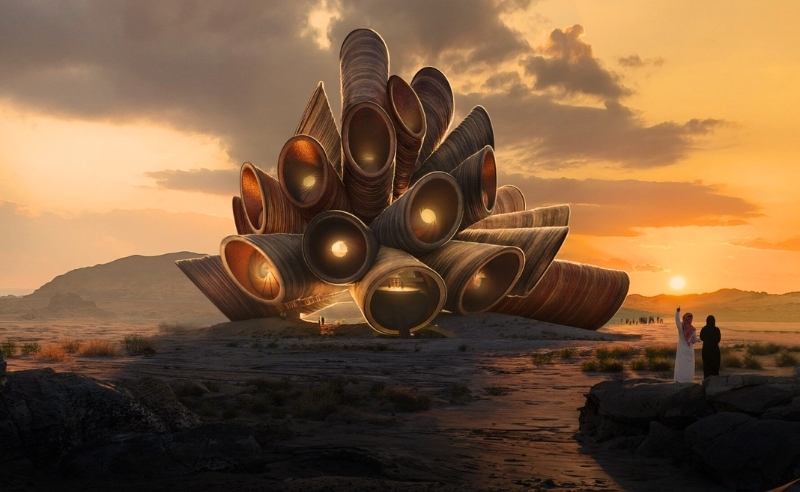
The most closely managed feature of AlUla Manara is absence. On a stretch of desert roughly 70 kilometres north of AlUla’s historic centre, every lamp, window and pathway planned for the observatory is subject to one rule: the darkness overhead must stay intact. Everything else, including the telescopes, the planetarium and the sandstone building, is arranged around that requirement.
The name carries the contradiction. Manara is the Arabic word for lighthouse, a structure that exists to produce light so that others can find their way. Here the logic runs in reverse. The Royal Commission for AlUla is developing the observatory around a sky that has remained unusually free of artificial light, and the whole attraction depends on keeping it that way.
Here, the night sky has been formally measured and recognised. In 2024, AlUla Manara and the neighbouring AlGharameel Nature Reserve became the first locations in Saudi Arabia and the Gulf Cooperation Council to receive International Dark Sky Park designation. The distinction carries practical weight. Artificial light interferes with astronomical observation and disrupts wildlife, and poorly directed outdoor lighting makes darkness harder to find once it has been lost. In a desert where the horizon runs uninterrupted, the Milky Way can be photographed without a city’s glow washing it out, and that condition is the project’s main asset.
The observatory planned at the centre of the site is to hold one four-metre telescope and two two-metre telescopes, built to support astronomical research. A visitor centre is planned with exhibition spaces, interactive displays, a planetarium, a restaurant and rooftop observation areas, so that a view through an eyepiece can be paired with an explanation of what is being seen and how astronomers arrived at it.
One of the more unusual elements is the search for life elsewhere. In 2024 the Royal Commission for AlUla signed a cooperation agreement with the SETI Institute, a US-based organisation that studies the origins and prevalence of life in the universe. The agreement covers research, instrumentation and education, and plans have included a LaserSETI instrument at Manara, designed to detect brief optical flashes that could indicate technological activity beyond Earth. No contact with anything is promised. The instrument places AlUla within a long-running scientific effort to answer whether humans are alone.
The building that houses this project was designed by Heatherwick Studio, the London practice founded by Thomas Heatherwick. Its form is made up of three large interlocking spirals, taken from the spiral patterns found in galaxies and in nature. Textured sandstone cladding links the structure to the colour and grain of the surrounding terrain, where a science centre might otherwise be expected in glass and steel. Shading elements and operable windows are intended to manage the heat, and lighting after dark follows the same discipline as the rest of the site, since a building made for watching the sky cannot spill glare into it.
The masterplan extends beyond the main structure to include accommodation for researchers, a dedicated stargazing lodge, remote stargazing pods and connections to hiking trails. Together these would allow a single day to run from a desert walk, through sunset, to a night spent watching the sky, without leaving the site.
Looking up has a long history on the Arabian Peninsula. Before satellite navigation, the stars guided travel across great distances, marked the turn of the seasons and organised an understanding of the natural world. Astronomers across the Arab and Islamic worlds made lasting contributions to the study of celestial objects, and many stars still carry Arabic-derived names. Manara’s programme draws on that inheritance through public events, photography, exhibitions and guided observation. Some of it is already running, with stargazing sessions, educational activities and astrophotography initiatives held around AlUla while the main facility remains in development.
The design was approved by the Royal Commission for AlUla in June 2026, after which Heatherwick Studio released the architectural plans. An opening date for the main destination has not been announced, so for now AlUla Manara exists as approved drawings, a protected sky and a growing programme of events, with the telescopes still to come.
- Previous Article French President Macron Lands in Riyadh on Solidarity Visit
- Next Article Celebrity Fashion Designer Ismail Heiza Styles His Signatures
Related Articles

Trending This Week
-
-
 Oct 15, 2026
-
-