





The Egyptian Desert School Built Without Concrete or Steel
Built from desert soil and pulled from the earth, SEKEM’s school in Al Wahat rethinks sustainable architecture in Egypt.
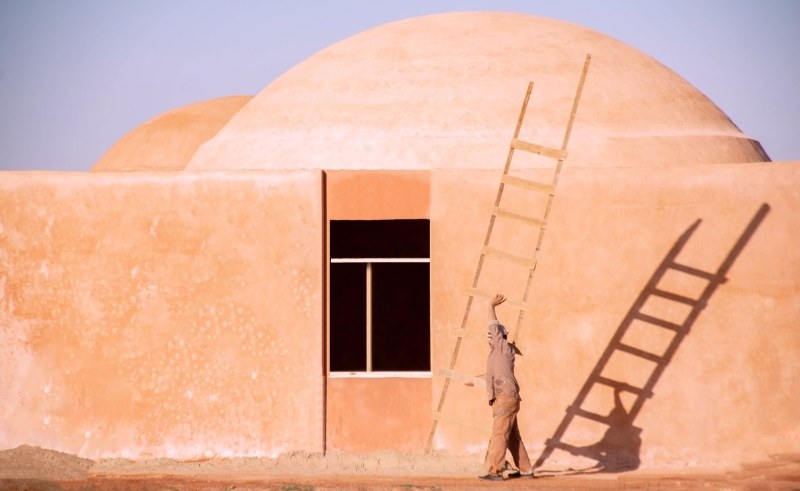
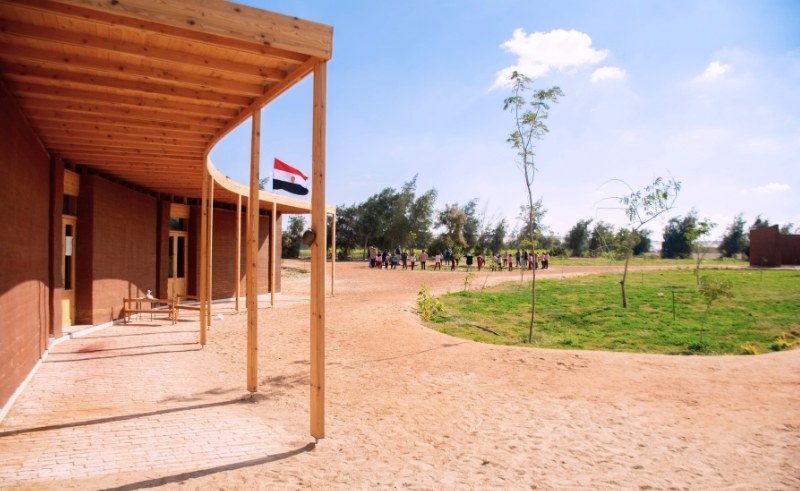
As an organization dedicated to promoting sustainable development in Egypt, SEKEM began with a mission of environmental reclamation through biodynamic farming in Al Wahat Al Bahariya. But as families settled and began working on the farmland, the lack of access to education revealed a deeper need. In response, SEKEM set out to build a school that reflects its vision of a community where environmental and human development are deeply interconnected. The result was the SEKEM Desert School, built entirely from rammed earth.
For Felix Auth, the German architect behind the project, the school was born out of a specific kind of material frustration. Formally trained as a carpenter, Auth arrived in Egypt looking for wood, only to find a landscape where timber is a scarce material. "So, to do that in a country where there's barely wood available for building, of course you quickly end up with clay as a material," Auth tells SceneHome.
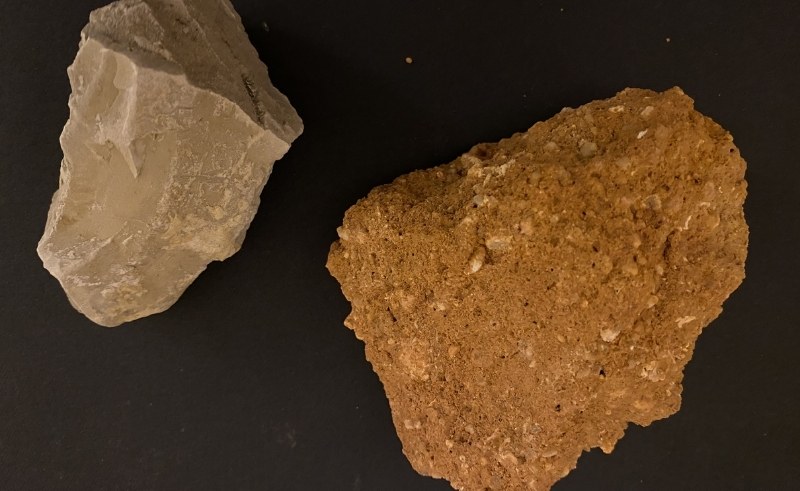
Their attempt to build with earth did not rely solely on traditional techniques; it required rigorous architectural experimentation. Since rammed earth was a first for the construction team, developing a prototype on the same plot of land became a necessity, an act of “action research” where the technicalities were developed through the labour of making. This phase involved testing a specific “recipe” for every wall, utilising kaolin clay mixed with a red soil typically found in the base layers of roadwork, which happens to be abundant just a meter or two below the desert surface. "A key factor is the mixture of the clay itself," Auth explains. "It has to be very precisely the right mixture... from the very tiny micro-particles up to solids. This was all a bit like cooking. A chef learns from feeling the food and tasting it."
The team also tested two different ramming techniques, the first using pneumatic tampers run by an air compressor and the second using traditional hand tampers. The takeaway? While hand-tamping could reach the necessary density, the sheer physical toll was immense.
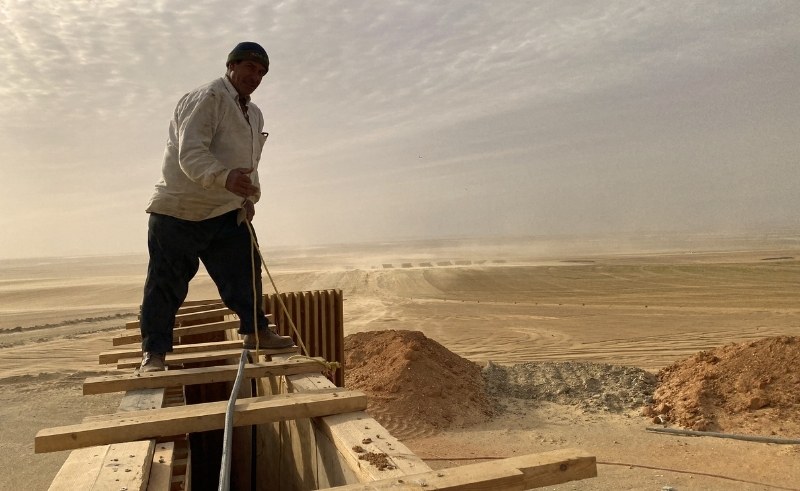
One of the most interesting tensions in Al Wahat isn't the harsh desert climate, it’s the cultural perception of the material itself. In the surrounding villages, clay is often seen as a symbol of the past, linked to the fragile mud houses of previous generations that required constant repair after the rain. As a result, there has been a surge toward red brick, cement, and plastic-based paints. “Most of the people are happy they moved out of their grandparents’ clay homes,” Felix admits. “To advertise or to promote clay buildings was kind of a weird thing. We had to reinvent the language of the buildings to appeal to the locals.”
This act of “reinvention” lies in the physics of the technique itself. By using significantly less water than traditional adobe, the walls have a density that resists the sponge effect of typical plaster. “The volume that will be replaced by air after drying is only 5-10%," Auth explains. "If there's water coming onto the surface, the material is not sucking it in like how plaster would.” Seeing as construction began in the scorching summer heat, the climate was a gruelling challenge for the workers. However, it became a strategic advantage for the architecture. The lack of rain and intense sun allowed the material to dry and cure with incredible speed, proving that traditional materials can be weather-resistant, thermally stable, and high-performance if reinterpreted to fit today’s environment.
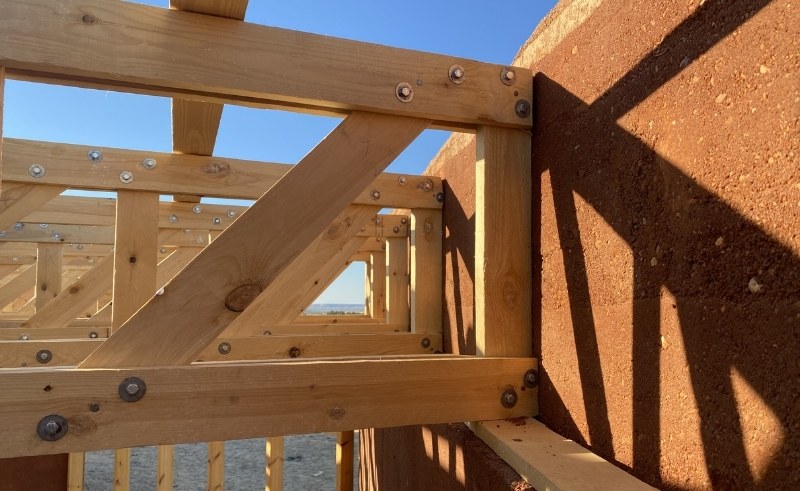
The project faced a lot of logistical hurdles. Because skilled craftsmen local to Al Wahat Al Bahariya were scarce, nearly all the manual labour was executed by artisans and specialised tools brought in from SEKEM’s main farm in Sharqia. Aside from the project’s site engineers, Alaa Youssef and Mohammed Abdallah, the build relied on a constant transport bridge back and forth to Cairo. “The hardest challenge is that there barely was any proper infrastructure. You’re literally building in the middle of the desert," Felix recalls. "You have to rely on your own infrastructure." He explains that all the infrastructure was built from scratch. Today, this level of self-sufficiency is literal: the entire site is powered by solar panels, with water sourced from a well dug back in 2008. Even the sewage and wastewater systems were designed for 100% circularity, filtering water to a specific quality to irrigate the surrounding desert farmland.
Today, the school serves 100 students from grades 1 to 9, with a capacity to grow to 220. While it functions as a regular school, its soul is in human development. Here, art classes and outdoor learning are core to the curriculum, teaching children to interact with the landscape as a living classroom.
Felix Auth is already looking toward 2027, with plans to build 16 sustainable housing units in Sharqia using these same construction principles. He’s even working with steelworkers to develop machines that will make rammed earth more efficient, aiming to compete with the price and speed of industrial concrete.
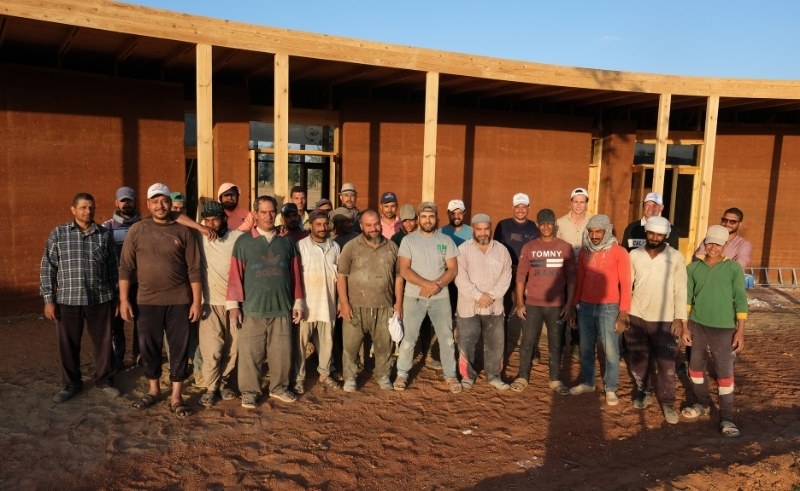
And for those sceptical of earthen architecture in wetter climates? Felix notes that with stabilisers, this model could work anywhere in Egypt. "We have used the same method in Sharqia, which is close to the Delta where we have high humidity, sometimes even up to 100% and everything is functioning wonderfully." Beyond climate resilience, the material provides a natural thermal regulation that virtually eliminates the need for air conditioning. It is inherently fireproof, mouldproof, insect-proof and soundproof, a durable, multi-proof structure that turns the desert’s own soil into a sophisticated building alternative.
As the costs of steel and concrete continue to climb, Auth’s final message is a call to action. “I would like to encourage everybody because I think people hesitate to use these natural materials, but it’s just healthy to use them. Natural materials should be the future of building.”
- Previous Article SceneNoise x Amsterdam Dance Event Present CROSSFADE: Egypt
- Next Article The SceneStyled Shady Business Edit
Related Articles

Trending This Week
-

-
 Sep 10, 2026
 -
 Sep 10, 2026
 -