

Noura Bin Saidan’s Muralist Manifesto
“I would colour all the streets of Riyadh. I don’t like to see empty white walls. I would paint all of them.”
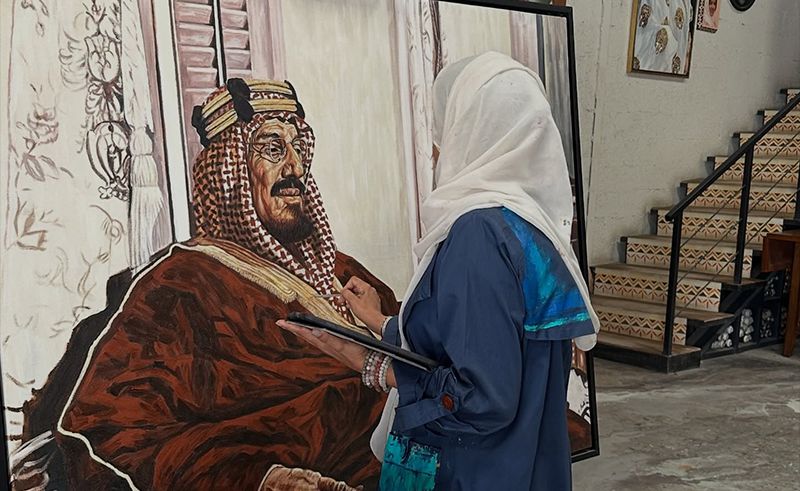
If you’ve ever been to Riyadh, you’re likely familiar with Noura Bin Saidan’s art. Her most famous works are not reserved for the privacy of wealthy homes or the quiet halls of prestigious art museums, but are instead created with the aim of being as visible as possible: since 2019, Noura Bin Saidan has transformed the public spaces of Saudi’s capital through her unmistakable muralist manifesto.
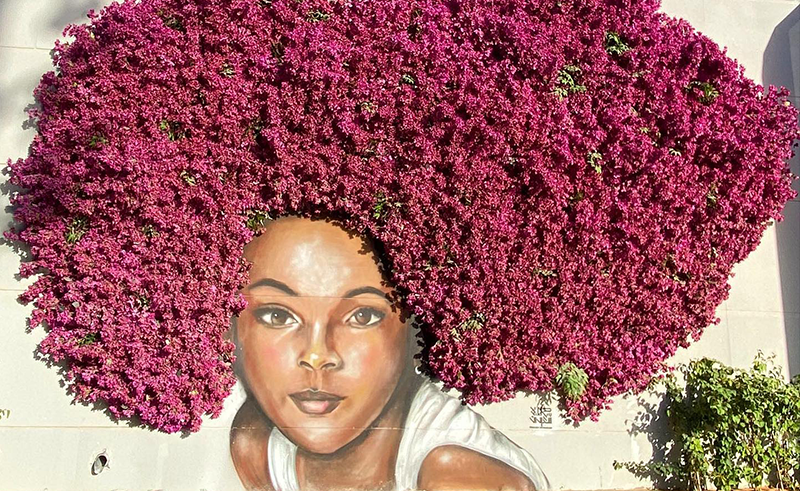
One of Bin Saidan’s most popular works sits in Boulevard City, an immense mural of a young girl whose hair is made of real flowers. It was created for Riyadh Season 2021, the year much of the Kingdom began to learn of Noura Bin Saidan’s work, if not (yet) her name. Since then, the work emerging from Bin Saidan’s studio in JAX District has only grown in scope and scale, from installations at Diriyah to 3D mapped graffiti for MDLBeast, collaborations with Adidas, and murals in London, Barcelona and Amsterdam. But whether near or far, the throughline in much of her murals remains the same: depicting the vastness of Saudi culture to the world, and to itself.
In this interview with SceneNowSaudi, Noura Bin Saidan speaks about the purpose behind her work, her message for young women artists in the Kingdom, and what she sees next for herself.
Your career really took off in 2021, with Riyadh Season. Could you tell us about yourself before that?
A few years before that I had resigned from my job and opened a small studio for public art commissions, and I would go to the office and just sleep. There was no work. Of course, when I had resigned from my job, I was scared because I didn’t know how things would turn out. When you have a job, you have stability and comfort. I had worked in many industries—food, telecom, branding and marketing—but I felt that that was not my space. I had a master’s degree in urban art. Little by little, I started to get commissions. I began with Riyadh Season in 2019, and his excellence Turki Al-Sheikh saw my work and requested that I take part in the following season, which was in 2021 after Covid, and that was really the beginning for me.
What was the Riyadh Season 2021 experience like, and what did it mean for you?
It was a grand experience. I was covered by Reuters, CNN, BBC, and even in Egyptian television. We did more than 17 murals, and it took about a month from idea to execution. We were working more than 17 hours everyday because the season had to open quickly, requiring overtime work. I had been doing fine art, drawing, and even fashion before then, but now the thing I’m most known for is my mural art.
How would you describe your murals?
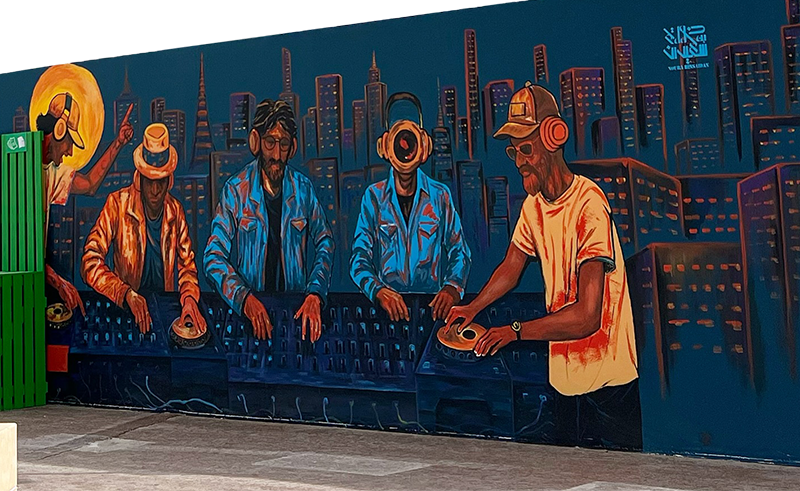
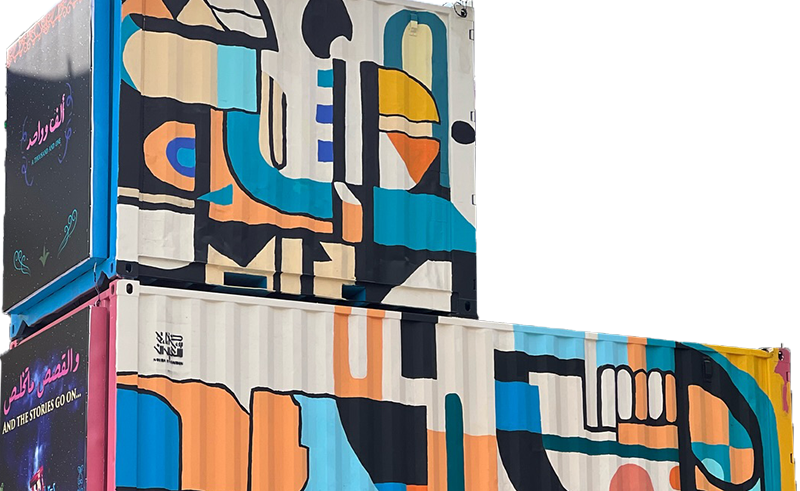
Most of my work is inspired by Saudi heritage and culture. I feel like culture is the fingerprint that makes you unique, and every artist has their own unique fingerprint as well.
Every region in Saudi has a different culture, different heritage, so that means I have a rich well to draw from. It’s what I try to reflect in my art to people. People want to know more about Saudi Arabia and Saudi culture, especially after Vision 2030. They have a very limited or incorrect understanding of Saudi culture, and I wanted to be a part of changing that through art. The artist has a big role in creating change, especially here in Saudi.
With Vision 2030 and other government initiatives to support art in the Kingdom, what are you noticing?
After Vision 2030, the artist’s life has changed. But people in Saudi now also have very high expectations when it comes to art; not everything satisfies them. You have to be very creative to impress them, so this is a responsibility for me, and I’m aware of this. I can’t remain the same Noura.
Making murals at this scale isn’t a solo effort of course. How long does it take you and your team?
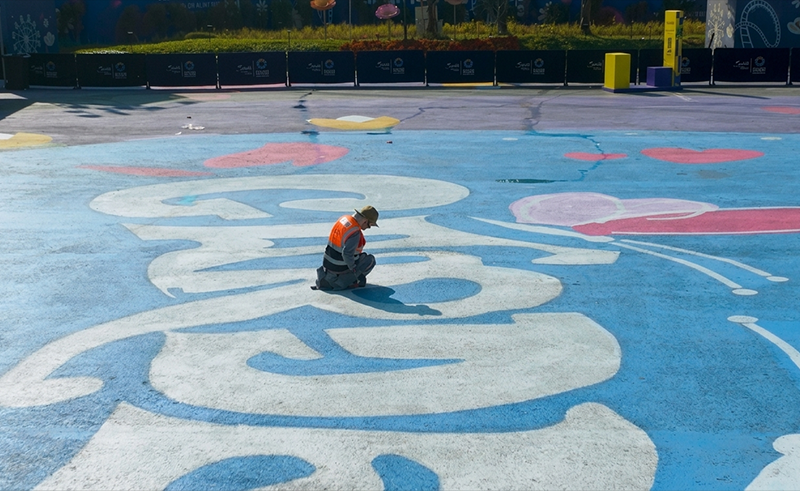
I have a big team for murals, and it changes depending on the need. When we did the Wonder Garden in Riyadh, for example, it was a size of 27,000 square meters and we had just five days. We were working 24 hours. We had a very big team of more than 120 people working in day and night shifts.
Is there one mural in your career you particularly like?
The one people know me most for the is the girl with the hair of flowers. Some people, when I introduce myself as Noura, don’t know me, and then when I say I’m the one who did this mural, they know me right away. All of Saudi took a photograph with this mural. That work was the choice of the committee of Riyadh Season, but I did it in my own style, and Alhumdullah the reception was great.
When you see a wall, do you know immediately what should go there?
Not always immediately. Sometimes it happens on the spot, or it’s easy—when we were doing a mural for a private museum about Um Kalthoum, we had to draw Um Kalthoum.
Other times we have to sit with the client and see what they want. I was in marketing, like I said, and this helped me a lot. It helped me understand who the target audience is passing through this space and what’s the message I want to communicate to them. From there, we work on the ideas. So it depends on the place and the message you want to communicate.
What will we always see in your murals?
You will see culture. You will see heritage. A Saudi touch. I’m so proud of my country and heritage and the roots we grew up from.
But work is not just technical precision; it’s also feeling. The emotion is what reaches the person, regardless of the work. It’s what differentiates every artist from the next. When I draw love, the audience will see it. Sometimes a piece of art is beautiful but has no emotion, like AI work, for example.
What will we never see?
I’ve never asked myself this question. You’ll never see a work I’m not fully convinced of. To me, it has to always be a strong piece, not just a regular one. Even if it’s a commercial work, I will not exhibit it if I’m not convinced by it.
In my personal works, you won’t see anything that’s far from Noura or our culture. That is what I try to reflect in all my work, even in my way of speaking. I’m always careful to present myself in a way that suits me as a Saudi.
 Where would you most like to paint a mural?
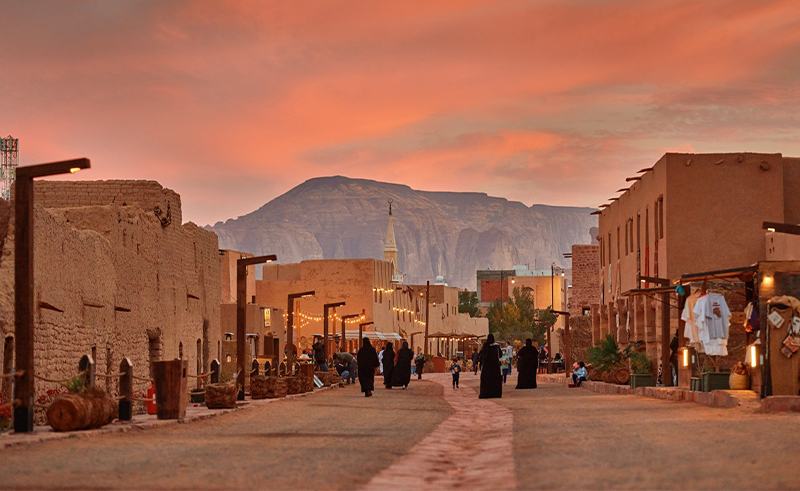
AlUla, Inshallah.
If you had an unlimited budget and no time constraints, what would you paint?
And no one could stop me? I would colour all the streets of Riyadh. I don’t like to see empty white walls. I would paint all of them. That’s what I would do.
 What advice would you have for young women and girls in Saudi pursuing a career in the arts?
Whatever dream or goal you have that feels hard, I always say: break it into parts. Divide it. It’s not just—try now and if it doesn’t work, that’s it. If you try a door and it doesn’t open, try again, but not the same door.
Everything has a time. Some goals you can achieve now, and some later. The important thing is to always be ready for it. It was 10 years after graduating from my master’s in art that my dream began to become realized.
What do you see next for yourself?
I’m open to everything. I’ve always been someone who tries to move with the wave, with the flow. Years ago, when people asked me where I saw myself after five years, I’d say a director at a fine arts institution. Then after five years I realised it doesn’t suit me. That’s why I don’t insist on any one particular dream. The most important thing for me is to be evolving, always.
- Previous Article Shuffle | April 14 - April 29
- Next Article The Ancestral Resilience of Omar El Farouk’s Fayoum Home