





Hossam Dirar's Exhibit Reframes Ancient Egypt's 'Book of the Dead'
Developed during a period of isolation, 'Coming Forth Into Daylight' turns inward, using ancient Egyptian symbols to explore awareness, perception, and the search for clarity beyond surface reality.
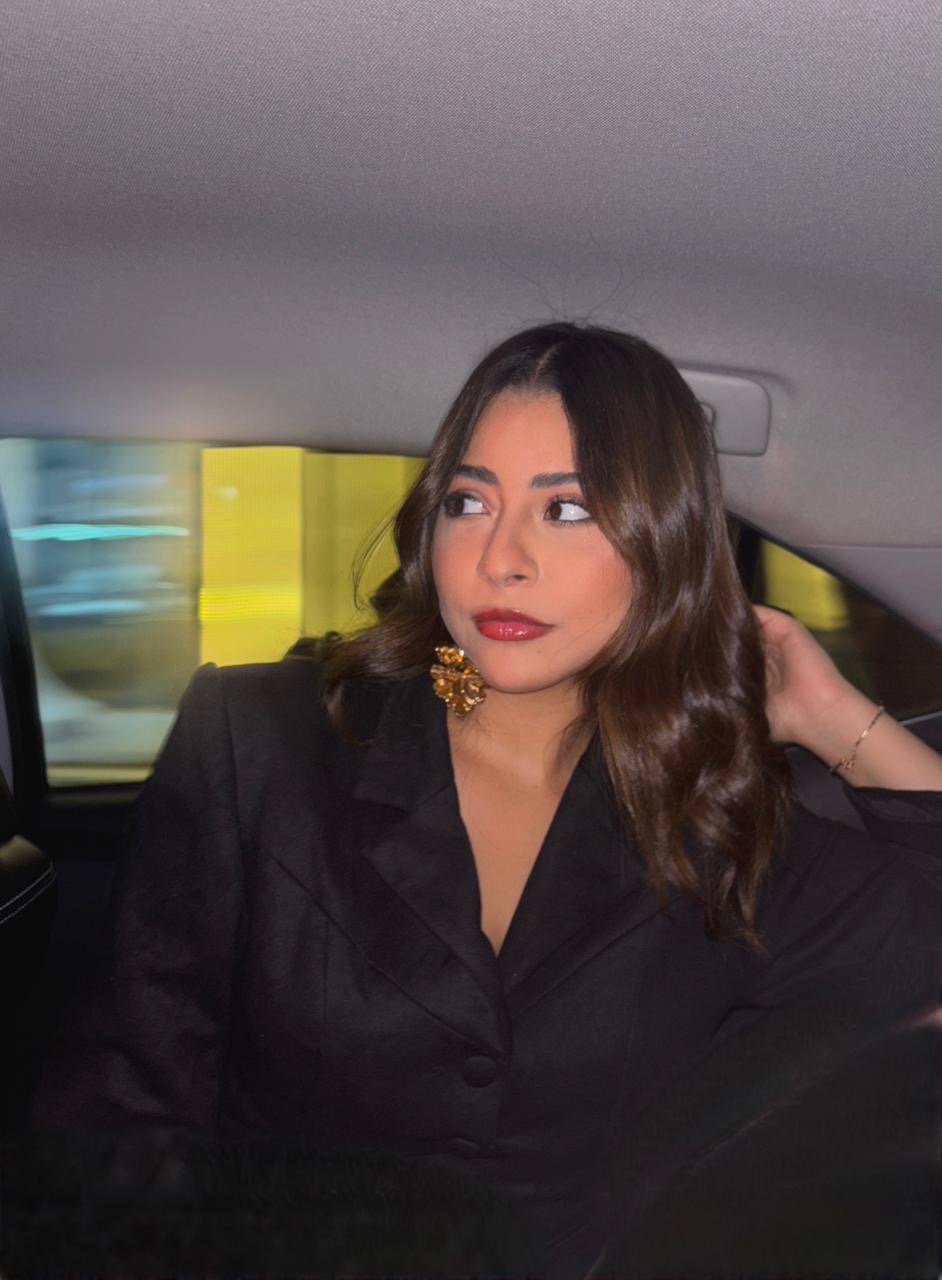
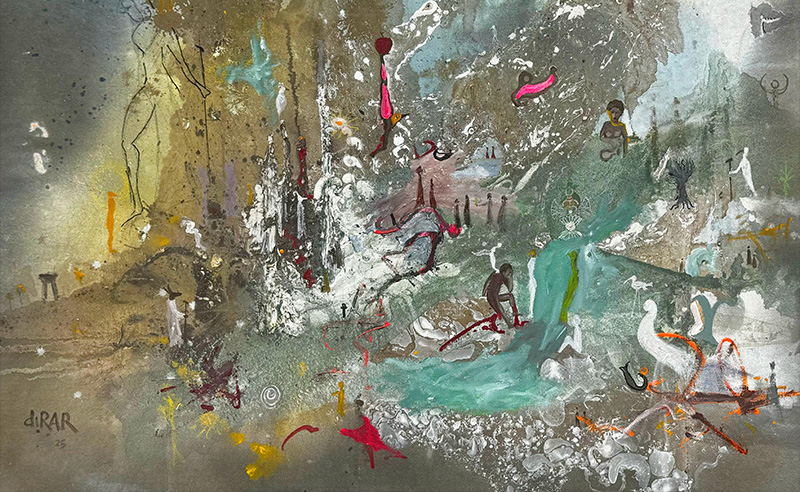
The title 'Book of the Dead' is a 19th-century imposition - a name assigned by Western scholars to one of ancient Egypt’s most intricate and enduring texts. For artist Hossam Dirar, it is a misnomer that obscures the work’s original intent.
“It’s not the 'Book of the Dead',” he says. “Its name is 'Coming Forth Into Daylight'. Rather than dwelling on death, the text centres on emergence, a passage into light, into awareness, and into a clearer perception of reality beyond surface appearances.”
Dirar’s new solo exhibition, titled after the text’s original name, opens at The Factory on April 19th. In the months and years leading up to it, he returned repeatedly to the gap between what ancient Egyptians intended and what the world came to understand. The afterlife manual, the death text; it sounds like something to be feared, but that's not the case. “I liked the true name even more than the subject of the book itself. It was a guide for the living — for how to move through existence with the kind of inner sight that lets you see what is real.”
Dirar, born in Cairo in 1978 and now dividing his time between the city and Barcelona, has spent the past decade and a half building a practice that keeps returning to ancient Egyptian iconography out of genuine metaphysical need. The civilisation’s symbols are, for him, the most precise vocabulary available for the questions he wants to ask. His 'Nefertiti' series, which went on display at Zamalek Art Gallery in 2018, placed the queen’s headdress on contemporary Egyptian women and questioned what had been lost in the intervening millennia. His 'Daydreams' collection examined the subconscious escapes people construct when daily life becomes too much to hold. 'Coming Forth Into Daylight' goes further inward.
The exhibition’s origins lie in a period of enforced stillness. “In 2020, I was in Seville when the pandemic locked the world down and stayed there for more than four months, I was in isolation,” he says. “In that time, I started going to places like forests, doing silent retreats. All of these things opened me up more and made me see life in a different way. I started discovering things inside myself.” It was in that deafening stillness that he began writing notes on how choices are made, what the heart’s function is in a life, what guides a person when the noise drops away.
What he found, in that writing and then in the images that followed, was that ancient Egyptian art kept asserting itself as the dominant visual language for what he was trying to express. “The ancient Egyptian civilisation, with its art, controls all the ideas and all the symbols I love to bring out,” he says. “I take them seriously from the symbols that ancient Egyptian art made.” The ankh, the eye, the ibis, the scarab — there is something about these that modern abstraction, for all its freedom, cannot always replicate a legibility that is simultaneously ancient and immediate, spiritual without being sentimental.
“The works in 'Coming Forth Into Daylight' occupy a territory between Surrealism and abstraction — a combination I have been developing for around three years and regard as still in process,” Dirar tells CairoScene. “I’m trying to make a mix, a structure of my own, between the two. An abstract work but with ideas and drawings inside it — even if they’re very small — with a surrealist sensibility.”
Dirar’s process reinforces this sense of a practice built around listening above than execution. The first marks are loose, a sketch of initial ideas and then the work begins to speak for itself. “I let a dialogue happen between me and the painting,” he says. “I consider it a person and we start talking to each other. I see what it needs. I leave it then I will come back.”
For Dirar, sometimes a background takes a year to resolve, worked on in intervals, with no fixed instruction. The surrealist characters and symbols — the figures, animals, and hieroglyphic fragments that populate his canvases — only arrive at the very end, placed into a ground that has already found its own character. “I always try to hide more than I reveal.”
That impulse toward concealment is philosophically consistent with everything the exhibition proposes. “'Coming Forth Into Daylight’s' central preoccupation - the idea that contemporary human beings have drifted from a state of inner presence under the pressure of repetition and noise - is not illustrated so much as enacted, the viewer has to do the work of attending, of staying with an image long enough to let it open.”
Light, in this context, is Dirar’s recurring symbol for the movement of self-consciousness. The ancient Egyptians, he argues, understood something about that kind of seeing that modernity has largely abandoned. “Life was understood as a continuous existence that does not end with death, but as a transition from one form to another,” he explains. "They were, in some sense, always in preparation — always in the process of becoming more clear."
- Previous Article New Safety, Housing & Banking Rules Set for Dubai in 2026
- Next Article The Ancestral Resilience of Omar El Farouk’s Fayoum Home
Related Articles
Trending This Week
-
-
 Sep 10, 2026
 -
 Sep 10, 2026
 -