






Arabian Hare Reintroduced to Royal Reserve
Prince Mohammed bin Salman Royal Reserve returns the Arabian hare as its 14th native species under the ReWild Arabia programme.

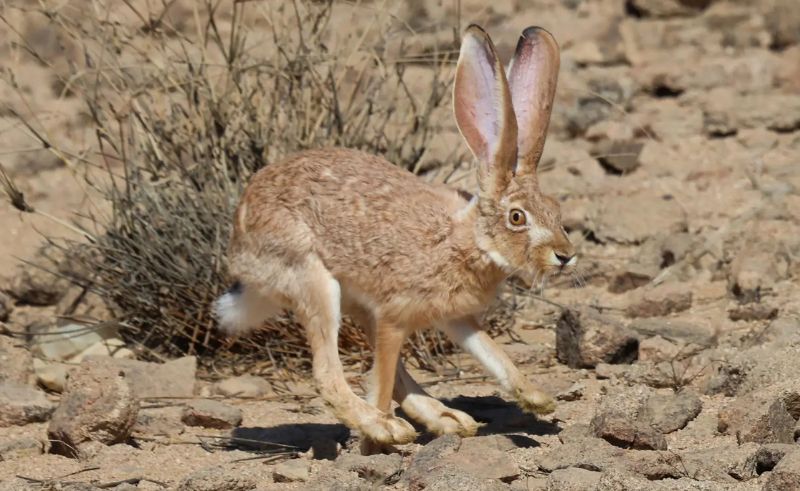
The Prince Mohammed bin Salman Royal Reserve has reintroduced the Arabian hare (Lepus capensis arabicus), marking the 14th native species returned since the launch of the ReWild Arabia programme in winter 2022.
Twenty hares were selected to enhance genetic diversity and are currently housed in purpose-built, predator-proof breeding enclosures designed to accelerate population growth before their staged release into the wild. The reserve confirmed that the first leveret has already been born.
The Arabian hare plays a foundational role in desert ecosystems. As herbivores, they graze on vegetation and disperse seeds, contributing to plant regeneration and landscape balance, while serving as a principal food source for desert predators.
The species is adapted to desert conditions, with cryptic colouring, near-360-degree vision and large ears—measuring up to 17 centimetres, or around 30 per cent of body length—that assist with thermoregulation and heightened hearing. Unlike many desert mammals, Arabian hares do not burrow and can reach speeds of up to 80 kilometres per hour, using zigzag movements to evade predators.
To verify lineage and safeguard genetic integrity, the reserve conducted analyses of partial mitochondrial Cytochrome B sequences and constructed a phylogenetic tree. The results confirmed that the introduced animals belong to a distinct Arabian lineage of Lepus capensis arabicus.
Following release at selected sites, ranger and scientific teams will monitor survival rates, distribution and habitat use through field observations and ecological assessments.
Since its launch, ReWild Arabia has reintroduced 14 species, with the Arabian hare becoming the sixth to successfully breed under the programme. Recorded births include more than 100 sand gazelles, 19 mountain gazelles, two Nubian ibex kids, 36 Arabian oryx calves and a Persian onager foal, forming part of a wider effort to restore ecological balance across the reserve’s landscapes.
Related Articles


Trending This Week
-

-
 Mar 30, 2026
 -

-