





This Egyptian Red Sea Town Has Witnessed Both Pharaohs & Pilgrims
From 16th-century forts to abandoned Italian phosphate warehouses, this Red Sea town carries the weight of millennia.

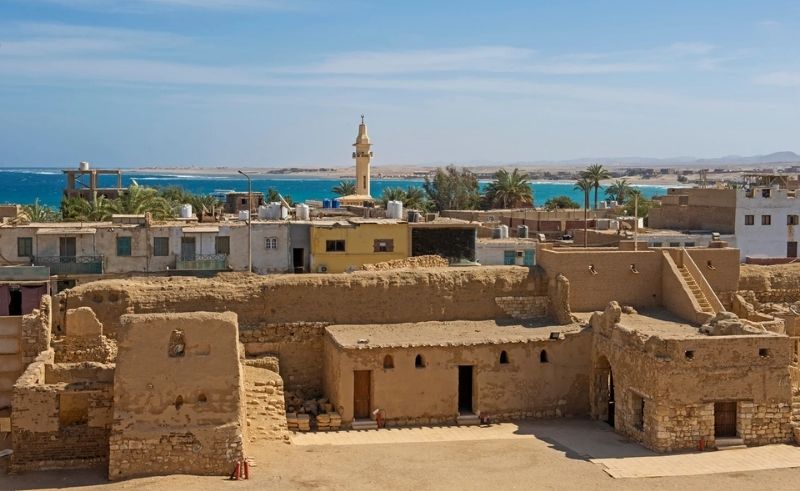
The Red Sea has a very particular smell, one that everyone who loves it or hates it will know. It’s a crisp, salty sensation, tinged with fish scales and algal bloom. And in the Egyptian town of Quseir, that smell seems to carry the added scent of history: on the stone blocks of its 16th century fort, inside its massive, abandoned phosphate company that was once the focal point of an Italian colony, and throughout the alleys of its Islamic medieval quarters and grid-like European homes. Spending the week in Quseir, one of the oldest Egyptian Red Sea towns and among the oldest port towns in the whole world, it was easy to forget that its waters were home to the same dazzling marine life that brings divers and snorkelers from the world over to Egypt’s Red Sea. Instead, we spent most of our time in this coastal town on land, spending each day venturing into a different chapter of Quseir’s long past. At different points in its history, Quseir was both the departing point of Hatshepsut’s trade ships to Punt in East Africa, and the departing point of the Kaaba’s Kiswa as it made its way annually from Cairo to Mecca. This privileged maritime position is evident in its name, which alludes to the fact that Quseir is situated along the shortest route from the Nile River to the Red Sea. Even the boutique hotel in which we stayed, El Quseir Hotel, was a case study in historical preservation. Built in 1910 by a local patriarch for his many wives and children, the three-floor hotel maintains its original stone walls, mashrabiyas, and wooden stairs. In the lobby, photos and memorabilia from 20th century Quseir reminded us that the high ceilings under which we slept each night once played host to families stretching back more than a century. Outside the hotel, life in Quseir is shaped by its coastal, sun-soaked geography. In the summer months, the daytime is almost blindingly hot, and as we walked through the empty morning streets, it felt almost deserted. In reality, the town comes alive at night. From my room overlooking the sea, I could hear throngs of families picnicking on the beach until three in the morning, laughing and chatting and drinking gabana coffee, which comes from the local Ababda Bedouin tribes of the Red Sea and must be consumed in odd quantities of cups—one, three, five, and so on. Nevertheless, there was too much to see by day to resign ourselves indoors all day long. Just a short walk from our hotel was a sprawling monument of 20th century heavy industry: the Società Egiziana per l’Estrazione e il Commercio dei Fosfati, an Italian-founded phosphate company. This massive complex was established in 1912, a few decades after the Suez Canal and steam ships brought about the end of Quseir’s 19th century golden age, transforming it from a cosmopolitan town home to several embassies and hotels to a sleepy fishing village. This complex, which is also referred to as the Italian colony, was home to a school, a Church, a train stop, and a rest house for King Farouk. Across half a dozen warehouses and factories, the company exported massive amounts of phosphate that once upon a time helped fuel fascist Italy’s war efforts under the leadership of Mussolini. Today, most of the structures except the Church, which is still used by the local Coptic community, are abandoned, making them a photographer’s paradise. Armed with an ultra-wide lens, I spent hours wandering the complex, beginning at the administration building where production charts, employee timetables, and chemical flasks were strewn across the floor. Later, I made my way to the massive facilities where sunlight filters through broken glass and onto the factory grounds. A place this large comes with deafening silence, which was often broken by the sound of pigeons—both the fluttering of their wings and their indecipherable cooing. I could also hear the wind whistling through sheet metal roofs and holes in the wall, rocking the creaky wooden doors back and forth. If it felt like a movie set, I found out later it was because it was one. Parts of the 2005 film Ahlam Omrena starring Mona Zaky were shot here, but more recent productions are the reason why some of the walls in the complex are freshly painted and bear Italian words like ‘magazzino’, recreating its heyday. Around sunset, it was always good to be in the vicinity of Quseir Fort, where the town’s main touristic street is also located. The fort was built by the Ottomans in the 1500s to defend against the Portuguese, and was later used by Napoleonic France to defend against the British. As I looked around, it suddenly became difficult for me to wrap my head around the sheer amount of history present in Quseir. But there, as I’ve come to learn, the past is never far away—it’s in the walls, the alleys, and the air, inviting anyone who visits to step into a living history that smells, sounds, and feels utterly unique.