





A Sacred Stone Escape Rises in Egypt’s Sinai Mountains
Built by hand in Saint Catherine, Dar Katrine is a mountain retreat shaped by Bedouin craft, coloured stone, and quiet devotion—where travellers come to slow down, gather, and rediscover themselves.

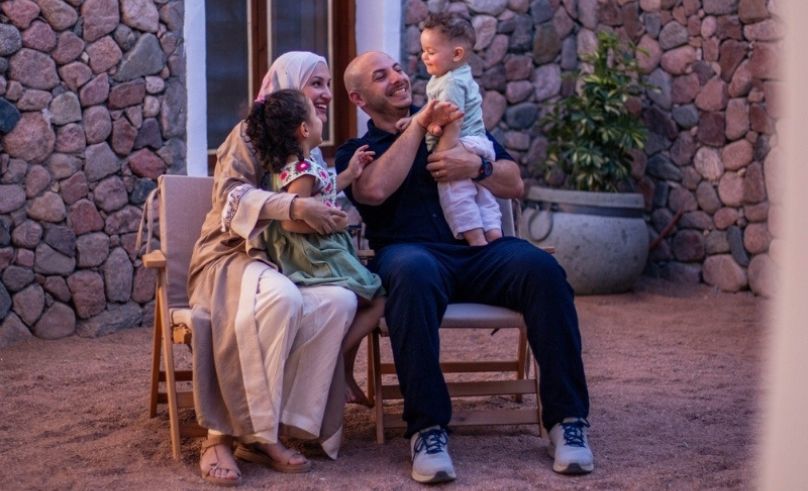
There's a certain pull all travellers have felt, one that calls to the hidden folds of the world, to cities still waiting to speak our names. That irresistible tug refuses the rigid lines of the digital grid, the restless demands of proving oneself in a world of deadlines and KPIs. Instead, it follows the quiet draw of untouched sunsets, climbing higher and higher into sacred mountains murmuring with divine edicts. It is in places like the peaks of Sinai, where revelation is said to have met the earth, that this pull feels most profound. And it was this very calling that guided Egyptian couple Mohammad Mahrous and Bassma Khaled to Saint Catherine until they found more than a location—they found the haven on which they built Dar Katrine, a guesthouse safely tucked between holy mountains. It was here, in this refuge carved from stone and sky, that Mohammad and Bassma first found one another beneath the divinity of a starry night, where silence spoke louder than the distant hum heard in a city. What began as a meeting between the pair became a shared sanctuary—and a refusal to live in the “concrete box of Cairo,” as they call it. Their love took form slowly, until it materialised in the home they built for their growing family at Wadi El Raha in Sinai. From the beginning, Mohammad and Bassma’s vision was shaped by openness: “We wanted flow and circulation, something that lets in the light in and blends right into the culture and architecture around it.” Now, Dar Katrine stands gathering warmth within its walls, ready to hold anyone willing to let the stillness carry them inward.
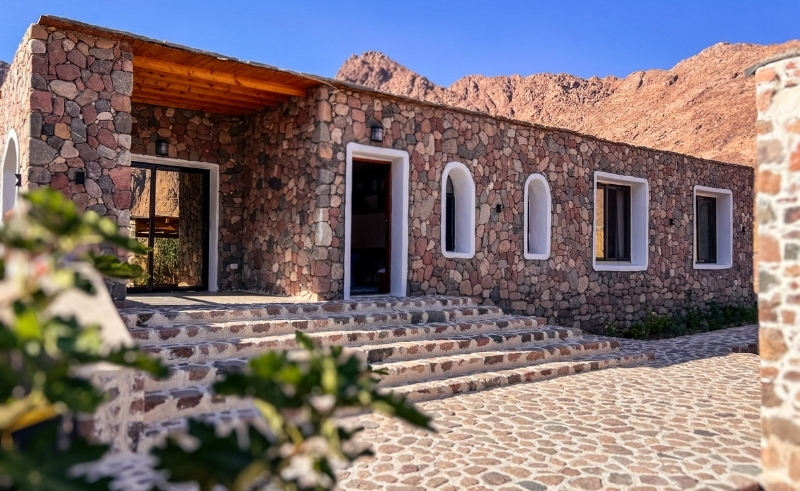
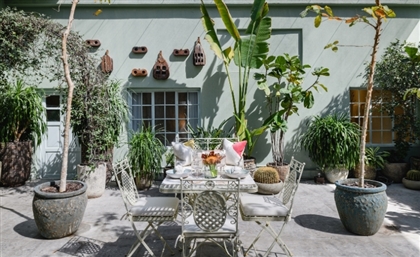
Spread over 1,500 square metres, the Dar centres around a courtyard that mirrors the communal rhythms of the mountains, and a garden that began its cultivation long before the house started taking shape. Here, children can run around swelling figs and grapes, past olives, pomegranates and golden apricots, the air around them scented with mint and sage. Inside, wrapped in walls of stacked stone, the natural materials and soft designs create a warm, inviting atmosphere—from sunlit alcoves to wide reception spaces. Even inside the two private wings—each with two mountain-view bedrooms, a sleek bathroom, and kitchen built for adventurous cooking—you’ll find soft linens, natural light, and handcrafted details. And whichever wing you end up in, you’ll find doors that open to a communal living room, anchored by a fireplace, where light, conversation, and quiet reflection mingle effortlessly. “We lived in Dar Katrine for months,” Mohammad and Bassma recall, “and nothing beats sitting here with a cup of mint tea after a long day.” Quiet corners throughout the Dar invite focus and wild imagination. A desk faces the mountains, sunlight spilling across pages, while a small library offers a haven for reading, writing, or simply letting thoughts wander and come together. For families, care is woven into every detail: child-sized furniture, toys resting in secret corners, and a discreet diaper-changing area allow little ones to explore safely, while parents can work, rest, or dream. “My favourite part about the Dar,” Bassma beams, “is that it’s entirely stroller-friendly.”
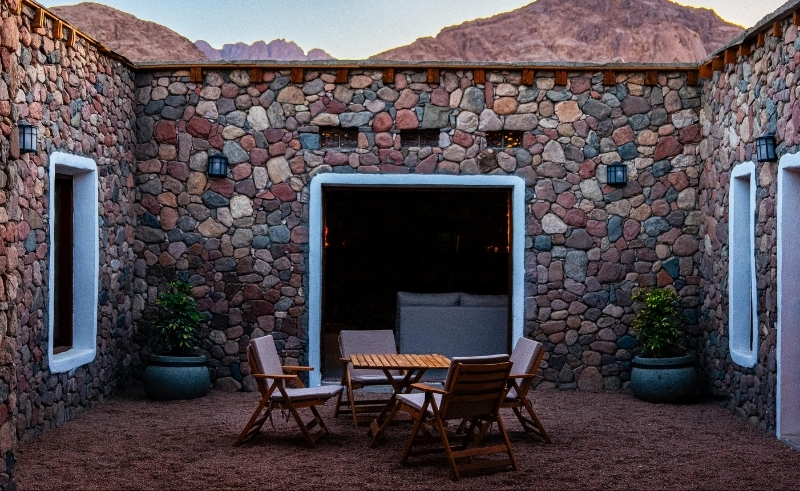
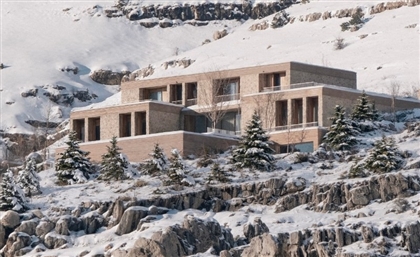
And when stepping into the kitchen isn’t on the agenda, the Dar’s sufra calls instead for a local lunch on a table perched in the courtyard framed by the mountains. Here, Bedouin hospitality sets the pace: slow down, savour each bite, and forget about anything besides the food, the company, and the mountains. Overall, the Dar feels familiar. Homey. Effortless. So effortless, in fact, that you could not have easily assumed building it was a pilgrimage itself. “We’ve been coming to Saint Catherine for nearly a decade, and spent six of those years building the Dar,” Mohammad and Bassma tell SceneTraveller, sharing a quiet chuckle. It began with a local mediator, Badry, the Chief (turned friend) who led them to an old house waiting to be claimed and remade. Immediately, the couple’s vision for the façade was clear: a home of earthly mosaic, like a tetris of coloured stones laid in quiet harmony. Later, they would find out their vision had a name—Dry-Stone Masonry. And as soon as they learned what to call it, they discovered that realising their dream would not be as simple as they thought. Sinai’s resources were wearing thin, and the stones they needed would be challenging to acquire. Even if they managed, the entire craft of Dry-Stone Masonry was on the brink of extinction, and so finding the right architect became a long journey of trial and error.
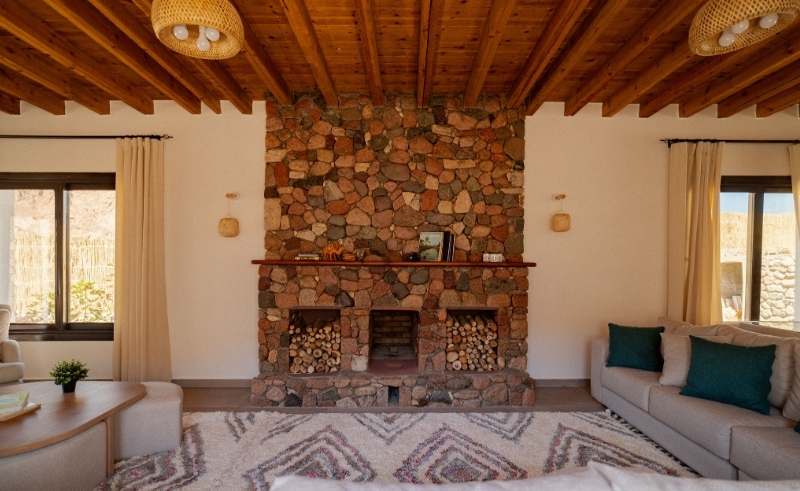
Chasing colour as conviction, a group of Bedouins dove deep into the mountains in search of the precise stones Mohammad and Bassma had imagined—a spectrum of hues they refused to surrender, no matter how far they had to go. This refusal to compromise extended beyond aesthetics, to a deep commitment to the holy land itself. From the first stone laid, Mohammad and Bassma built with the understanding that Dar Katrine would take nothing from the mountain that it could not give back. Even throughout the construction process, waste was to be carried out and never left behind; water to be respected. Every element was considered through the lens of what the mountain could sustain. Once the first hurdle had been overcome and the stones had been secured, it was time to find the right mason. Ten came before the eleventh. Ten times, the mountain met ambition with resistance as the stones refused to settle into something lasting. Then came Mahmoud Abou Karash, a Bedouin mason and poet who understood that to raise a wall, you must first plan. “I have been working in this field for 17 years,” he starts. “But I had never executed a building in such a distinctive way as this one; it’s the only one of its kind in the city,” he boasts. Abou Karash arranged the stones on the ground, studying each gap and imbalance, until a pattern felt true. Only then, with the approval of the team, did he begin to build upward, stacking stone upon stone without any cement peaking through. This meticulous task could have only been perfected by Karash—“an artist by all measures”—who will be joining Mohammad and Bassma in safeguarding the disappearing craft of Dry-Stone Masonry by giving workshops to all those willing. As for the finally realised stone walls, they still hold the imprint of all the hands that made it, “We decided to leave some of the first stone samples so Dar Katrine could speak of its own history.” Above those stubborn walls, five-metre planks stretch across the ceiling; wood carried from Mansoura, a quiet adaptation to a mountain whose own resources continue to diminish. It is this same philosophy, working with the mountain and not against it, that shapes how Dar Katrine exists within its landscape today. Days are spent tracing quiet paths through the valleys and climbing ancient hiking trails where stone and silence stretch for miles. The mountain remains as it has always been because those who call it home, including Mohammad and Bassma, move through it with care, leaving only footprints behind. The ancient Saint Catherine’s Monastery stands close by, its walls holding centuries of prayer and pilgrimage. In between, there is the steady rhythm of Bedouin life: neighbours who stop to share tea, stories traded in passing, a sense of belonging offered without question. And for those looking to delve deeper, camels wait patiently to carry you into the wilderness, where nights can be spent tented beneath a sky so thick with stars, it feels almost within reach. And therein lies the appeal of Dar Katrine. It offers a waking to the hush of the mountain and the quiet certainty that you have arrived somewhere that asks nothing of you but presence. Here, you are not passing through, nor chasing, nor proving. You are simply held—by stone, by sky, by the warmth gathered in the walls. And when you finally leave, you carry nothing with you but the memory of the mountain. Then, months later, in another hidden fold of the world, when the noise grows too loud and the grid begins its restless call again, you will remember the sanctuary waiting patiently in Sinai. And you will do everything in your power to return.
- Previous Article Is Hamza AbdelKarim’s Barcelona Move a Shift For Egyptian Footballers?
- Next Article 10,000-Year-Old Rock Art Discovered in Southern Sinai