





How Mahmoud El-Gohary’s Vision Led Jordan to the 2026 World Cup
A project launched by Mahmoud El-Gohary in 2003 ultimately paved Jordan’s path to the 2026 World Cup.

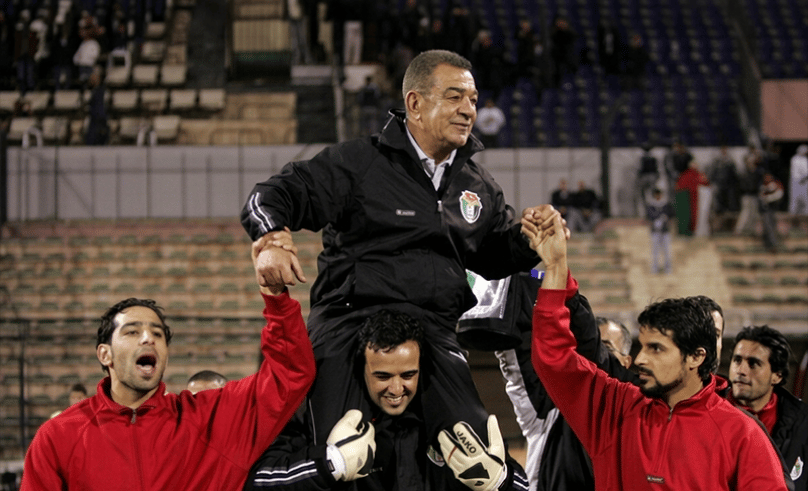
After nine failed attempts and decades of near misses, Jordan finally secured its place on football’s biggest stage by qualifying for the 2026 FIFA World Cup in the United States, Canada and Mexico.
For many, the achievement was years in the making. In reality, it was the culmination of a project that began more than two decades ago, spanning generations of players, coaches and administrators. At the heart of that story stands one man: the late Egyptian coach Mahmoud El-Gohary.
The Arrival of “The General”
-2200bc14-13f4-4b79-983c-dcb1ced601a0.png)
In 2002, Jordan turned to El-Gohary, one of the Arab world’s most respected football figures, to take charge of the national team and help shape the future of the game in the country.
From the moment he arrived, El-Gohary’s ambitions extended beyond match results. His goal was to build a sustainable footballing structure capable of producing success for years to come.
Early signs of progress appeared at the 2002 West Asian Championship in Damascus, where El-Gohary guided Jordan to the final. The title seemed within reach after Jordan took the lead against Iraq, only for their opponents to mount a comeback and claim the trophy.
Although the defeat was painful, it provided an early lesson in a much longer journey.
Planting the Seeds
-1c37697e-83a6-4c97-95be-e74c93ccb33b.png)
A year later, El-Gohary shifted his focus from short-term competitiveness to long-term development.
Under his supervision, the Prince Ali Youth Centres were established across Jordan, becoming the cornerstone of the country's football development strategy.
The initiative was designed to reach every corner of the kingdom, with centres spread across cities, towns and rural communities. Specialized development hubs were also created in Amman, Irbid and Zarqa to nurture the country’s most promising young talents.
El-Gohary’s role extended beyond talent identification. He worked to strengthen youth academies, improve age-group national teams and introduce technical and administrative structures that would support player development for years to come.
Many of the players who would later form the backbone of Jordanian football emerged from the system he helped create.
The First Results
El-Gohary’s next objective was clear: qualify Jordan for the 2004 AFC Asian Cup in China.
The national team achieved the feat for the first time in its history, finishing second in a qualifying group that included Iran, Lebanon and North Korea.
Jordan’s remarkable run continued at the tournament itself, where the team reached the quarter-finals before suffering a heartbreaking penalty-shootout defeat to Japan.
The progress was reflected in the FIFA World Rankings. In August 2004, Jordan climbed to 37th in the world, the highest ranking in the country's history at the time and a clear indication of the strides being made under El-Gohary.
Dreams Deferred
-25e1b761-24bf-4417-a321-3b517d822729.png)
Following the Asian Cup breakthrough, attention turned to an even greater ambition: qualifying for the 2006 FIFA World Cup in Germany.
Jordan fell short, finishing second in its qualifying group and missing out on a place at the tournament.
Further disappointments followed. The team failed to qualify for the 2007 Asian Cup after finishing behind the United Arab Emirates and Oman in qualification, before exiting the West Asian Championship in the semi-finals.
Those tournaments marked El-Gohary’s final appearances as Jordan head coach.
Yet while the results did not always match expectations, the deeper impact of his work was becoming increasingly evident. Many members of the Jordan squad that qualified for the 2007 FIFA U-20 World Cup in Canada had emerged from the youth-development structure he established.
Returning to Finish the Job
-20d5d85c-d0d1-424f-b160-0b377a8c93fc.png)
El-Gohary’s connection with Jordanian football did not end when he left the national team bench.
In 2009, he returned to Amman as a technical adviser to the Jordan Football Association, helping oversee long-term planning and development initiatives.
Working largely behind the scenes, he continued to support the growth of Jordanian football, convinced that meaningful success required patience, continuity and investment in future generations.
Gone Before the Harvest
-a068f6eb-1994-427f-8099-49f847bd90cd.png)
On September 3rd, 2012, El-Gohary passed away in Amman.
Jordan honoured him with a military funeral in recognition of his contributions to the country’s sporting development before his body was returned to Cairo, where he was also given military honours.
He did not live to see his project reach its ultimate destination, but he witnessed enough to know it was moving in the right direction.
After his death, Jordan continued its upward trajectory. The national team reached the intercontinental play-off for the 2014 World Cup under fellow Egyptian coach Hossam Hassan and qualified for the AFC Asian Cup in 2011, 2015 and 2019.
The breakthrough moment arrived in 2023, when Jordan reached the Asian Cup final for the first time in its history before finishing runners-up to hosts Qatar.
From 2003 to 2026
When El-Gohary launched the Prince Ali Youth Centres in 2003, he could not have known that the dream he had planted would take more than two decades to fully blossom.
What began as a development project gradually evolved into a sustainable footballing ecosystem, producing generation after generation of players capable of competing at the highest level.
Jordan’s qualification for the 2026 World Cup was more than a sporting achievement. It was the culmination of an idea, the fulfilment of a long-term vision and the final chapter in a story that El-Gohary started but never got to see completed.
More than a decade after his passing, his influence remains woven into the greatest moment in the history of Jordanian football.