





Rola Azar's Music Record Palestinian Emotional History as it Unfolds
She left Palestine after October 7th. Now, Rola Azar performs wherever there's a stage, and guards the part of herself that was never only about the cause.
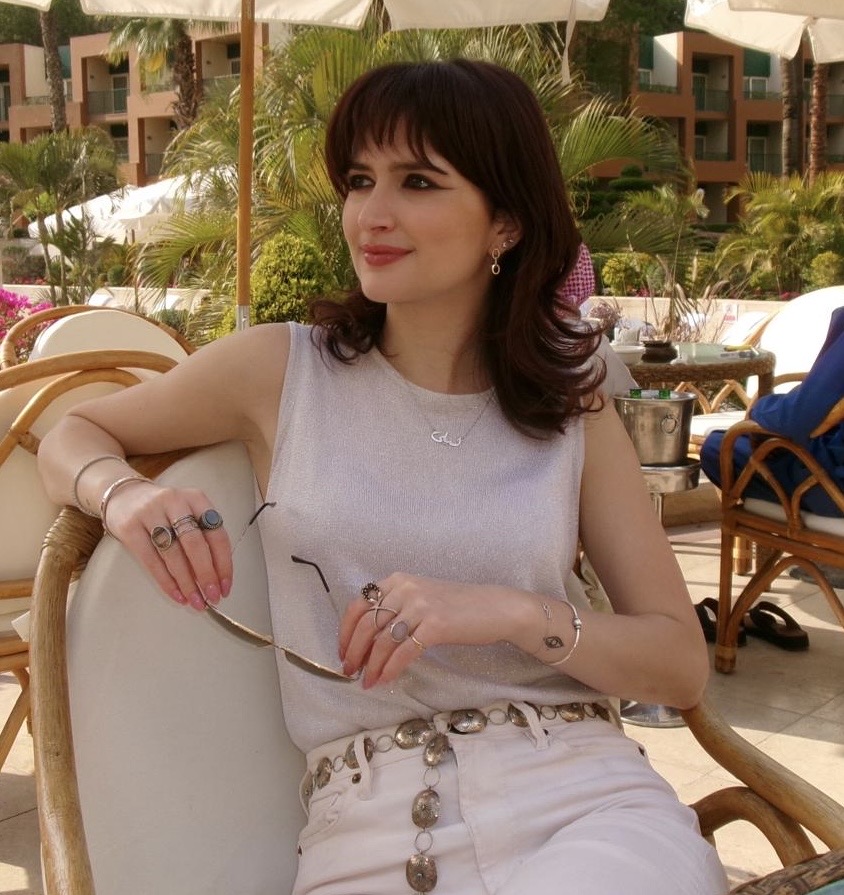

Modern folklore musician Rola Azar has appointed herself archivist of a feeling. History books can keep the footnotes. She wants the ache, the joy, the despair, everything that goes missing between the lines. “One day, people will listen to these songs and understand what Palestinians were feeling in this era,” she says.
The longing and despair and joy she belts out of the deepest wounds in her consciousness reach past her Palestinian identity. “I don't like to confine the Palestinian only to the cause,” she says about herself, and her music, on a Zoom call from Amman. She is running a makeshift home studio that travels with her, today set up on a table in the corner of the living room.
These past few years have been a blur of passport stamps and singles, five of them with Palestinian-Jordanian musician El Far3i. Her latest release is a four-track EP called ‘Hathi Ardi’ (This Is My Land), with three more albums in progress, the timeline stretched by the work of being independent. She is looking for representation and has conditions. “I want total freedom to sing whatever I want, without being afraid,” she says.
Azar left Palestine on October 12th, 2023, five days after the war started, and hasn’t been back. On October 13th, Israeli forces raided her home looking for her. They came back six times, calling and threatening her, and found an empty room each time. She was already gone, into a journey that would carry her around the world: Berlin, Amsterdam, the US, Amman, Tunis, The Hague, and Spain, and on. “From then on, I've been moving around to wherever there's music, wherever there are shows,” she says.
“If I go back, they'll silence me. I’d be imprisoned or beaten. So I prefer to serve my cause from outside the country.” She flips the camera to a bag on the floor beside her bed. “I'm literally living out of a suitcase.”
She grew up in Nazareth as a ‘48 Palestinian, one of roughly two million Arab citizens of the Israeli state drawn up in 1948. They make up a fifth of the population and live under policies that privilege Jewish citizens. “I come from a place where I have no police, no president,” Azar says.
For her last 10 years inside, she lived in Jerusalem, studied Oriental music, then taught it. The career was a family inheritance. She started as a backup singer for her father as a child, and by 18, she had taken over his band and was running the show herself.
Ask her which song was the turning point and the answer arrives in a split second: ‘Ikhla' na'lak ya Musa’ (Take Off Your Sandals O Moses). Built on the Quranic image of Moses removing his sandals on sacred ground, it casts Palestine itself as holy soil, then moves through symbols of steadfastness, the rose, the olive, the fig, even the wounded body and the coffin of journalist Shireen Abu Akleh, to insist that resistance lives at every level.
Lebanese composer Fadi Zaraket wrote it for Azar to sing, not long after she had left. “At the start of the war we were strictly forbidden to speak,” she says. “But I loved the song and felt its words and its power. I decided, it is impossible not to sing it, even if I go to prison for three years. So I took it.”
“I believe even these heavy, sad songs are important for documenting the era,” Azar says about ‘Ya Musa’ and other songs she recorded during the same period like ‘Intathiri’ (Wait), about a mother holding her daughter’s dead body after being hit by a shell, which sent her into a month-long depression. To this day, she hasn’t listened to it again. But Azar doesn’t only want to be known for her songs about Palestine. This period is her laboratory, a chance to show the world another side of her craft and her personality.
“I have a persona that's hyper and loves fun,” Azar says with a wide smile. “I want to sing for Palestine but I also want to do what I love, because I'm not one persona, I'm several. I'll sing the songs that express my feelings as a Palestinian, and at the same time, make crazy songs about love, even a song about nothing at all.”
El Far3i has been her main collaborator as she tests new water. Their first track together, ‘Wallada’ (Birth) in 2025, grew into the EP they're building now. A few months on, she released ‘Ya Ret’ (I wish), a song he wrote for her, an indie ballad far from her modern-folklore signature.
“El Far3i would say ‘tell me how you feel,’ and I'd say ‘I'm very homesick, there's something beyond missing. There's longing, but I don't want anyone to trample on me.’ Meaning, I miss my country, but I don't want to go back and have someone silence me,” she says, recalling the conversation as he wrote the words to ‘Ya Ret’. She was missing a home she couldn’t return to, and a family she hadn’t seen in nearly three years. “It came as a collaboration, a mix between my feelings and his as a Palestinian-Jordanian.”
“Yes, I'm longing for Palestine, but I'd want a Lebanese or Syrian or Tunisian or Moroccan person living abroad to connect with this too,” she says. “Our goal with this album is to express our feelings, nothing else.”
Related Articles

Trending This Week
-

-

-
 Jul 23, 2026
 -