






Jazz Ambassadors in Egypt and the Politics of Sound
Louis Armstrong, jazz diplomacy, and the musical battle for global influence.

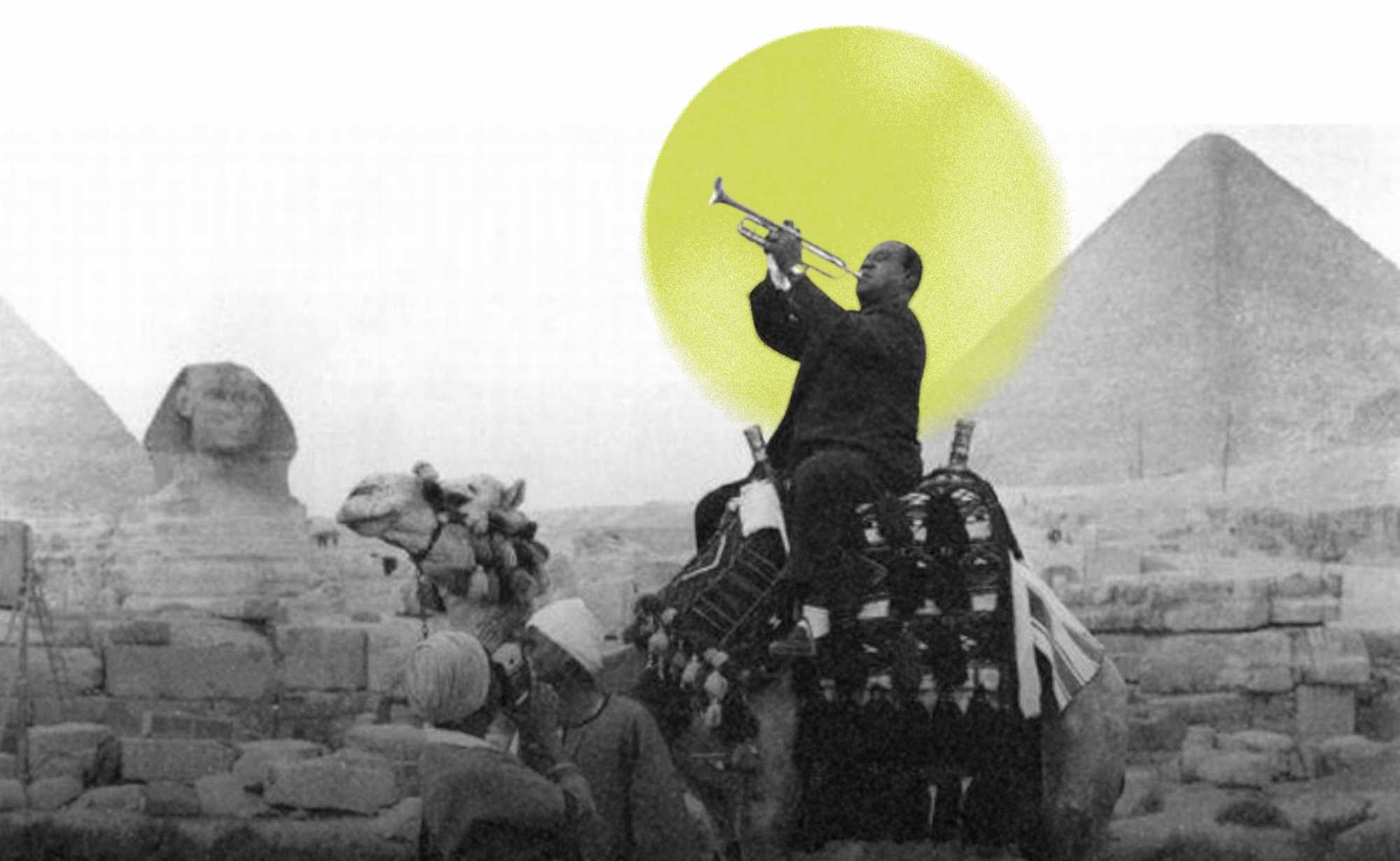
It’s January 28th, 1961. A cool wind weaves its way through Cairo’s crowded streets before spilling out onto open land. It flows through the porous limestone of the Pyramids, before creeping down the Giza plateau, where it approaches the eternal gaze of the Sphinx. There, it stops for a moment, listening closely to the curious sounds beneath it. Vibrating through it, it feels the brassy calls of a trumpet and the sweet swing of jazz.
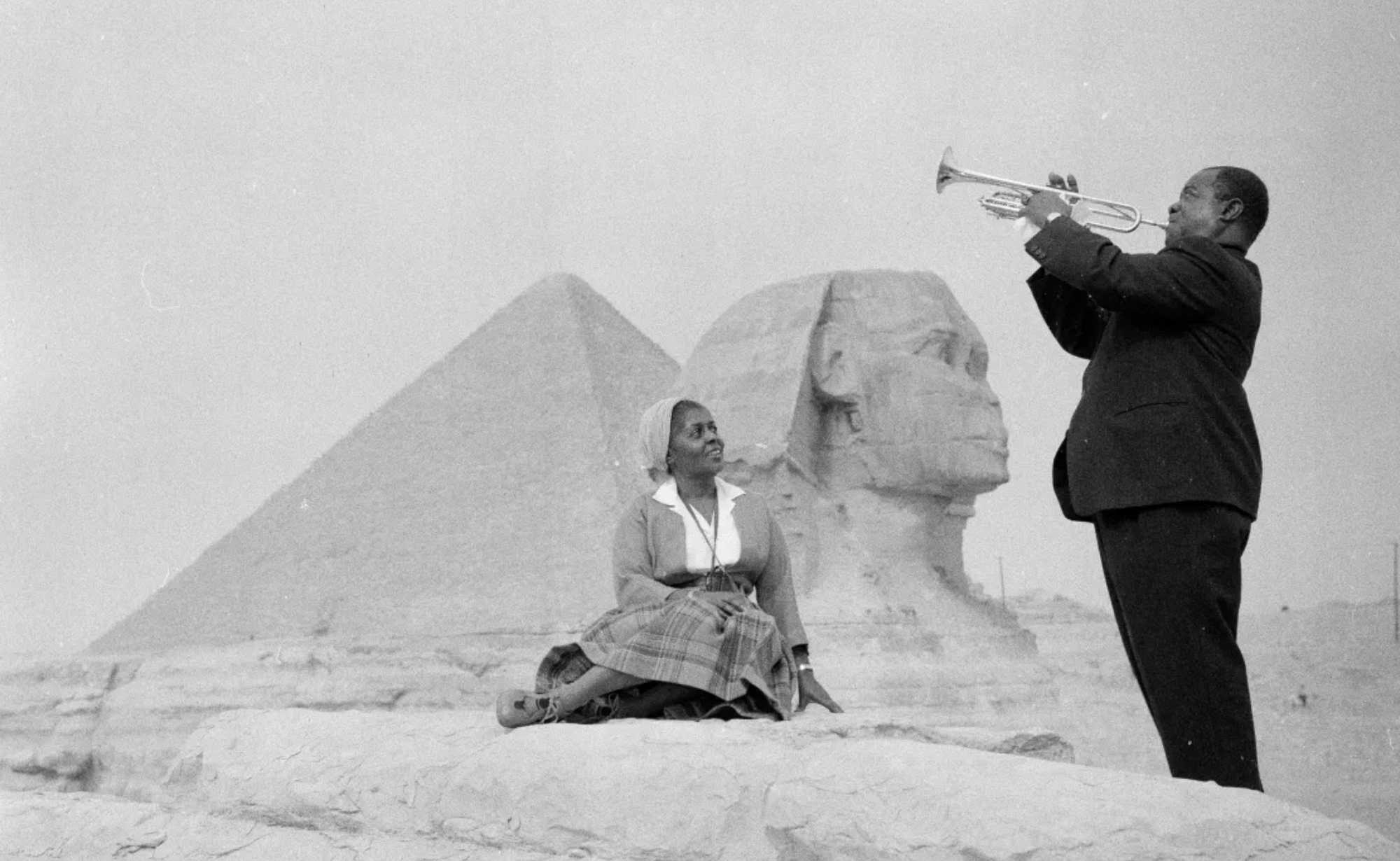
We all know the picture: Louis Armstrong, trumpet raised, playing for his wife Lucille against the vast, enduring landscape of the Pyramids: modern soul meeting ancient ones. What is less remembered is that Armstrong did not come to Egypt simply as an admiring tourist or a loving husband with a song. He arrived as a cultural ambassador of the United States, part of a carefully orchestrated effort to let American jazz speak for its politics.
The Cold War, which unfolded in the decades after World War II, played out just as much in the cultural sphere as it did in the political one. As the United States and the Soviet Union emerged as global superpowers, they competed for cultural and ideological influence over newly independent nations across Africa, Asia, and the Middle East. This struggle reached its apex in the 1950s and 1960s, as countries in Africa were shedding colonial rule and seeking to define themselves, on their own terms, as nations. These countries became the battlegrounds of the Cold War. In these battles, soft power and cultural diplomacy operated as subtle but powerful weapons. As the Soviet Union cast the United States as a nation defined by racial injustice and inequality, the US turned to jazz - and its legendary jazz musicians, to counter these narratives.
Jazz is a genre, but it is also a language; an unfinished and ever-evolving expression of African American struggle. Born in the American South, it blends spirituals, African rhythmic traditions, and American blues into something entirely new. As musicians moved to the American North during the Great Migration - a period in which over five million African Americans fled the Jim Crow South for cities like New York and Chicago - they carried with them the stories and music of the South to new spaces and new listeners. In this way, jazz is in constant dialogue between the past and present, between musicians, genres, and eras, to represent and give voice to the complexities that constitute the American identity.
By the 1950s, jazz was being deployed to tell a new story: the story of American national identity, promoting ideas of creativity, openness, and racial equality. The Jazz Ambassadors program was conceived as a means of exporting these ideas abroad and transplanting them into new cultures. Artists such as Dizzy Gillespie, Duke Ellington, Dave Brubeck, and Louis Armstrong became musical diplomats, formally representing their country on an international stage.
Throughout the years, the musicians travelled extensively on months-long tours, performing in countries that were often facing periods of political turbulence. In fact, in October of 1960 - just three months before coming to Egypt - Armstrong’s sheer presence stopped a civil war, for a day at least. In the early years of the Congo Crisis, Armstrong was sent to Léopoldville, now Kinshasa, in the middle of a violent conflict. When news arrived that Armstrong would perform, both sides agreed to a truce for one day and one day only: the day Armstrong came to play.
This image is powerful; American jazz - a unifying power - eases unrest abroad while promoting ideals of American equality and openness. Yet the contradictions embedded within this narrative were not lost on Armstrong or many of his fellow musicians. Jazz relies heavily on improvisation. Unlike classical music, which relies on a strict adherence to written compositions, jazz musicians are free to interpret and reshape melodies during performances under the guidance of a rough outline. During these performances, moreover, solos are encouraged, offering each member of the band a moment of equal voice and visibility. To policymakers, these elements were symbolic of American democracy: a system in which individuals could participate freely within a collective framework.
But the same music also tells a different story. In songs like “Black and Blue”, Armstrong and his orchestra give voice to the realities of racial injustice - realities that stood in stark contrast to the image the United States projected abroad:
“I'm white inside but, that don't help my case
That's life can't hide what is in my face
How would it end ain't got a friend
My only sin is in my skin
What did I do to be so black and blue”.
In 1957, Armstrong cancelled a planned tour to the Soviet Union as a musical ambassador in protest against the Little Rock crisis, where the National Guard was deployed to prevent nine African American students from entering a racially segregated high school in Arkansas. By the time he came to Egypt in 1961, while substantial progress had been made in the civil rights movement, Jim Crow laws, which codified black Americans’ subsidiary status to their white countrymen, were still in full effect in the South - and would be for another four years. This tension was not lost on international audiences - or on the musicians themselves. After all, how could America promote ‘facts’ of racial equality, honouring a music tradition created by Black communities, while treating these musicians as second-class citizens back home?
The Jazz Ambassadors occupied a uniquely difficult position. On the one hand, they were celebrated abroad as symbols and representatives of American culture. On the other hand, the profound discrimination faced back home called into question the truthfulness of this narrative. During the Cold War, both the United States and the Soviet Union sought to put their best foot forward overseas, even if they had to stretch the truth to do so.
Some navigated this contradiction through their music; its tunes, its lyrics. Jazz performances have often served as forms of protest and resistance, and now this resistance could be heard by global audiences. Others spoke more openly, challenging American policies and drawing attention to civil rights struggles. In this way, jazz diplomacy was more than propaganda or a means of soft power; it was a space where competing narratives about America could coexist and take form.
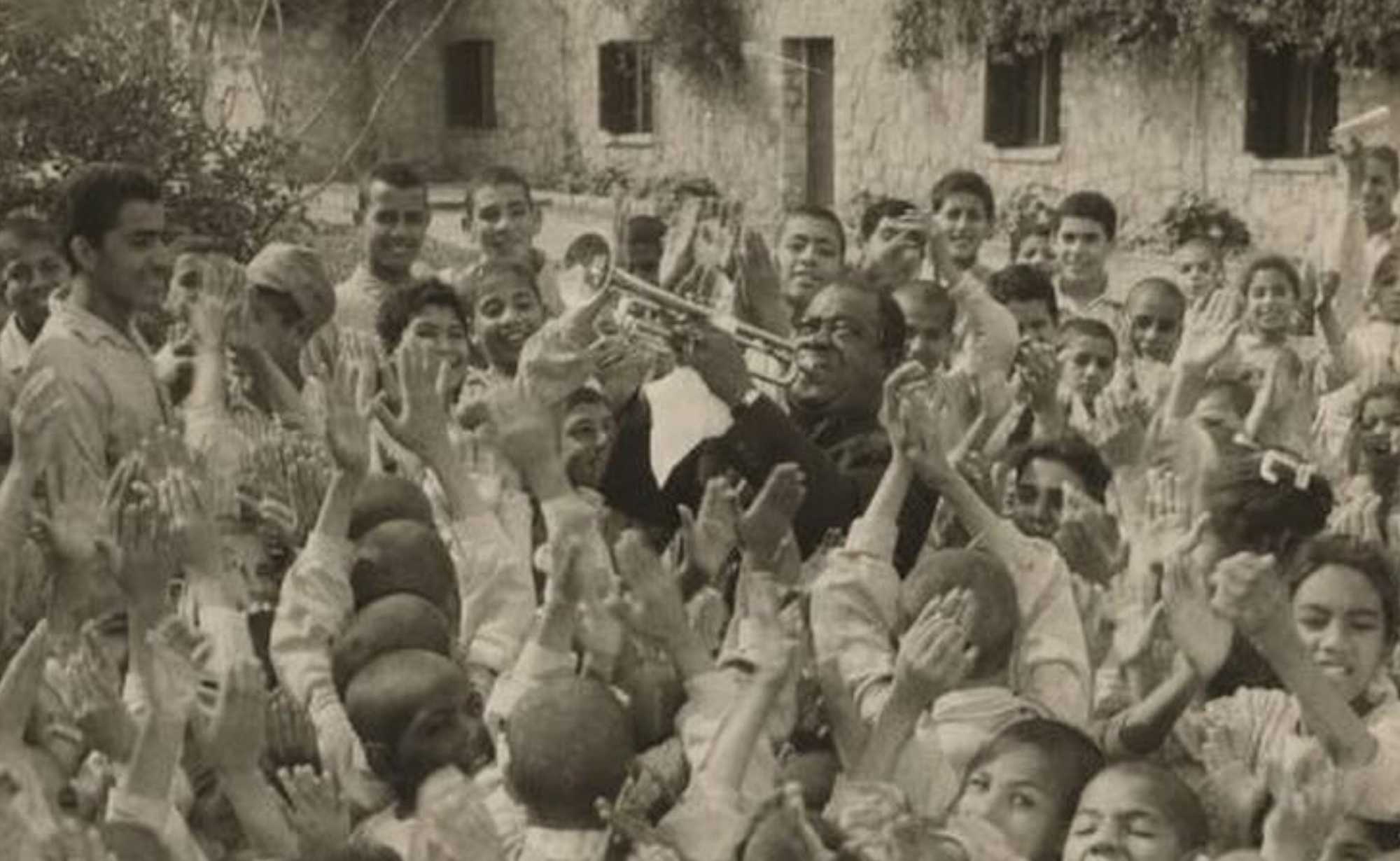
The morning Armstrong played for the Sphinx, he had a morning reception at the American Embassy, and an evening concert before leaving Egypt the next day. Yet somewhere between, he made time to play for an orphanage in Cairo. Armstrong was known to have a deep and emotional connection to Africa, and in these quieter, less documented moments of his tours, jazz was able to reach audiences and form deep and honest human connections - soul to soul.
In the years before and after his visit, the Soviet Union made steps to sway its influence on Egyptian development and culture. A year before, in 1960, construction began for the High Aswan Dam with the help of the USSR. In the arts, four years after Armstrong’s tour, Russian Grigori Kozintsev’s adaptation of Hamlet was a sensational hit for Egyptians. Armstrong and his trumpet were both a gift to Egypt - etched into our visual memory - and a strategic instrument aimed at steering hearts and minds away from these Soviet interventions.
Today, what remains of Armstrong's visit is the cultural and musical footprint it left behind, rather than the rivalry that fostered it. Jazz did not leave Egypt the next day, as Armstrong did, and the toots and whistles of his trumpet are kept alive in Cairo’s modern jazz scene. Today, the Cairo Jazz Festival brings together visitors and musicians from across the world and highlights Egyptian artists who have taken jazz and made it their own. In November of 2021, the American Embassy in Egypt sponsored American jazz artists to play at Cairo’s festival, keeping the musical relationship between the two countries alive. What arrived as an instrument of foreign policy has become part of a living, local culture.
The wind that once carried the sound of Armstrong's trumpet across the sands, back into the city, and into the ears of musicians of Cairo, remains today. In Egypt - and many places visited by Jazz Ambassadors - the genre does not exist as an imported sound as a distinct language of its own; one that tells the story of those who played it, and those who listened.
- Previous Article Health & Social Solidarity Launch Women’s Health Initiative
- Next Article The Ancestral Resilience of Omar El Farouk’s Fayoum Home
Related Articles

Trending This Week
-
 Oct 06, 2026
 -
-

-