




Nermin Habib Brings the Egyptian Zir to Paris Design Week
Once used to keep water cool, Egypt’s traditional zir becomes the starting point for Nermin Habib’s latest ceramic work.

Living in Egypt’s desert climate meant finding practical ways to keep water cool. Ancient methods included the olla and the zir, large earthenware vessels designed to store water. Their porous clay allowed water to evaporate through the surface, naturally lowering the temperature inside. Bahrain-based multidisciplinary artist and ceramicist Nermin Habib drew inspiration from this tradition for her latest work.
Presented at 1000 Vases during Paris Design Week 2026, ‘Zir’ takes the traditional Egyptian water vessel and presents it as a sculptural object. Habib retains recognisable elements of the form, including its broad body and irregular opening, but removes its original function.
“Zir started as part of my wider research into the olla and traditional earthenware water vessels found across different cultures. I became particularly interested in the Egyptian zir because it was once such an ordinary part of everyday life. It was a functional object used to store and naturally cool water, but it also carries so much cultural memory,” says Habib
Hand-built from mixed black and white stoneware, the vessel brings two contrasting clay bodies together across its surface. The colours fold into uneven bands, creating a pattern that shifts across the form. Horizontal ridges trace the hand-building process, while a rough, slightly off-centre opening echoes the mouth of the traditional vessel.
“I wasn’t interested in making a replica of a traditional zir. I wanted the reference to be recognizable, but for the piece to have its own contemporary language. I reduced and reinterpreted the form, then hand-built it using black and white stoneware,” Habib explains.
The two clay bodies also make each piece slightly different. “As the two clay bodies move through one another, they create patterns that I can influence but never completely control, so every surface becomes unrepeatable. I love that tension between intention and unpredictability,” she says.
In her wider practice, Habib uses hand-building, texture and surface to document the process of making. For ‘Zir’, she began by studying the original vessel’s proportions, function and cultural context before deciding which details should remain recognisable in the finished piece. “In the finished work, the function has disappeared, but the memory of the object remains. I often describe it by saying: the vessel no longer holds water. Instead, it carries the memory of what it once was,” Habib says.
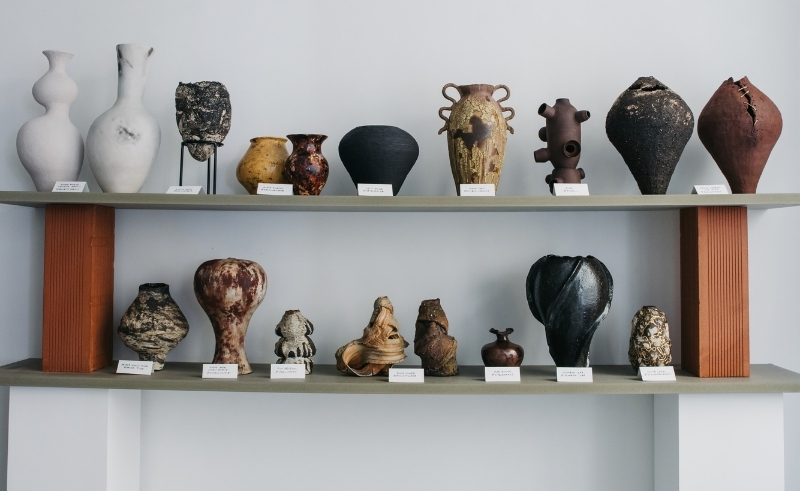
At 1000 Vases, ‘Zir’ was shown alongside interpretations of the vessel by makers working with different materials, traditions and references. The exhibition gave Habib’s Egyptian reference a place within a wider conversation around one of the most familiar objects in human history. “Showing Zir at 1000 Vases during Paris Design Week felt particularly meaningful because the exhibition brought together interpretations of one of humanity’s oldest and most universal objects: the vessel," she says. "To place an object rooted in Egyptian material culture within that international conversation felt like another layer of the work itself."
Based at The Art Station in Muharraq, Bahrain, Habib’s practice is centred on ceramics. Her background in visual storytelling informs her approach to texture, surface and the visible marks of making, which remain present in the finished work.
- Previous Article Faraj Suleiman On Releasing 'Masaha' & Resisting The Algorithm
- Next Article Global Health Exhibition to Bring Over 500 Speakers to Riyadh