





'Dreams of Dendara' Gives Voice to a Forgotten Lineage of Women
Sabrine El Hossamy's award-winning short film traces the echoes of women who once occupied the titular temple's halls.
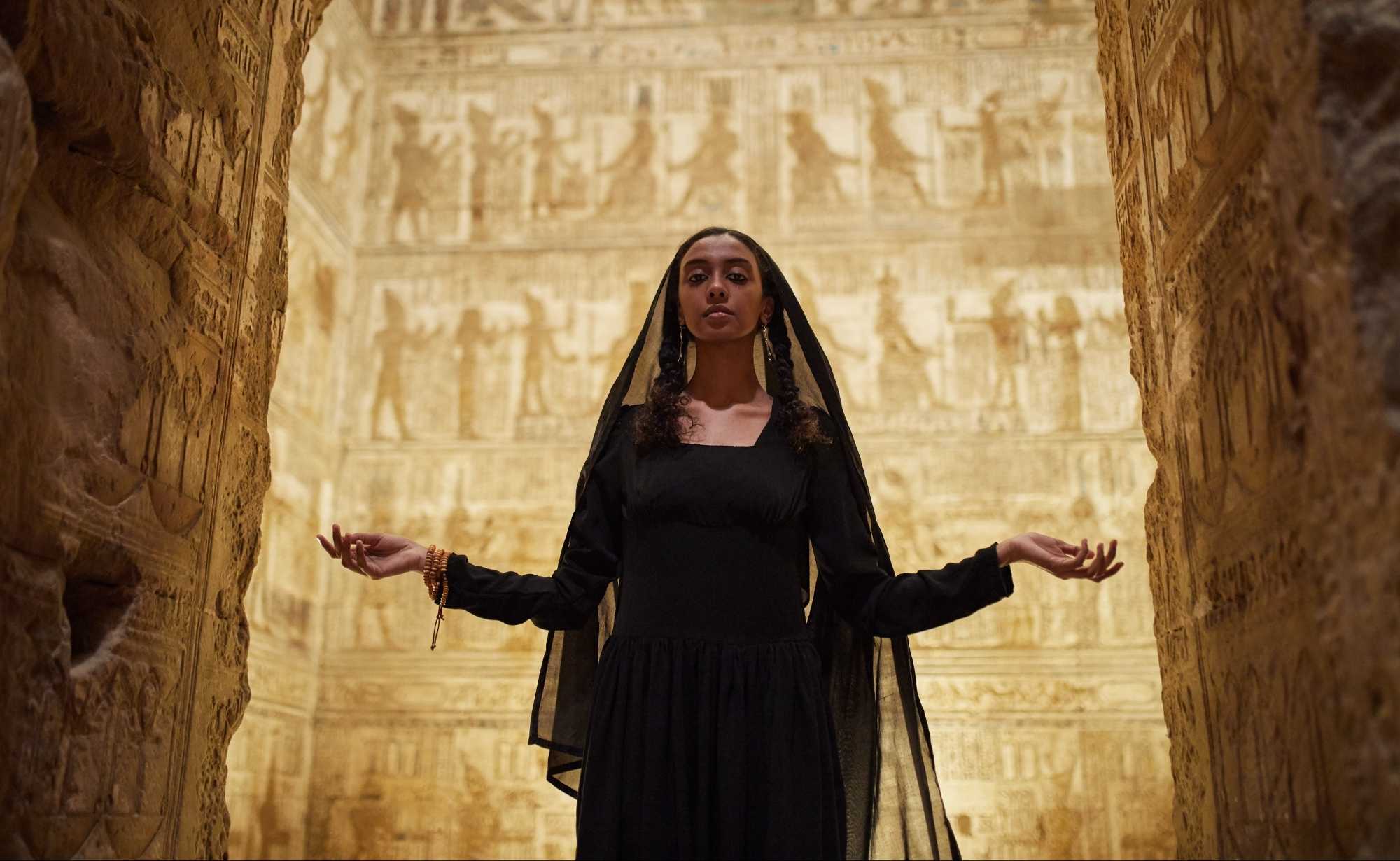
When Sabrine El Hossamy first visited Dendera Temple during the pandemic, she found the temple in a state few people ever experience, with no crowds and no tourist buses. Standing inside one of ancient Egypt's most significant temples dedicated to Hathor, the goddess of music, joy and fertility, the musician and percussionist began imagining the women who once occupied its hall. Those were priestesses, performers, and keepers of ritual whose voices had long since faded from view.
That visit would eventually crystallise to become 'Dreams of Dendara', a 24-minute short film that uses the temple as a point of departure for a story about inheritance, memory and the search for a female voice across generations. Through the relationship between a father and daughter, the film explores what remains of that legacy and what has been lost along the way, touching on themes of bodily autonomy, womanhood, and cultural continuity.
The project recently won the Golden Mask of Tutankhamun at the Luxor African Film Festival, where El Hossamy had first participated as an emerging filmmaker four years earlier. We spoke to the director about Hathor, ancient Egyptian music, filming inside Dendera, and why recovering Egyptian women's voices became the emotional core of her debut film.
You’ve said the idea for 'Dreams of Dendara' began during a visit to Dendera during the COVID-19 pandemic. What was it about that experience that had an impact long enough to become a film?
I've always been fascinated by ancient Egypt, particularly the role of women and music within it. Dendera is one of the most important temples dedicated to Hathor, the goddess of music, joy, fertility, and love. As a musician and percussionist myself, I felt an immediate connection to her. There are depictions of Hathor holding a frame drum, and historically the temple's priestesses were musicians and performers who played a central role in rituals, celebrations and ceremonies surrounding birth and community life.
When I visited during the pandemic, the temple was completely empty. There were no tourists, no crowds, just silence. It allowed me to experience the place in a very different way. I was also fascinated by the fact that the temple guardians are part of a lineage that has continued across generations. One guardian in particular, Selmy, became a source of inspiration to the father role in the film.
I left Dendera thinking about these women who once occupied such a powerful space as musicians, priestesses, and keepers of culture. The idea of reviving that memory stayed with me. I then had a dream about this and here we are.
Dendera is one of Egypt's most photographed temples, yet the film seems less interested in the monument than what it represents. What drew you to that approach?
The temple became a gateway into a human story. At its heart, 'Dreams of Dendara' is about a father and his daughter. The father is a guardian of the temple, and through their relationship we explore ideas of inheritance, memory, and the female voice. The temple is a living presence that shapes how they understand themselves and each other.
What interested me was the relationship between people and place, and how history continues to live through those who care for it.
Hathor is often remembered as a goddess of love and beauty, yet the film engages with much darker realities. Why was that tension important to explore?
For me, it isn't really a contrast. It's a story about continuity and the ways that continuity has been interrupted. One of the themes the film touches on is FGM, which is often assumed to be an ancient Egyptian practice when in fact it has no roots in ancient Egyptian culture. Ancient Egyptian society celebrated joy, music, fertility, sensuality, and the feminine body. Those values were central to Hathor herself.
The women in the film are searching for their voices. In that sense, the story isn't about moving away from Hathor's legacy but trying to reconnect with it. The lineage is still there, but something has been lost along the way.
The film touches on FGM without becoming a conventional issue-driven film. How did you approach that balance?
I never wanted the film to be solely about the act itself. What interested me was the idea of what is taken away. FGM becomes a metaphor for silencing, cutting a woman off from her ability to feel, express herself, and connect with her femininity. The film isn't trying to explain the issue through statistics or activism; it's interested in the emotional and spiritual consequences of losing one's voice.
Was there a personal experience that pushed you toward these themes?
Music played a significant role in shaping my perspective. As a female drummer, I've often encountered assumptions about what women should or shouldn't do. There were moments when I felt judged simply for occupying a space that wasn't traditionally expected of women.
That experience made me think deeply about women's relationship to expression, creativity, and freedom. The themes explored in the film grew from those questions.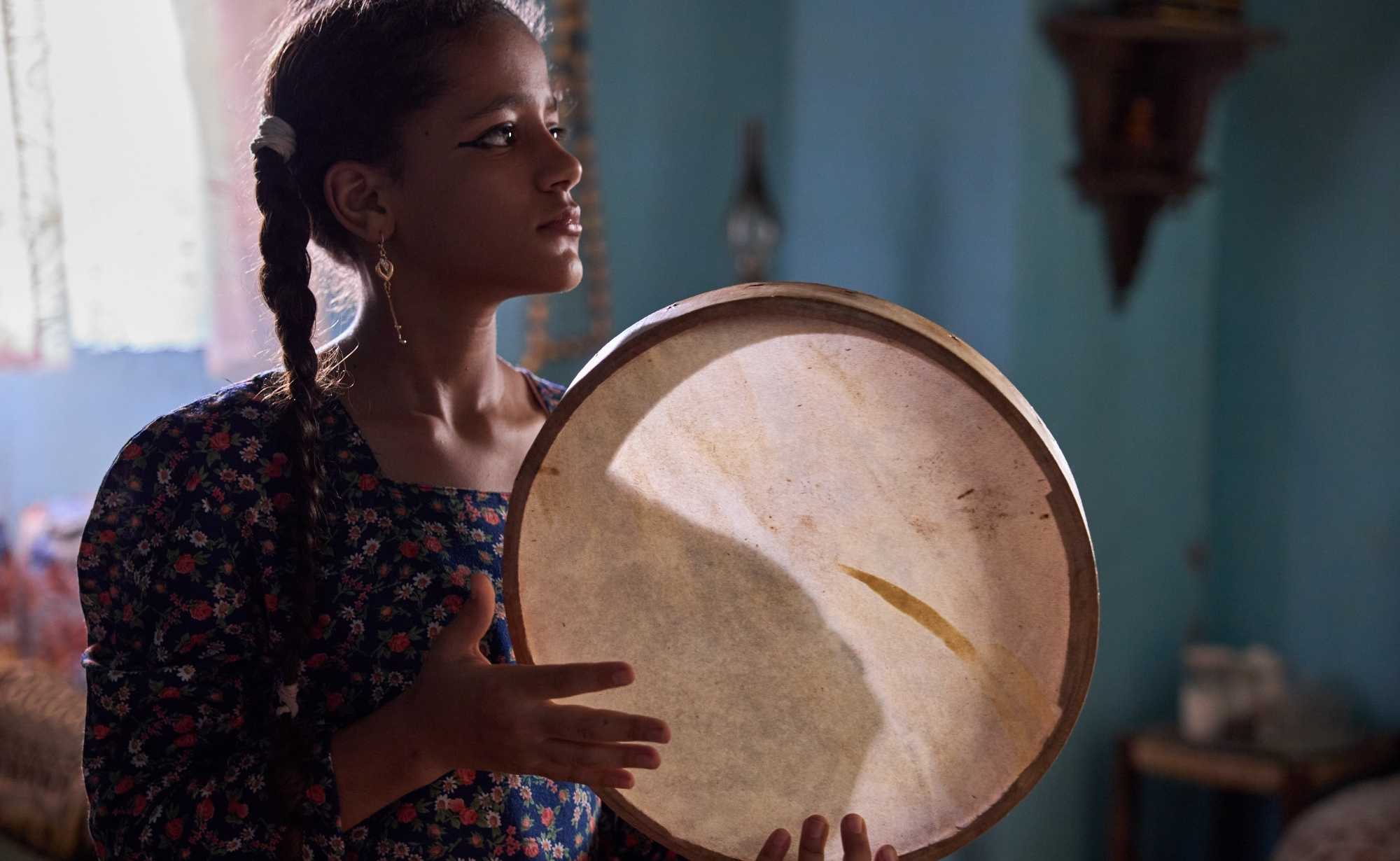 How much research went into the project, both historically and musically?
The research was extensive. We worked closely with three Egyptologists who helped us reconstruct aspects of ancient Egyptian language, music and ritual practice.
One of the things I'm most proud of is that the film experiments with classical ancient Egyptian language and inscriptions in a cinematic and song context. We drew from historical texts and collaborated closely with specialists to ensure accuracy.
As for the music, every instrument featured in the film is based on instruments depicted in the temple itself. Some were painstakingly recreated, including instruments crafted by Ghaly, a specialist instrument maker from Port Said who is dedicated to reviving ancient harps.
The score was developed with composer Hayat Selim, while singers Shahd Ezz and Fayrouz Walid elevated the project through their vocal performance. Music was a strong accompaniment to the story.
What were the challenges of filming in a location with such immense cultural and historical significance?
Simply filming inside the temple was a challenge. Very few films after Shady Abdelsalam used an Egyptian temple as their primary setting in the way we did. Throughout the process I often thought about Shadi Abdel Salam and the visual language he established in Egyptian cinema. The production itself was demanding. We were working in a remote temple in Qena, often shooting late into the night in temperatures that dropped to around seven degrees Celsius. Every logistical detail had to be planned carefully.
One of the most meaningful moments came when the legendary production designer Onsi Abu Seif, who worked on 'The Mummy', told me that Shadi Abdel Salam would have been proud of the film. That was an extraordinary compliment because his work has been such an inspiration.
Did the cast approach the material differently knowing it touched on subjects that remain sensitive today?
Casting was incredibly important. The young girl at the centre of the film is from Luxor herself and had been spared FGM. Bringing her into the project felt right because she understood the emotional reality behind the story in a very personal way.
Alongside her, we had an exceptional professional cast. Khaled Kamal, in particular, brought tremendous depth to his role. We spent a great deal of time discussing the motivations and emotional history of his character.
The film is only 25 minutes long, yet its themes could easily sustain a feature. Why begin with a short?
As a first-time director, securing support for a full feature would have been difficult. A project like this could easily have taken years longer to realise.
The short became a way of making the film tangible, allowing me to show its world, themes, and visual language. It became a way of showing what was possible rather than waiting indefinitely for the perfect circumstances.
The film recently won the Golden Mask of Tutankhamun at the Luxor African Film Festival. What did that recognition mean to you personally?
It was incredibly emotional. Four years ago, I attended the Luxor African Film Festival as part of a workshop for emerging short-film female directors, where I won first prize. Returning to the same festival with 'Dreams of Dendara' and receiving the Golden Mask of Tutankhamun felt like completing a circle. What made it even more meaningful was hearing that the jury's decision had been unanimous.
But perhaps the most rewarding moments came afterward, when young women from Luxor approached me to talk about the film. They saw themselves in it and understood what it was trying to say.
MediaHub & Al Motahedah are primarily known for backing large-scale commercial productions. What convinced them to support a project as personal and unconventional as 'Dreams of Dendara'?
Mohamed El Saady was one of the first people who truly saw the value of the project and was willing to take a chance on it. The film was not an obvious commercial proposition. It sits much closer to art-house cinema than mainstream filmmaking.
The fact that MediaHub and Al Motahedah embraced it, and that Saady believed it deserved a platform, was incredibly important. Without that support, 'Dreams of Dendara' might never have existed in its current form.