





Stephan Kaluza Paints Forests That Don't Exist in Dubai
Stephan Kaluza’s first UAE solo show at JD Malat Gallery presents oil paintings of imaginary forests that become more abstract as visitors move through the exhibition.
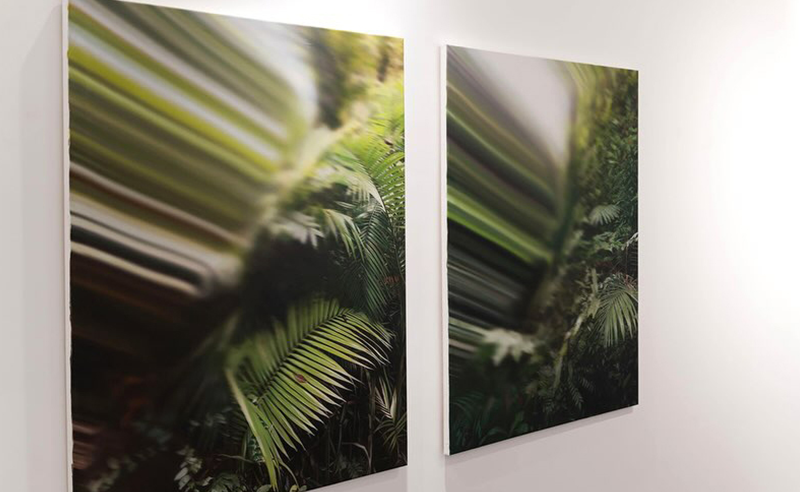
Lean in close and the forest falls apart into brushwork. Step back and it closes over again, so smoothly that the eye files it under photograph and moves on to the next thing, which is also a forest, and also a lie.
Stephan Kaluza has spent a career on this particular deception. The undergrowth, the water, the light coming through at the angle you remember from somewhere: all of it is oil, laid down by hand, and none of it grows anywhere on this planet. He gathers his material across continents, then builds outward from one small thing he noticed and could not put down, a structure, a fall of light, until a place assembles itself around it.
“I then enjoy returning to it serially; everything else circles around this one point. And the more it is constructed, the further such an image distances itself from reality.”
That is the condition of FROM DUST TO BLOOM, his first solo exhibition in the UAE, which has been at JD Malat Gallery in Downtown Dubai since September 17 and comes down at the end of this month. Enter at the right-hand wall, where the illusion is at full strength, and start walking.
“In the exhibition, we introduced a certain choreography: from right to left, the paintings begin to ‘dissolve,’ becoming increasingly abstract and ‘displacing’ the paintings of nature.”
Most of what hangs here belongs to Transit, a series he has carried past 300 paintings.
“A world that can already be understood as a ‘transit station,’ as a moving and movingly fluid transit of fleetingness. I believe we do not realise just how much we are already inside such a transit station… things are beginning to leave us.”
Twenty years ago Kaluza set off from Piz Badus in the Swiss Alps and walked the Rhine to the North Sea, 1,620 km down the right bank, stopping every minute to photograph the far shore. It took him about eight months and produced 21,449 frames, which were later joined, edge to edge, into a single unbroken ribbon of picture running for kilometres at the height of a hand. A river, flattened until a person could carry it.
“Thus, the Rhine was compressed for the human eye,” he says. “And indeed, one is not merely capturing a landscape, but an entire history…”
He came to all this honestly, raised at the edge of the Teutoburg Forest, in Bad Iburg, where he still keeps a house. “As a boy, I ran barefoot through the forest; it was all just an adventure.” The adventure has acquired new residents since. “Wild animals, such as the wolves that have returned to those woods, no longer evoke fear… they are fascinating.”
What he does in the studio has rather less of the barefoot about it. Take Sunset, in which Transit 311 appears three times, the same scene cooling as it goes.
“I calculated the colours of the first image on the left, and then reproduced and intensified that precise proportion in the paintings to the right. It was a self-experiment: how do we stage a work if, for once, we filter out the emotional aspect of painting?”
The experiment produced three beautiful paintings, which is either a triumph or a failed hypothesis, depending on how he feels about it.
Hanging alongside them are two series he cannot leave alone. The Disappeared has been running for years. Impact is new. They are about the same exit.
“It is, of course, nature that is disappearing, slowly but surely. It departs quietly and silently, and at some point, we will realise that we are living in a purely human world, devoid of grand rainforests.”
He is less forgiving about our side of it.
"Humanity has defined its own bubble on this planet, from which it looks down, apathetically and sometimes arrogantly, upon the forests from which it emerged. It is only a matter of time before it bursts, this bubble of a mutated brain… one might think.”
In Impact the bubble turns up inside the picture, uninvited, as bands of hard colour slicing across the branches. “Something undefined and colourful invades the image of nature, displacing it like a virus.” He likens it to an internet glitch, the stutter of a video giving up.
“We have seemingly forgotten that we are a part of nature; we have become its executioner.”
For years he has photographed European battlefields, meadows and rivers and woodland carrying no visible memory of what was done there, and he is honest about how little the pictures can tell you. The paintings offer greenery, and the greenery offers nothing. Whatever you know, you walked in with. “In its silent presence, nature highlights the fleetingness, and thus the abysses, of human endeavour. Photographing battlefields is a task that, unfortunately, will never end.”
A phrase trails his work, nunc stans, the standing now, and his fondness for it is the fondness of a man who has considered the alternatives.
“A painting is such a nunc stans; it is a frozen state that will remain unaltered for at least the next 500 years. This is also why portraits were painted in the past; a person is, in a sense, captured for eternity, even if they have long since ceased to live.”
He is painting forests the way people once painted the dead.
The method suits the ambition. Photorealism means hours given to a single leaf, and for company he summons medieval monks at their manuscripts, whole lives spent bent over the very small. “While it is not quite as extreme in my own work, it truly requires an immense degree of focus.”
All of which has landed, improbably, in a city with no patience for leaves. Kaluza is charmed by it. “One of the world’s most modern metropolises has essentially risen from the desert, like a blossom out of nothingness,” he says, and then, better: “the skyscrapers stretching upward like a mountain range of the Anthropocene.” He admires the appetite behind it, and finds it missing at home. “In Europe, this will has significantly waned compared to past centuries of growth.” What he hopes visitors carry back out into the heat is an invitation. “Cities should not exist in opposition to nature, but rather be an evolution of it.”
His next subject lies beyond the reach of any camera he could carry. He is painting the first forests that ever stood, the swamp giants of the Devonian and the Carboniferous, with nobody around to admire them and nothing to call them by.
“Within this vast continuum of time and space, humanity played no part; there was not even a concept of us.”
Those forests fell, and sank, and compressed into coal, and we have been burning them ever since to light rooms like this one, with its cool air, its bright walls, and its paintings of trees.
Related Articles
Trending This Week
-

-
 Oct 24, 2026
-
 Oct 28, 2026
-