





Samo Shalaby’s Art Pushes the Boundaries of Identity Through Fiction
Egyptian-Palestinian artist Samo Shalaby leads us behind the curtain of his theatrical worlds, where beauty is bait and ghosts long to be remembered.
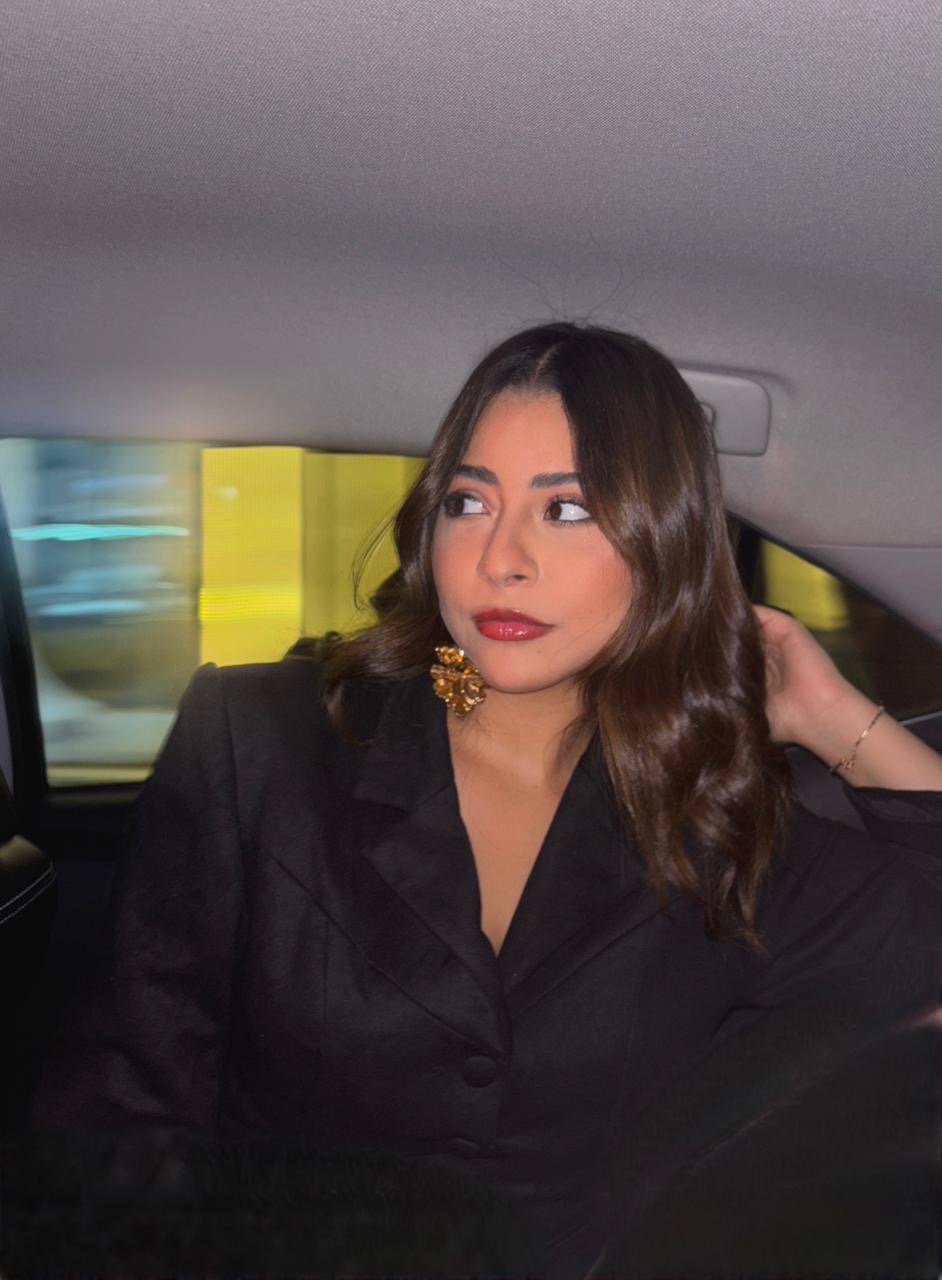
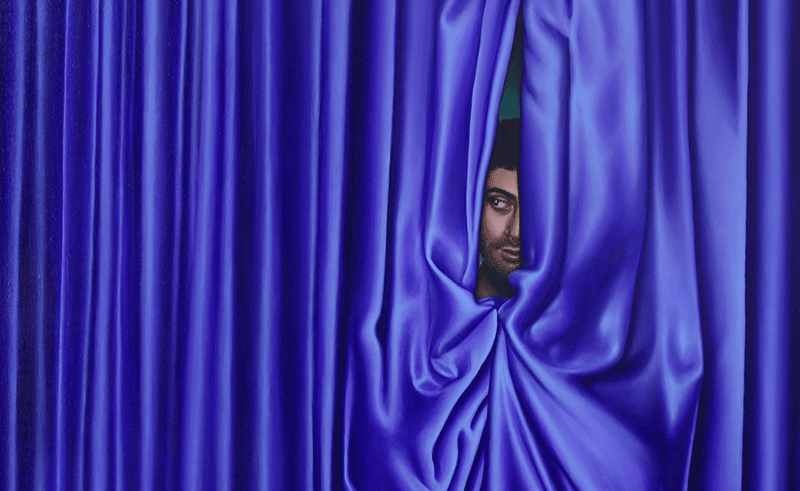
Egyptian Palestinian artist Samo Shalaby has a unique way of using beauty to hide grief and mortality in his paintings.
"I've always believed that the truth lies in fiction," Samo Shalaby tells CairoScene.
"Sometimes the most honest way to express something is to reimagine it."
That belief runs through everything the Egyptian-Palestinian artist has made, from his early stage paintings to the miniature portraits set in antique frames.
His canvases are full of performance in action, dressed in velvet and gold leaf, as though an audience has wandered in late and missed the exposition.
Shalaby was born in Cairo in 1999 into an artistic family. His mother, an artist in her own right, kept a studio at home, and he spent his childhood among canvases, handmade costumes and antiques shops in a city where objects outlive their owners.
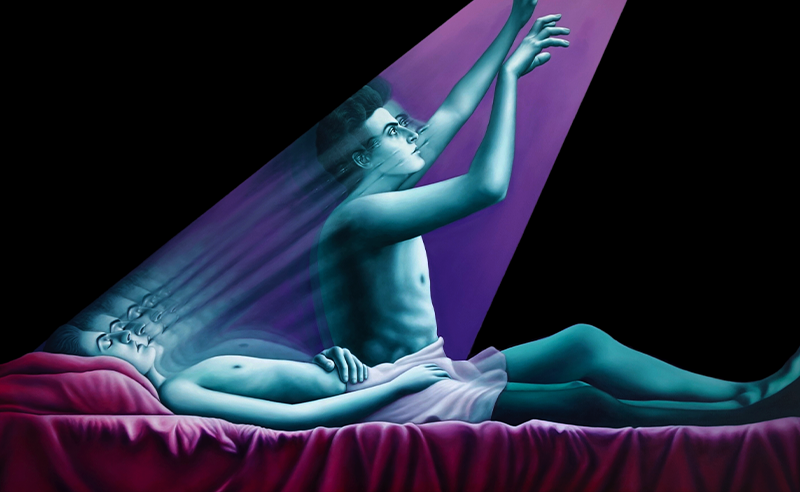
The family moved to Dubai after the 2011 revolution, and Shalaby later studied graphic communication design at Central Saint Martins in London, leaving painting behind. It found him again during the pandemic lockdown, returning in a more theatrical form: stage-like worlds with masked figures seeping under the drapes. He now lives between Dubai and London.
Shalaby's ongoing Curtain Call series makes drapery the subject itself.
"Performance, theatre and art create just enough distance for difficult emotions or taboo subjects to surface without forcing them, letting the audience meet you halfway and write the rest of the story for themselves," he says.
"I am happy for two people to stand before the same painting and leave carrying entirely different pictures."
The curtain earns its place in his iconography because it holds all of this in a single object.
"It conceals, but at the same time, it announces," he says. "Sometimes hiding something is the clearest way to reveal it."
There is nothing sentimental in how he handles the loveliness of his surfaces.
"Beauty is bait. It's what first draws people into the work. I want them to stop, look, and spend time with the image, but the longer they stay, the more they begin to notice that something isn't quite right."
Beneath the gilding and the banquet tables, grief and mortality wait their turn.
"Beauty can reveal difficult truths through seduction rather than confrontation, and it can hold grief, fear, desire, mortality, or longing just as easily as it can hold pleasure," he says.
"I don't want people to leave with definitive answers. I want them to leave with a different question than the one they arrived with."
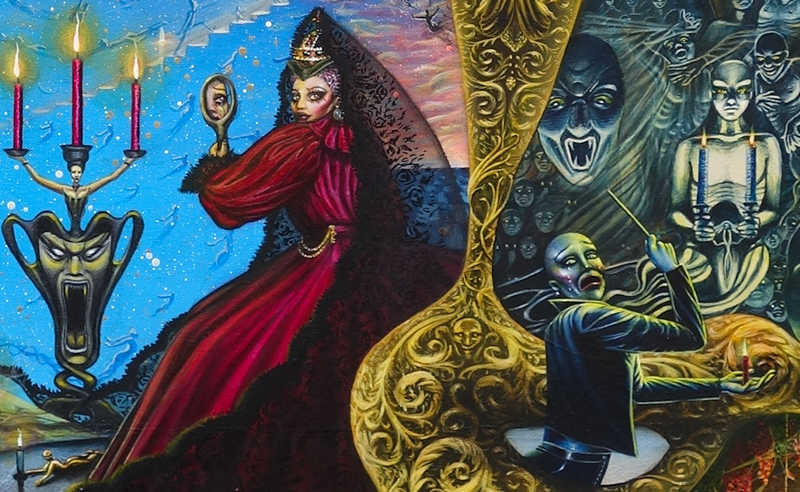
His paintings also unsettle through time: a single canvas can span centuries, old master glazing beside a modern eye, Renaissance dress on figures who might have left a nightclub an hour ago.
History, for him, is raw material rather than a rulebook. "I almost think of it as a primer, or a coat of gesso. It gives me a surface to build on, but it doesn't dictate the final image."
Symbols, objects and figures from different eras share his rooms "even if they never historically could have".
"I'm trying to understand it, extend it, and let it speak to the present," he says. "It's not a fact, but it's still true. It's just not dressed the way you're used to seeing it."
Dress matters to Shalaby as much as paint. Alongside his paintings sits his photography, including "Dante's Dream", a self-portrait project shot on Grand Cayman in which he styled himself as figures in Paradise, Purgatory and Inferno.
“I think 'becoming' is a better word than 'performing.' Through those characters, I found different versions of myself rather than pretending to be someone else.
If I had to choose one, it would probably be Purgatory. It's a space in-between, and that's where most of my work tends to exist."
"Costume is a language," he says. "Every reference, every material, every silhouette carries meaning, whether the viewer recognises it consciously or not."
Some characters return across his work, dressed so differently they are almost unrecognisable, "but they are, in essence, the same presence".
No wall text will ever flag these reappearances. "They're characters that live in my head, and they step onto the canvas when they're ready."
Each work begins as a vision, sketched over and over, "trying different poses, costumes, gestures, and symbols until they feel right." He plans and stages, and somewhere in the process the authority shifts.
"If something doesn't feel right, the painting tells me. A pose changes, a costume evolves and an expression shifts. That's the moment I know the character is alive."
His objects receive the same courtesy as his characters. In Memento Mori, a series of painted miniatures housed in antique frames, the frames arrive with their own histories and their own say in the matter.
"Some pieces come with clearer histories and traces of the past than others, but there are always gaps, and I like that. It leaves you wondering."
The series revives the mourning customs of earlier centuries, the lovers' eyes and memorial tokens once exchanged between the grieving. "I want to celebrate each object, highlight forgotten tokens of affection, and revive those traditions for a contemporary audience."
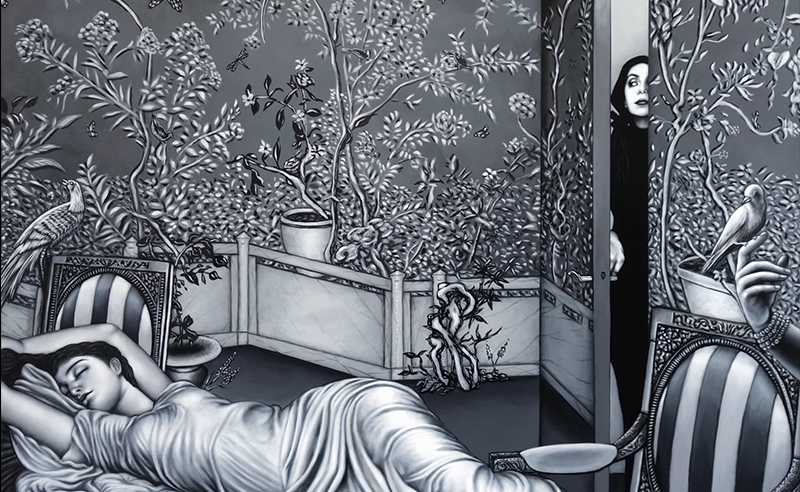
That tenderness deepens into grief in Observatory Mansions, an exhibition built from interiors, decay and the residue of vanished lives.
Shalaby feels a genuine connection to the spirit world, and his ghosts have little in common with the ones in films. "I'm more interested in the emotional side of haunting than the supernatural one.
These aren't horror stories to me, and this isn't Halloween. Most ghosts just want to be remembered, and all they crave is life and moving on. I find that very sad."
"Instead of fear, I want my audience to empathise, to humanise these ghosts," he says. "They want you to remember the lives they lived, not just the way they died.
To me, a ghost is a memory, a manifestation of longing, and I find that much more moving than anything frightening."
Longing also drifts through The Garden of Hypnos, his meditation on sleep, where the dream becomes a landscape with its own weather and its own laws.
"What I love about dreams is that they dissolve logic and all practicality. Dreams don't judge, and they don't explain. They have nothing to say, but everything to show."
None of this amounts to escapism. "I don't think fiction exists to escape reality. I think it exists to reach parts of it that facts alone can't," he says.
"I don't paint events as they happened. I paint how they felt. Fiction gives me permission to translate an experience instead of documenting it."
Shalaby's inner world is ornate, but emptiness does not frighten him. "I love minimalism, and some of my favourite works are by artists whose work I'd never make myself."
His own maximalism traces back to an essay he read years ago, The Death of Detail, which put words to a suspicion he had long carried.
"Historically, even the most everyday objects, like a keyhole, a door handle, a fork, were made to be both functional and beautiful.
I feel like we've lost a lot of that," he says.
“There's a growing sense of sameness globally, in our cities, our trends, our fashion, our interiors, our art."
- Previous Article SceneNoise x Amsterdam Dance Event Present CROSSFADE: Egypt
- Next Article The SceneStyled Touching Grass Edit