




Gaza's Ahmed Muhanna Ran Out of Canvas, So He Painted the Aid Boxes
Ahmed Muhanna lost years of paintings to an Israeli airstrike. He kept working on the only material still arriving in Gaza: food aid boxes. Now his work is touring Europe, and he can't go with it.
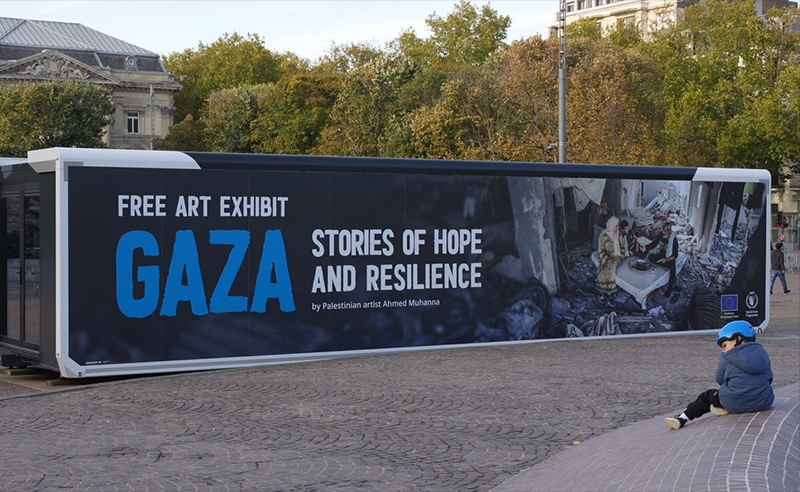
In Piazza San Silvestro, in the middle of Rome, a wall of cardboard hung where a wall of canvas would usually go. The boxes still carried their stencilled lettering: WFP, World Food Programme. On each one, Ahmed Muhanna had painted a face. A woman carrying water. A child asleep against the flattened brown of the box.
The paintings, more than 60 of them, made up Gaza: Stories of Hope and Resilience, a travelling exhibition organised by the UN World Food Programme and the European Union to bring the crisis closer to European audiences. It opened in Brussels in September 2025 and moved through Göteborg, Malmö, Copenhagen, Bremen, Bonn, Maastricht, Leuven and Lille before closing in Rome this past June.
Muhanna was not in Rome. He has never seen the exhibition in person. He is in Gaza, in Deir Al-Balah, where he was born in 1984 and where he still works. "Before the war, I believed that art is a space for contemplation, life, and hope," he says. "I used to draw the Palestinian man in all his emotions and dreams."
He trained formally, earning a Bachelor of Fine Arts from Al-Aqsa University and completing a 2021 residency at Eltiqa for Contemporary Art. He has painted murals across Gaza and shown in group exhibitions since 2002.
Little of that early work was about war, he says. "My goal is not to draw the war, but to draw the man who is trying to live despite all the circumstances."-163e5e79-d5f4-4f9a-9573-ad8e64f59af9.png) That has not changed, even after Israeli forces bombed the Eltiqa gallery where his work was on display, destroying paintings he had made over many years. "The loss of my artwork was very painful, because it was not just paintings, but part of my memory and many years of work and experience," he says. "When you live in Gaza and lose people, places, and memories on a daily basis, the loss of paintings becomes part of a series of greater losses."
That has not changed, even after Israeli forces bombed the Eltiqa gallery where his work was on display, destroying paintings he had made over many years. "The loss of my artwork was very painful, because it was not just paintings, but part of my memory and many years of work and experience," he says. "When you live in Gaza and lose people, places, and memories on a daily basis, the loss of paintings becomes part of a series of greater losses."
The practice survived when the paintings did not. "I learned that the idea cannot be bombed, and that the artist can start over, even if he loses everything."
Paper and canvas were gone, so he used what kept arriving: the cardboard aid boxes. It started as a practical choice and became something more deliberate. "The aid boxes were the only available material," he says. "But over time, I realised that these boxes carry a whole story. They are evidence of hunger and the survival of people, and their dependence on aid."
He does not paint over what the box already says. The aid stamps stay visible, and his figures share the surface with them. "When I draw on it, I do not change its meaning, but I add a human testimony to it."
Watching that work tour Europe while he stayed in Gaza left him with what he calls complicated feelings. "At first, I felt proud because my paintings are able to reach the world. But at the same time, I feel sad because I cannot stand by them."
He talks about the paintings as though they have a freedom he does not. "Sometimes, I feel that my paintings live the freedom that I was deprived of. They travel, meet people, and tell our story, while I am still here in Gaza. I feel that a part of me travels with them."
Between exhibitions, Muhanna teaches children, handing them brushes the way his own teachers once did. "When I give a child a brush, I give him a space to express what he cannot say in words. When I draw, I also give myself this space."
He does not claim art can stop a war. "Art does not stop the war, but it helps us not to lose our humanity in the midst of this war."
He measures the exhibition's success modestly. "If these works can make one person feel what the people of Gaza are experiencing, or push him to think or empathise, then I consider that the message has reached."
- Previous Article SceneNoise x Amsterdam Dance Event Present CROSSFADE: Egypt
- Next Article Nine Rare Migratory Bird Species Recorded at Royal Reserve
Related Articles
Trending This Week
-
-
 Oct 15, 2026
 -
-