





Egyptian Painter Samir Fouad’s World of Fright & Fantasy
Feverish and foreboding, the 82-year-old painter’s expressionist portraits capture a surreal world in flux.
Originally published on March 15th, 2026.
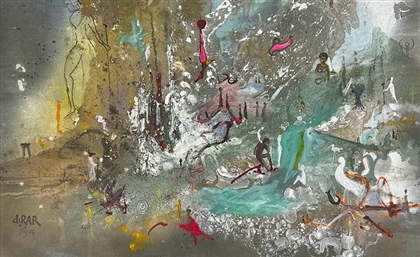
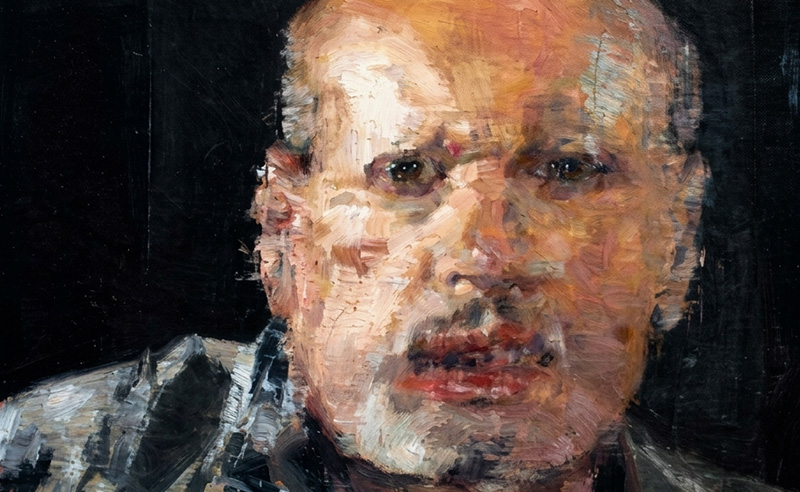
Like a fever dream, there is both absurdity and logic to Samir Fouad’s paintings. One gets from them the sense that they’ve walked in on a scene not meant to be witnessed, only to find that the subjects have been anticipating you, the viewer. What you happen to catch a glimpse of—faceless figures mid-scream, warped expressions of pain and pleasure, symbolic slaughter—are distortions of the last thing you see before the door slams shut again, and Fouad’s surrealist world carries on without you.
Since his childhood in 1940s Heliopolis, Samir Fouad has been a prodigy of watercolour painting. His father, himself an accomplished artist of Islamic ornamentation, objected to Fouad pursuing a career in art. This was the Nasserist era, and Fouad was advised to pursue something more practical. He chose electronic engineering. For three decades, he rose through the ranks of Egypt’s second-ever generation of computer experts while continuing to paint for himself. Fouad’s first exhibitions were in the 1970s and 80s, though it wasn’t until 2001, at the age of 57, that Fouad decided to pursue art full-time. In the 25 years since, shifting from watercolour to oil, Fouad has completed his most important works, been the subject of one book, and wrote two of his own, the most recent being Midan Safir, a memoir of the childhood flat in Heliopolis in which he grew up and which remains his home and studio 82 years later.
In this conversation, Fouad spoke with us about the scary world that gave rise to his most recent exhibition, about his artistic influences like Francis Bacon, Eadweard Muybridge, and the cinema, and about the role Egypt’s Ministry of Culture should play in the art market.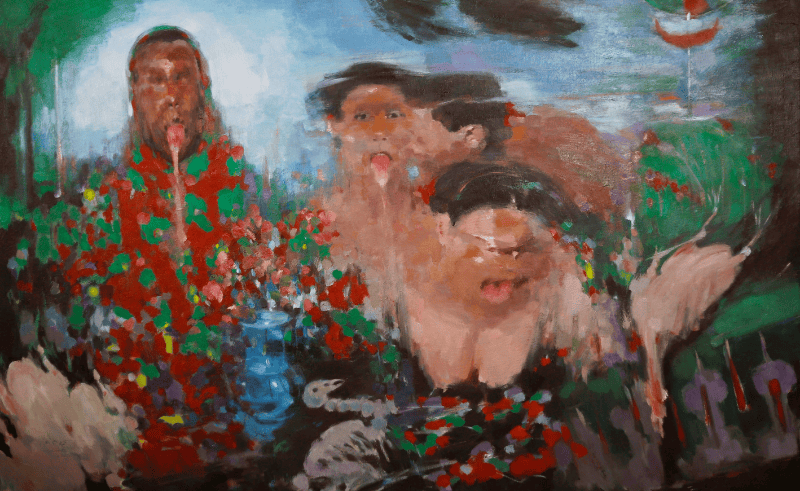 Your latest exhibition at Picasso Art Gallery in Zamalek had an intriguing, if slightly ambiguous, title: Green and Withered. Could you tell us what it means?
Green and Withered is about how locust-like creatures can wipe out the greenery of our life. Not locusts, but locust-like creatures.
When you say locust-like, you mean…?
The locust-like creatures are me and you (laughs). We are destroying the planet. We are cutting trees, we are eradicating all what is producing oxygen, and we’re emitting an enormous amount of carbon dioxide into the air. We are destroying oceans. We are destroying the environment, simply. What could be worse than that?
And what do you think people saw when they looked at your paintings?
What they see is one story, and what I mean for them to see is another. In Green and Withered I mainly used two expressive elements, or however you want to call them. One was people sticking their tongues out, the other was making them scream.
Why these motifs, the tongues and the screaming?
You stick your tongue out when you are teasing or provoking or mocking, and this was what I wanted. I wanted to tease or mock. And a scream is done in protest or agony or pain, or to just try and release your feelings.
Was this the message you were conveying to the audience?
As an artist, you’re always trying to express something which is in your mind, or a state of mind, or an excitement which reflects something you’ve seen or something you’ve felt. This is transformed into a visual expression. It’s very difficult to put visual language into words, just like with music. You listen to music and it puts you in a certain mood, a certain state, a certain feeling. This is the objective of art.
It’s always just yourself. Your convictions, your ideas, your beliefs, your values. All of this is shown in your work. It’s just like when you write. If you write a story, this story is you.
Which parts of yourself do you think particularly come out in these works?
If I had to point to some elements, I would say time. I have always been obsessed with time. It is a mystery which we don’t understand, and yet a prison in which we all live. I’ve been obsessed with time and what it does to us, and I’ve tried to express this in movement. My paintings are not static. It’s not as if I’ve taken a shot of something and frozen it. I try to make things move through rhythm and through change in the subject itself, in order to convey a feeling of a flowing object rather than a static object.
Because I’m obsessed with time, it’s got to appear in my work. Otherwise, you are an artist or a person separate from your work. If that happens, it means you’re just an artisan. You’ve learned how to do something and you’re doing it, just like a person making a wooden chair or a carpet. You’ve learned how to make a pattern. It’s not a creative process; it’s a repetitive process. That’s the difference between the artisan and the artist.
Your paintings have a fantastical quality, like a surreal world-scape of sorts. There’s this distortion in your subjects, the screaming open mouths, the slaughtered chickens. Let me ask it differently: what’s the world-scape you’re creating?
It’s our world, our scary world. I’m scared. The climate is changing. We’ve never had weather like this before, where we hit the 31-degree mark in early February then go back to winter. What’s it going to be like in two or three years? The heat is going to be unbearable. I’m scared for my grandchildren. Today they’re 15 or 20 years old. When they’re 40 or 50, what will the world look like?
But on the subject of distortion: art is a distortion of reality, so you do not mean distortion. The distortion on the surface of the painting is your character and your values. You are not doing it deliberately to say, ‘I’m distorting the objects because I’m a good artist.’ No. I paint first a static object and I don’t like it. It’s too static, it doesn’t please me. So I start to move it bit by bit until I can say, ‘Yes, this is nice.’-06addcb5-abf0-4ab8-ab76-869052dd626d.png) When I first saw your paintings, they reminded me of Francis Bacon’s portraits. These feverish, expressionist portraits with agonized faces, like Bacon’s Screaming Pope. Can you tell me about your influences?
When I first saw your paintings, they reminded me of Francis Bacon’s portraits. These feverish, expressionist portraits with agonized faces, like Bacon’s Screaming Pope. Can you tell me about your influences?
My influences are so, so many, but you’re right that there is an influence from Bacon. Why? Because we’re both influenced by a photographer called Eadweard Muybridge.
Muybridge was active in the 1880s, and he was the first one to photograph the sequence of movements of a horse. He was trying to analyse how their legs move. I bought a book about him when I was very young, maybe 20 or 21, which shows I was fascinated by movement from an early age, and that it’s appeared in my work much later on.
The second thing which joins me and Bacon is that I was very influenced by the cinema. When I was born, there was an open-air cinema next to my house. I could see the films from my window, so since I was 4 or 5 I have been watching movies. This was the 40s. I couldn’t understand what they were saying. I was just seeing characters moving in a sequence of frames. When you are influenced by cinema, you are influenced by movement. And Bacon was influenced by cinema as well, particularly Russian cinema.
In your paintings, there is a similarity across your subjects, not just in the way they’re portrayed but in the subjects themselves. Can you tell me about them?
I come from Heliopolis. That’s where I born, raised and lived all my life. It was a cosmopolitan place in the 40s when I was born, with lots of Armenians, Greeks, Italians, and people from the Levant. But I was fascinating by the workers in our house, who came from the countryside. I felt this was my link to the true Egyptian spirit. I absorbed the Egyptian spirit through my parents, of course, but I mostly absorbed it through the workers who used to work for us. I was a kid and they were young as well.
Then, when I grew up and started to work as a professional, I worked from live models. Most of them were simple Egyptian women who came from the countryside or folkloric areas like El Matareya or El Marg. I’m also someone who likes to talk to others, to the doorkeeper, the greengrocer. You’ve got to be like something full of sensors, and these sensors sense everything going on around you. After that, you produce a piece of art which combines some of these things unconsciously.
And your studio is still in Heliopolis?
It’s the flat I was born in, which was my father’s and which I kept. I moved to Nasr City when my family was growing, but then after my children got married and all that, I moved back to this flat in which I was born, which is now also my studio. I’ve been here for 82 years. I don’t think this has ever happened to an artist. It’s very unique to come to a place where you have 82 years of memory since you came into this world. I wrote a book about it, called Midan Safir, named after the square where the flat is. The book signing was at my last exhibition.
As for my studio itself, I work in two rooms. I work in the western room in winter, because the light is brighter, and then I move to a northern room in the summer because it’s cooler. So I’ve got the luxury of having two studios.
Several gallerists and artists I’ve spoken to recently have complained about conservatism in the tastes of Egypt’s art collectors. Given the nature of your work, what do you think of that?
The collectors are segmented. There is the collector who just wants to copy his friend or wants a piece of décor where the colour and size matches what he needs, and doesn’t care about the art itself. Then there are the collectors who are starting to learn more about art and appreciate it, but they’re only about half the size of the first segment. Then there is the third segment which is very few. They are the old generation who are very selective and whose collections represent the wealth of Egyptian art. There’s maybe 30-40 of them, if we’re lucky. We know them by name.
The main problem is that commercial galleries are dominating the Egyptian art scene—the scene, not the market. The commercial galleries are the ones who exhibit the various artists and promote them, and the ones who get to define who is a good artist. Because they are commercial, a large element of this becomes about who sells. If an artist sells better than another one, it doesn’t matter if he or she is of a lesser artistic value than the one who doesn’t sell. If you’re an Egyptian artist who represents a landmark in our art but your work is heavy and doesn’t sell very well, you won’t get promoted by the commercial galleries.
So who should be promoting them?
It’s the Ministry of Culture. I’ve been saying this for a while. Through their museum, through their annual or periodical exhibitions. The Ministry is trying to do this now, but they haven’t got the funds. In their museum, the displays are poor, the lighting is bad, and there’s no air conditioning. It doesn’t represent the art scene today as it should. They tried to do the best they could, but they have no funds.
The Ministry has receded a lot from the Egyptian art scene, and this is bad. We should not leave the major influencing force to be the commercial galleries.
You began pursuing art full-time in your 50s because you said you wanted to leave your mark on the Egyptian art scene. To borrow a business term, do you think that your work has bridged, or fulfilled, a certain gap?
No, no, I wanted to fulfil myself, and I’m still making art because I haven’t yet finished my statement. How it’s going to fit into Egyptian art history is not for me to say. My work is part of numerous collections in Egypt and abroad, and collectors wait for my new exhibitions to see what my next thing will be. It’s not because I’m getting old that they’re collecting my work, or because I’m a good investment, but because I’m still producing something new.
And what is the new thing you’re producing now? Can you give us a peek?
I don’t know what it’ll be like. Is it going to be morbid? Maybe. Maybe I’ll do the opposite. Maybe I’ll be optimistic in a dark world, as a resistance. Trying to resist the dark by doing something bright. Or maybe I’ll do something very dark. At the moment, what I’m producing now, as in today and yesterday, is very dark. It’s dominated by black.
But you never really mean it. You don’t say, ‘Okay, I’m going to work in this style now.’ It’s when you do five, six, seven paintings and you put them in front of yourself, that you see them and say, ‘This is how I feel? Bloody hell.’