



The Women Building Saudi's Surf Scene From Scratch
Saudi Arabia’s first women surfers learned across Morocco, Australia and the UK, then returned home to build a surf culture the Red Sea never had.
For the 2025 ISA World Surfing Games in El Salvador, at the opening ceremony, each team member presents an athlete with a vial of sand from the shoreline of their home country. It is one of the oldest traditions of surfing. The sand from all the countries participating in the tournament is combined in one container – every ocean and every beach represented are merged into one. Australia represents the sand from Bells Beach, Brazil represents the beaches of Santa Catarina and France, the Atlantic shores of Biarritz.
Rmas Alhazmi went out with sand from the Red Sea.
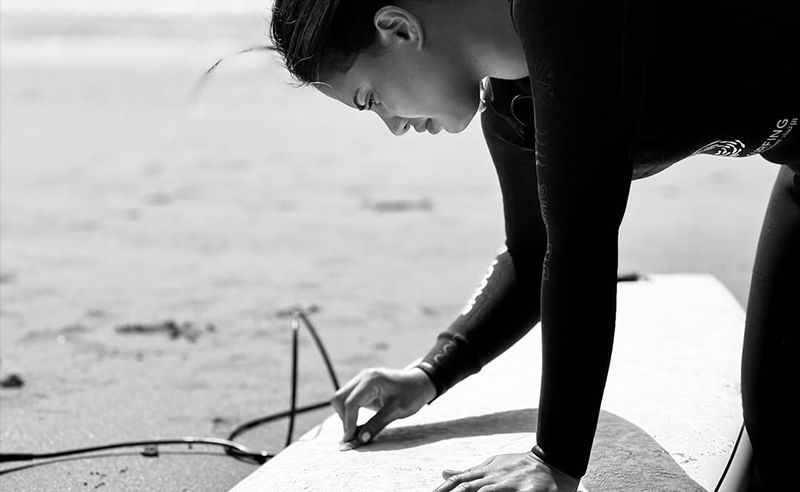 The Red Sea, the same Saudi shoreline that is unable to produce the long period groundswell necessary to create the waves breaking on the fast right-handing reef break at El Sunzal. It’s a spectacular body of water surrounded by land to the north and narrowing down to the south by the Bab al-Mandab Strait, one of the most stunning ecosystems on Earth, and the birthplace of the Saudi fishermen, pearl divers and scuba diving fans, but it hasn’t been thought of as a surfing destination, until now.
The Saudi Surfing Federation was founded in November 2021, joined the International Surfing Association the following year, and has since sent athletes to the Asian Championships, the ISA World Games and the ISA World Surfing Games. The federation is led by a woman, Nouf Al Nasser, and the athletes it has produced include, among others, three women who have become the founding generation of a women's surf scene in the Kingdom. Leila Zahid, Lamar Mufti and Rmas Alhazmi, each arrived at the water from a different groundswell, and each are carrying something different when paddling out.
What they are building together, from almost nothing, on a sea that barely produces rideable waves, does not resolve into a single story.
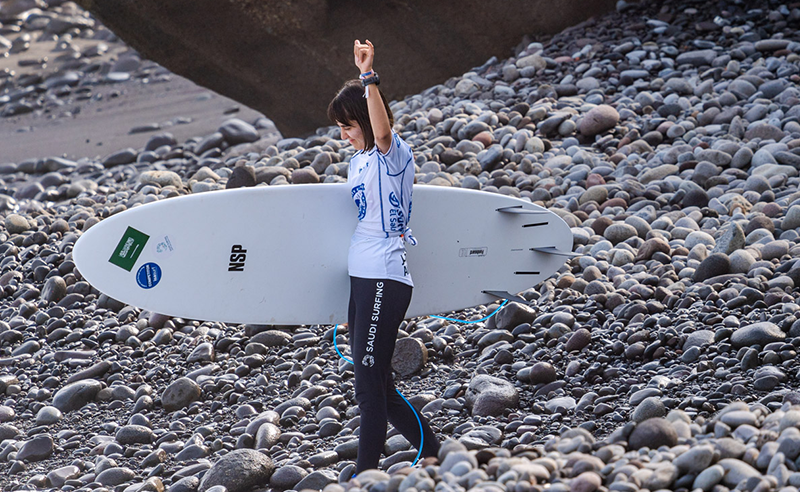 Leila Zahid learned to surf outside Saudi Arabia, in Morocco and when she came back, the experience was unlike anything she had encountered on the water. "Surfing abroad felt like stepping into something already fully formed and crystallised," she said. "There was a culture, a routine, a sense of belonging that existed long before me. Coming back to Saudi was the complete opposite. Suddenly, there was no blueprint and I wasn’t just simply participating but actively helping build it. I became more aware of my role in shaping what surfing could look like here."
Saudi surfers are learning a sport without the inherited scaffolding that shaped surfing elsewhere with no generations of local surfers passing knowledge down and no mythology attached to specific breaks. Much of the culture has had to be assembled manually, through travel, observation and return. People learned in Morocco, Bali, Portugal, Australia, then came back carrying pieces of those places with them along with its techniques, etiquette, habits, even the language used to describe the sea. “There's no clear path, no established system. That means you have to be very self-driven and creative in how you train and progress. But beyond the physical challenges, the hardest part is internal, learning to trust the process, even when it feels uncertain or unconventional."
Zahid’s relationship to the ocean is difficult to separate from the perspective it creates. “It gives me a kind of awareness that’s hard to find anywhere else,” she said. “Surfing forces you to be completely present. You can’t overthink or control everything, especially in an environment as unpredictable as the ocean. You're reminded that you're part of something much bigger, and that's both humbling and grounding.”
In Saudi Arabia, the surf scene is still small enough that the same faces recur constantly — in the water, at competitions and across Instagram stories. “There's an intimacy that comes from everyone knowing each other and growing together,” Zahid said. “But that closeness can feel exposing. There's a sense of public perception that can start to influence your personal progress.” The attention, Zahid explains, comes as fascination about a sport that still feels unfamiliar within Saudi Arabia. “People are naturally curious, especially when it's something they don't see often or fully understand,” Zahid said. “If anything, everyone has been incredibly supportive and genuinely in awe of what we're doing.”
Long before surfing became part of Zahid’s life, the Red Sea already was. She encountered it first not as a surfer, but as a diver. “The Red Sea was never my introduction to surfing,” she said, “but it was my entry point into the ocean itself. That’s really where my relationship with the water began,” she said. Surfing arrived afterwards as a continuation of what was underway. Zahid carries that foundational sense of the ocean's scale into every session in every country she travels to for training. She also carries with it a protectiveness toward the coastline that formed her. "I've always had a deep respect for nature, and that connection only grew stronger through those early experiences," she said. "It can be frustrating at times to see people neglect or take that environment for granted."
In Saudi Arabia, none of that pre-exists these women. They are constructing it from the beginning, with almost no waves to practise on, in a country where the very Arabic word for the sport goes unused because nobody has needed it until now.
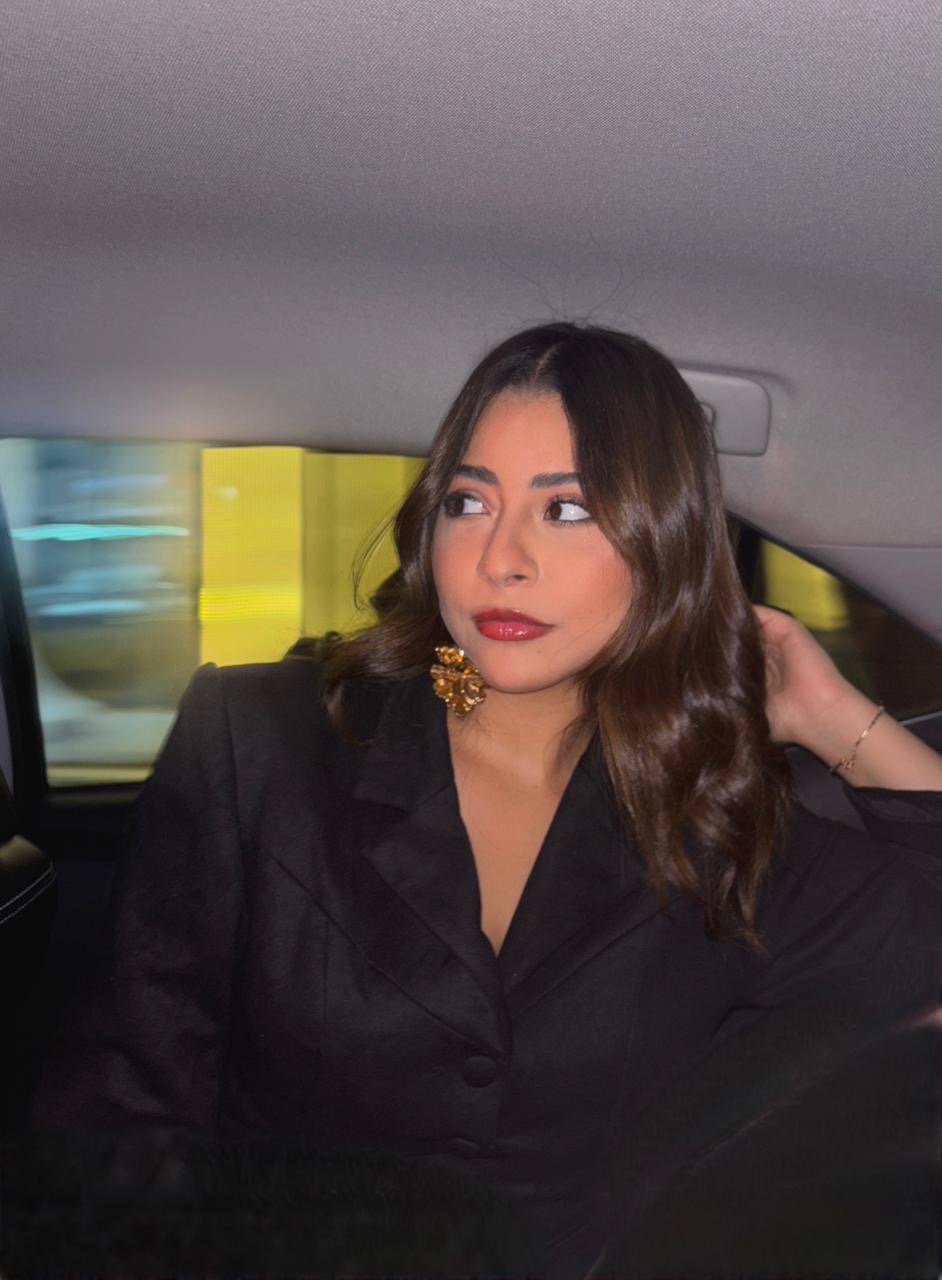
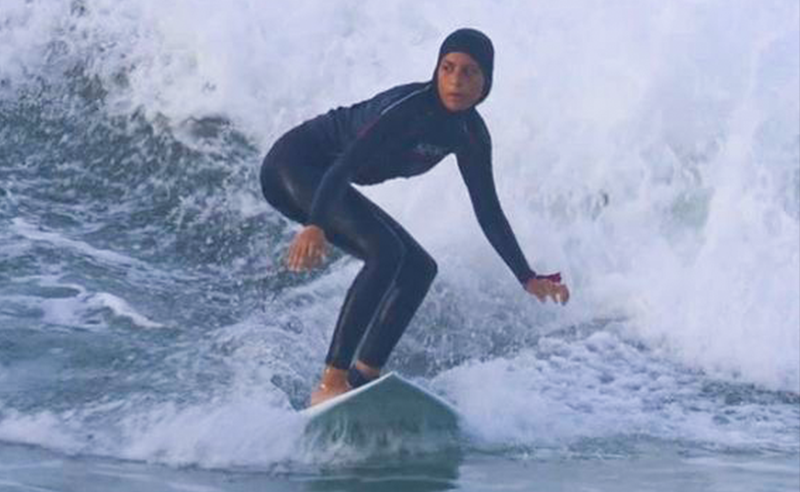
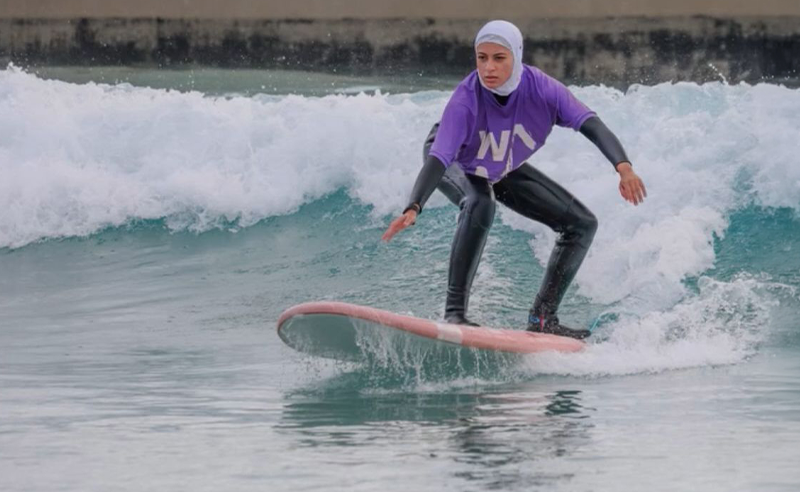 Lamar Mufti began surfing in the United Kingdom, inside artificial wave pools far removed from the geography usually associated with the sport in Saudi Arabia. Before she ever entered the water, she spent months online looking for proof that someone like her already existed within surfing; a Saudi woman, a hijabi surfer, anyone who can make the idea feel less hypothetical. She had only recently started wearing the hijab herself and wanted to know whether the two identities could coexist. “I kept searching for someone who looked like me,” she said. “At the time, I couldn’t find a single hijabi surfer.” What she did eventually find were only two Saudi women surfing publicly online: Rmas Alhazmi and Salma Linjawi from the Saudi junior team. “That was it,” she said. “It felt like such a small community.”
Mufti learned largely on her own, in British wave pools where she pieced the sport together through YouTube videos, observation and conversations with surfers around her. “As soon as local surfers saw me, they’d come over and start asking questions,” she said. Before long, her nationality became her shorthand inside the pool. “Every time I walked in, people would just call me ‘Saudi Arabia’,” she said. “That became my name there.” Mufti’s first international competition was the Asian Championships in India, where she arrived as the only Arab woman in the entire field, and where journalists stopped her repeatedly to ask how Saudi Arabia supports a woman athlete, and what had brought her, as a woman, to travel for the championships. "Then I realised that oh, yes, this is rare, what I'm doing," she said. "Didn't realise that before." At the ISA World Surfing Games in El Salvador, the questions from television presenters and journalists were nearly identical across different microphones, all of them curious about the hijab and how she was able to surf with so many pieces on.
The practical answer to that question reveals a problem that nobody in the surf industry has really fully addressed yet. "Finding appropriate hijab surfing fits doesn't exist in today's world," she said, "as no hijabis surfed before. All surfing brands like Roxy and Rip Curl don't have hijab-friendly swimwear. So, I basically have to create my own." Clothing becomes part of the calculation in the water; loose tops, which offer the level of coverage she feels comfortable in, pull heavily once soaked and can throw her off balance mid-wave. “If my top is too loose, I slip off the board trying to catch a wave,” Mufti said. She experiments constantly with tennis skirts or shorts layered over leggings, slightly oversized tops adjusted for movement without feeling overly revealing.
"When I first started surfing, I thought that I was only surfing for myself," she said. "However, when I first joined the Saudi surfing team and started competing internationally, this is when I started to realise that I'm carrying something bigger every time. I come to realise after each trip that I'm not only representing Saudi females or Saudi in general but I'm representing an entire identity and religion.”
The effect of Mufti’s visibility is already measurable in her message inbox. "I've been getting messages on my socials from girls saying their parents are now allowing them to do water activities in their hijab after seeing me surf," she said. Even as institutional support for women’s sport expands in Saudi Arabia, the harder challenge is believing you are allowed to enter a space that once felt inaccessible. For Mufti, that process has never required separating sport from faith or cultural identity. “I really hope they still hold on to culture and religion,” she said. “They should believe that sports should never compromise religion, because this is what makes you unique and different from all other countries competing. Don’t let the outside world and communities change your perspective.”
On training, Mufti goes to the gym every day, works with an online fitness coach, and surfs in the UK whenever she can get access to water. Back in Saudi Arabia, the options are more constrained. "Both wavepools are not in Jeddah," she said. "The Saudi Surfing Federation is really helping this sport grow in the Kingdom, but overall as an athlete I've had to be more self-driven with my training."
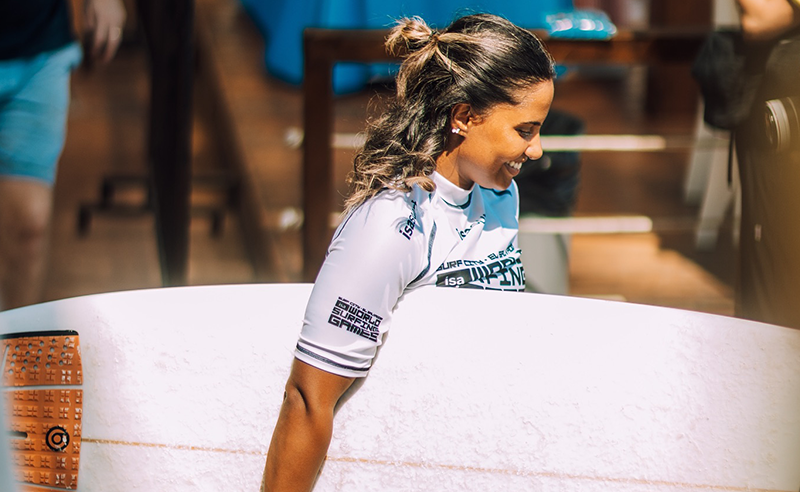 Rmas Alhazmi grew up in Australia, where women in the lineup were ordinary enough to become formative. “I used to watch female surfers all the time,” she said. “They were the ones who opened the door for me. They made it feel possible.” That way of looking - attentive to movement, atmosphere and small shifts in light was foundational to her journey. Alhazmi now works as a filmmaker. “I think in frames even when I’m not holding a camera,” she said. “I’m always noticing things, the contrast between the sea and the landscape, the stillness before a wave breaks.”
The surf environment, she has found, creates openness in the people within it. "There's something about being in that environment where people are stripped away from their usual distractions," she said. "It becomes one of the best places to observe human behaviour and form ideas. You hear stories, conversations, little moments of honesty, and then the wave comes and interrupts everything, like a natural cinematic pause in the middle of it all."
When Rmas returned from Australia to Saudi Arabia and joined the national team, she ran into the problem that defines early-stage surf culture in a country without consistent waves, it was how to maintain the sport between international trips, and how to keep the body from forgetting. "Every time we came back from a surf camp or competition, it was difficult to maintain that momentum," she said. "The muscle memory would fade without consistent access to the ocean." Alhazmi began replicating surf-specific training exercises at a public gym in Jeddah, which drew puzzled attention from other gym-goers. “A few even came up to ask if I surfed, which says a lot," she said, "about how unfamiliar the sport was locally at the time."
The opening of wave pools in Saudi Arabia over the past two years has changed the sport. “Before, every time I wanted to improve, I had to travel,” Alhazmi said. “Now I can actually surf regularly and keep building on my skills.” she said. “Padel started small too, now there are competitions, coaches, communities around it. Surfing feels like it’s moving in that direction.”
“I know there are more experienced surfers in the lineup, but internally I keep grounding myself: it's okay, you showed up, and you're trying to make everyone back home proud," she says of her experience in competition heats. "That mindset becomes really important, especially under pressure."
On the broader question of whether surfing belongs in the Kingdom, Almazmi locates the sport within a relationship with the sea that predates all of this. "We have a deep connection to the sea across both the eastern and western coasts," she said. "It has always been part of how people live and engage with their environment. Surfing is simply becoming a new way of expressing that relationship, and it's slowly finding its place within it."
- Previous Article SceneNoise x Amsterdam Dance Event Present CROSSFADE: Egypt
- Next Article Tawakkalna Adds 40 Services From 24 Saudi Government Entities