




Omar Mahgoub is Balancing the Premier League, the NHS & Academia
Omar Mahgoub is the first Egyptian physiotherapist in the Premier League, working at academy level with Arsenal while continuing his work in the NHS and academia.

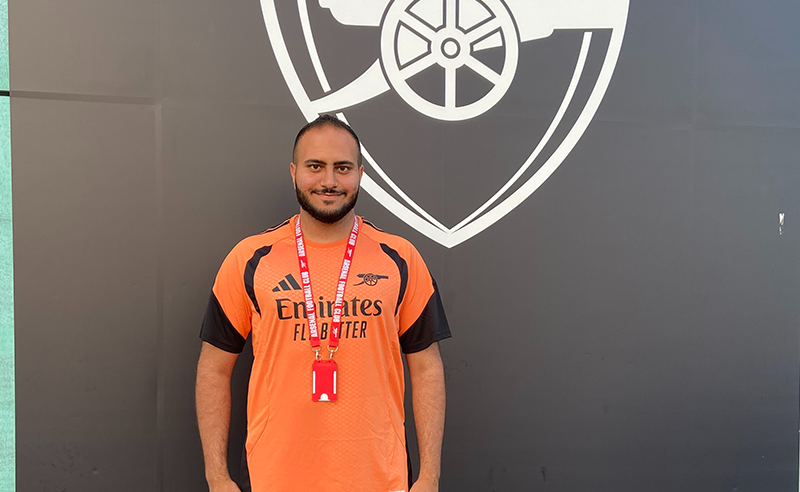
For Omar Mahgoub, working in the Premier League is only one part of the job.
The Egyptian physiotherapist recently joined Arsenal as an academy physiotherapist after two seasons at Brentford. Alongside his work with the club’s academy, he continues to work in the NHS and teaches as a guest lecturer at the University of East London.
Three roles, three different environments, but one career that has always revolved around people, performance and learning.
His interest in physiotherapy began while he was still an athlete, when an experience of his own made him look at the profession differently. “I was playing karate and got injured, and I had a physiotherapist who really helped me through that process," Mahgoub tells SceneSports. "I remember thinking, ‘This is what I want to do.’”
Having grown up in Cairo and spent time in Dubai and Qatar, Mahgoub had always wanted to stay close to sports, and he knew he wanted to take physiotherapy into the field. After studying in the UK and starting his career across different areas of the NHS, he looked for opportunities in sports. His early experience took him beyond football, including work in rugby and with the English National Ballet.
Football eventually became the path that took him into the Premier League. Mahgoub spent two seasons at Brentford, working within the academy and getting his first experience of the demands of elite English football. “That was really when I started to understand what Premier League football actually looks like from the inside," he recalls. "You realise very quickly that everything should be at the highest standard.”
Now at Arsenal, Mahgoub continues to work within the academy level, focusing on rehabilitation, injury prevention and preparing young players for the demands of senior football. “Especially in the academy, you’re not just trying to get a player fit. You’re trying to prepare them for the next level.”
That approach shapes how Mahgoub views physiotherapy itself. “Most people think a physiotherapist’s job is mainly about what happens after an injury," Mahgoub says. "For me, I’m much more interested in what happens before it.” That means working across movement analysis, sports testing, rehabilitation and performance to understand what each player needs as they develop.
For Mahgoub, football is only one part of a wider professional life. He continues to work in the NHS, where he treats patients outside elite sport, while his role as a guest lecturer at the University of East London gives him another way to share what he has learned.
“They all feed into each other. What I learn in one environment makes me better in another," he says, “For me, it doesn’t matter whether I’m treating someone through the NHS or working with an aspiring athlete in an academy. Everyone deserves the same level of care, the same attention to detail and the same commitment. The person in front of me is always the priority.”
His position at the highest level of English football also carries another distinction. Mahgoub believes he is the first Egyptian physiotherapist to work in the Premier League, leaving him without an established path to follow. His nationality has also become a point of connection within the Premier League environment.
“When people here find out I’m Egyptian, they get excited. There’s already such a strong connection between Egypt and the Premier League because of the players who have represented us. People immediately want to talk to you about Egypt.”
For Mahgoub, that connection comes with a sense of responsibility.
“I’m not just doing this for myself. I’m very motivated by the idea of representing Egypt well and showing that we can be here in different roles, not just on the pitch.”
Mahgoub also hopes to one day bring the knowledge and experience he is gaining in England back to Egypt, particularly through the preventative side of physiotherapy that has become central to his work. For now, he continues to build his experience across the NHS, academia and one of football’s most competitive environments.
- Previous Article 7 MENA Startups Transforming Customer Support with AI
- Next Article National Intellectual Property Policy Approved in Saudi Arabia