





'The Good Paper' is Turning Waste Paper Into Handmade Stationary
What looks like paper starts as scraps, pulp and water. At The Good Paper, Sherifa El Awa turns waste into textured sheets where no two pieces match.

Sherifa El Awa keeps a mould and deckle in her workspace; two wooden frames, one fitted with mesh, that together do the oldest job in papermaking. You dip them into a vat of pulp, lift slowly, let the water drain through the screen, and then what settles on top becomes a sheet of paper. The pulp El Awa uses is made from waste: old prints, packaging, scraps and offcuts from previous jobs. Everything was torn up, soaked, blended back down to fibre and started over. "Everything is done by hand," El Awa says, "so no two sheets ever look exactly the same."
El Awa is the designer and maker behind The Good Paper, a Cairo-based studio producing handcrafted recycled paper for invitations, menus, place cards, tags and packaging inserts. She graduated from AUC's design program in 2020, but the project started earlier than that when a family member wanted to print invitations on recycled paper but couldn't find a single supplier in Cairo who offered it.
She began researching, then experimenting, then making her own recycled sheets. The idea persisted through university, where it crystallised into shape when a student club needed flyers. "I suggested printing them on recycled paper instead," El Awa explains. "This is when I realised this could be more than just an experiment. It could actually become something real." The Good Paper grew from there through commissions and curiosity, doing the same physical process repeatedly until she got the hang of it.
The creation process goes like this: waste paper from various sources is torn by hand into small pieces and soaked until it softens, then blended into pulp. "I adjust the pulp depending on the texture or thickness I want," El Awa says. "Sometimes I add natural elements like flowers, seeds, or biodegradable glitter." The pulp is poured into a vat of water, then lifted using the mould and deckle to form a thin, even layer across the mesh. That layer is pressed to push out the remaining water, left to dry completely, then peeled and sometimes pressed again.
The ragged edges that people notice first on her work, soft, uneven, fibrous, are a byproduct of this process, not a finishing touch applied afterwards. "They're called deckled edges," El Awa tells CairoScene. "They naturally form during the process. When the pulp is lifted with the mould and deckle, the fibres settle and dry in that organic shape and that's where the term comes from."
The word traces back to the German 'deckel', meaning lid or frame. The removable piece is placed over the mesh to define the sheet’s boundaries, while the edges form naturally wherever the pulp settles. When papermaking mechanised in the 19th century, the deckled edge was one of the first things to go, trimmed away to look uniform. Its return, in fine stationery and art paper and handmade work like Sherifa's, reflects a preference for objects that show how they were made. "It's less about designing that 'imperfect' look," El Awa says, "and more about letting the material behave naturally."
In practice, the technical side is the easier part. The paper is fibrous enough to jam in standard printers, so Sherifa uses a machine that can handle it. Ink absorption is higher than on conventional stock, which means settings need to be tested carefully before any final job. "We always have to adjust settings and test carefully before final printing to make sure the result comes out right," El Awa says. What she understands as the harder problem is the gap between what clients expect and what the material actually does. "A lot of clients are used to very clean, digital, mass-produced results," El Awa adds, "so helping them understand the nature of the material and what it can and cannot do is the biggest challenge."
Handmade recycled paper doesn't just receive a design the way coated stock does. The texture affects how the ink sits, how colours read, and how the overall piece feels in the hand. "What looks clean on-screen changes once it's printed on handmade recycled paper," El Awa explains. "The texture and fibres always add something new, so the final result feels a bit different. I see it more as the design adapting to the paper and that's part of what makes it special."
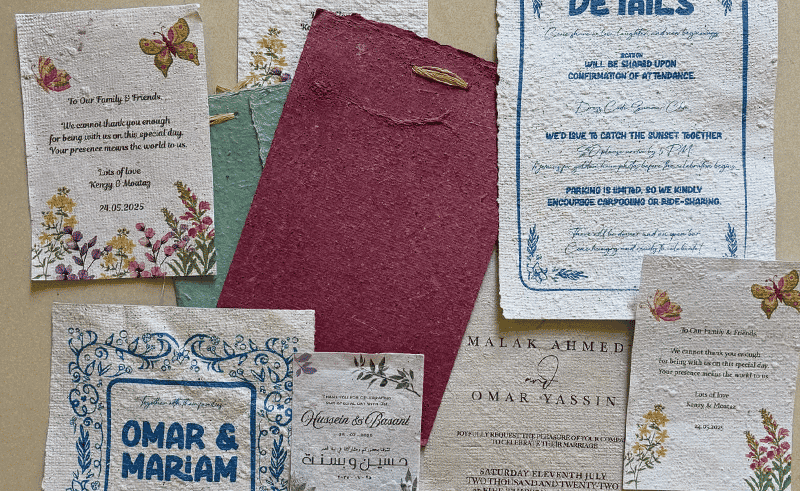
TGP’s clients tend to be small brands, wedding planners, brides, students on experimental projects, and designers looking for something that sits outside the standard print shop menu. Some of the most memorable commissions have been personal ones. "I have a recurring client who prints cards for his wife every year on her birthday using The Good Paper," El Awa says. "It's become a yearly tradition, which is really special to be part of."-4923767a-e043-4f6b-baca-e2501a825436.png) El Awa made table cards for a close friend's engagement party last November. "It felt very personal being part of such an important moment in their lives," she shares. She also worked on the printed pieces for a seated dinner organised by a well-known chef. "It was a beautiful setting and very thoughtfully curated."
El Awa made table cards for a close friend's engagement party last November. "It felt very personal being part of such an important moment in their lives," she shares. She also worked on the printed pieces for a seated dinner organised by a well-known chef. "It was a beautiful setting and very thoughtfully curated."
Earlier this year, The Good Paper ran a papermaking workshop at the Cairo Art Book Fair, more than five hours of continuous sessions, visitors making and decorating their own sheets from scratch. "We were exhausted by the end," El Awa recalls, "but it was completely worth it. We had so much fun, and it was really rewarding to see people experience the process firsthand."
The next thing she is working toward is packaging. "It moves beyond flat printed pieces into something more functional and structural," El Awa says. "I'm still in the early stages, but I like the idea of seeing how the material behaves in a more practical, everyday context."
- Previous Article SceneNoise x Amsterdam Dance Event Present CROSSFADE: Egypt
- Next Article The Abandoned Architecture of Villa Badran by Gamal Bakry