






'I Am Not a Number' Visualises Gaza's Genocide Beyond the Death Toll
‘I Am Not a Number,’ an interactive project by Badr AlKhamissi, visualises identified genocidal killings in Gaza drawn from publicly available records of names and, where possible, ages.

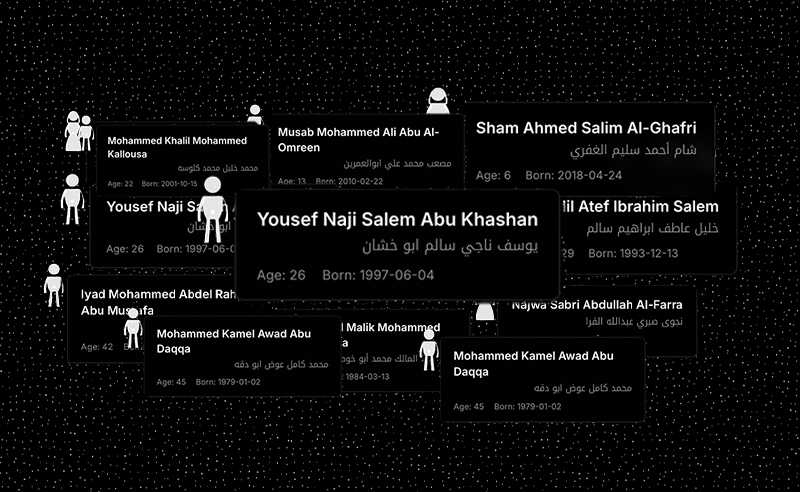
Large-scale genocidal killing is inherently difficult to comprehend. Cognitive psychology has long indicated that as numbers increase, emotional response tends to diminish, a phenomenon widely referred to as psychic numbing. A single death is more readily grasped than mass loss, which is typically conveyed as a single aggregated figure.
This forms the premise of I Am Not a Number, an interactive project by Badr AlKhamissi, an Egyptian researcher working in artificial intelligence and cognitive science. "A feeling of helplessness has gripped me since the genocide in Gaza began," AlKhamissi says of the project. "The world does not want us to speak, while we watch with our own eyes the killing of humanity on that land. The project is an act of resistance, means to remember each person whose life was taken.”
The project takes the form of a digital visualisation of identified victims in Gaza. Each individual is represented by a single point, arranged within a dense and uniform field. The data is sourced from publicly available records of named victims, including basic identifiers such as names and, where available, ages. At the time of the project's creation, AlKhamissi documented 60,199 names. As of April 2026, the Gaza Health Ministry has confirmed at least 75,498 Palestinians killed - a figure that independent researchers and public health analysts consistently describe as a significant undercount.
At first glance, the interface appears as a field of indistinguishable dots. Its density reflects the scale of recorded deaths, while also mirroring the way large numbers are often perceived as abstraction, with the individual not immediately discernible.
Interaction alters this perception. As users navigate the visualisation, individual entries are revealed sequentially, allowing names to be encountered separately rather than as part of a total. The experience shifts from the aggregate to the granular, from a single figure to a succession of identifiable individuals. "I ask you to pass by them. You will see a name, an age, a life. We must remember that they are not numbers," AlKhamissi says.
- Previous Article HOF Capital Acquires Porsche’s Stakes in Rimac Group
- Next Article AI Farming System in Abu Dhabi Cuts Energy Use by 60%