





How the Set Design of ‘El Nos’ Recreates a Lost Century of Cairo
“In historical productions, the décor and costumes are as much stars of the work as the actors themselves. If they are not executed with precision and authenticity, the entire illusion collapses.”

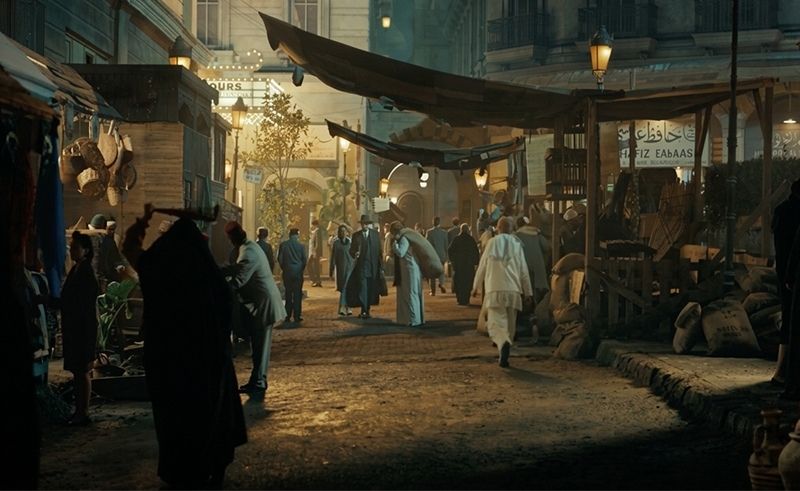
‘El Nos’ is a historical Egyptian drama set during the late monarchy era, following a resourceful anti-hero navigating Cairo’s shifting social and political landscape in the early twentieth century. Blending espionage, crime, and period storytelling, the series builds its narrative through the changing face of the city itself — from crowded alleyways to the more polished neighbourhoods emerging in a rapidly modernising Cairo.
After the first season aired last Ramadan to strong viewership, ‘El Nos’ returned in Ramadan 2026 with a second instalment. To understand how its world is constructed on screen, we spoke with production designer Ahmed Abbas, who worked on both seasons and oversaw the design of the series’ elaborate historical environments.
“In historical drama, décor can communicate 80% of the era alongside costumes, the story and the script,” Abbas explains. “A desk, a telephone or a correctly placed flag can sometimes say more than dialogue.”
For Abbas, establishing the timeframe is always the first step. Although the production team did not define exact dates, the first season unfolds in the 1920s, while the second takes place roughly a decade later. The visual shift reflects Egypt’s transformation during that period, as the country moved through political change and urban development.
Once the era is established, Abbas turns to the script. Understanding the characters and where they live helps determine the architecture and visual language of each set. “I ask questions like: who are these people? Are they living in older districts like Gamaleya or Al-Muizz Street? Or are they in newer, more affluent areas like Garden City, Zamalek, or Downtown?”
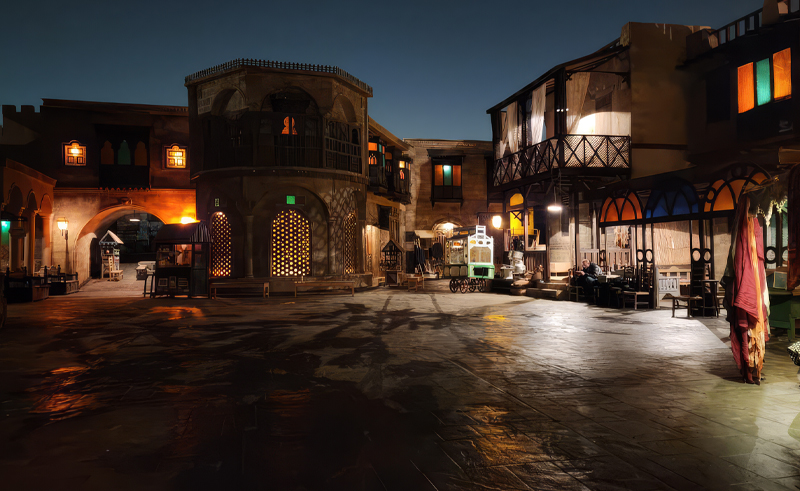
From there, research and construction begin. Across both seasons, the team created around 175 sets, nearly 100 of them interiors built specifically for season two.
The scale alone presents a challenge, but Abbas says historical accuracy is the real test. “If the production design is not executed with precision and authenticity, the entire illusion collapses.”
To build that authenticity, Abbas and his team relied heavily on archival photography and historical footage from the 1920s through the 1940s. He believes visual references offer far more insight than written descriptions. “Since working on the series ‘El Fetewa’, I have depended on genuine Egyptian archival sources. During the monarchy, foreign photographers documented Egypt extensively. These images and films are extremely valuable.”
Early Egyptian cinema also served as an important reference point, particularly films featuring Naguib El-Rihani and Umm Kulthum, as well as cinematic adaptations of Naguib Mahfouz’s novels.
Once designs were finalised, construction moved quickly. While renovating a real home might take two months, Abbas explains that most sets are built within seven to 20 days. Larger builds can take longer — the recreation of Emad El-Din Street, for instance, required up to six weeks. “It demands quick solutions, imagination and constant problem-solving,” he says.
Much of the series was filmed inside Media Production City, where the team recreated Emad El-Din Street complete with theatres, cafés, tailors and grocery shops — professions that were relatively new to Egyptian society at the time. For season two, additional alleyways were constructed in the Islamic district zone of Media Production City to give the production full control over scenes set in older neighbourhoods.
“The majority of the more refined exteriors are filmed on our Emad El-Din Street set,” Abbas says. “Scenes set in poorer districts are shot in the Islamic Zone.”
The team also searched for real locations that still preserve historical architectural character. Qasr Taz was used for certain alleyway scenes, while El Qanater El Khayreya stood in for neighbourhoods such as Old Maadi, Garden City and Zamalek. Filming in central Cairo itself proved difficult. “Downtown has changed too much,” Abbas explains.
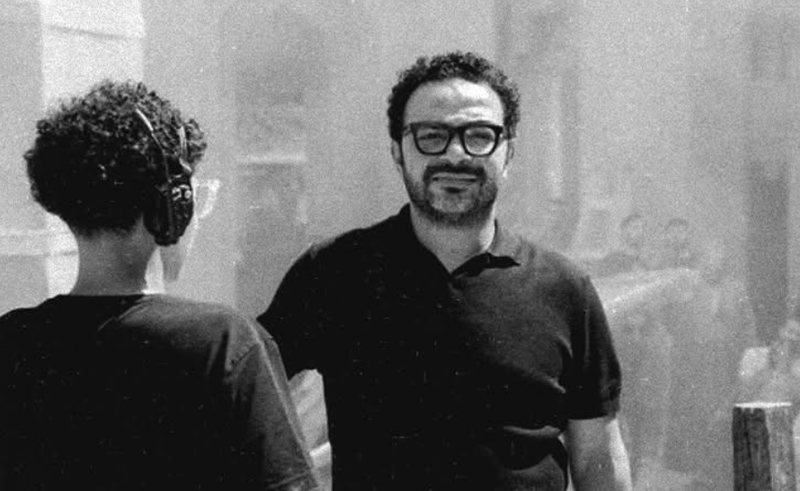
Despite these locations, about 90% of the series is filmed on constructed sets. Season two in particular relies heavily on interiors built entirely from scratch.
One of the most ambitious pieces is the tram, originally built for the first season and reused for the second. The production team created a fully functioning tram that moves along motorised tracks, connecting neighbourhoods like Gamaleya and Emad El-Din Street within the story. Built lighter than a real tram, it allowed the production to capture dynamic movement on screen without the logistical challenges of transporting an actual vehicle.
Historical dramas also require recreating professions, tools and objects that no longer exist. One of the most complex builds this season was a futuristic laboratory featured in the series. Abbas researched industrial materials and technologies emerging in the early twentieth century — including early radio systems, telephones, steam mechanisms and speculative ideas about television. Many of the props had to be fabricated from scratch, including sensor-style light bulbs and a time-capsule-like machine.
Another demanding project was the radio station. Designing a 1930s sound studio meant researching early broadcasting technology introduced to Egypt by companies such as Marconi, as well as studying archival studio layouts.
Abbas estimates that designing the architectural space itself accounts for around 50% to 60% of the work. The rest involves sourcing or recreating the equipment that fills those spaces. “Sometimes we find only 30% of what we need and have to recreate the remaining 70%.”
For the radio station set, the team visited the Egyptian Radio and Television building in Maspero to study equipment and materials. Vintage audio devices were rented from Studio Misr, Studio El-Nahhas and Al-Ahram Studio.
The production design department operates as a tightly coordinated system involving set designers, costume designers and props specialists. “The coordination between these teams is everything,” Abbas says.
Across departments, the colour green — associated with Egypt’s monarchy-era flag — became a visual anchor. It appears throughout the series in wallpapers, furniture, props and costumes to create a consistent tonal atmosphere.
In the second season, the protagonist becomes an undercover editor-in-chief of a newspaper, moving him into wealthier social circles. As a result, Abbas leaned toward Art Deco influences in the architecture surrounding these characters. Art Deco entered Cairo during the 1930s and 1940s as the city developed a more cosmopolitan identity, particularly in areas such as Downtown, Garden City and Zamalek.
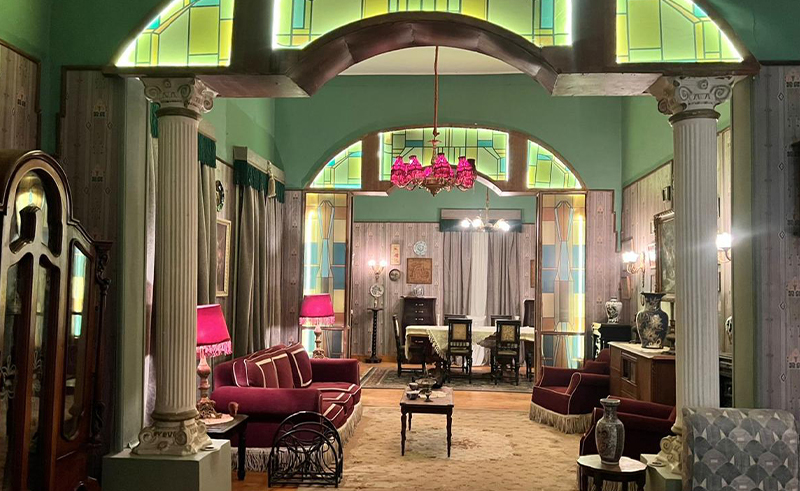
Season two also takes the story beyond Egypt. When the character travels to London, the production recreated an early twentieth-century London district inside Media Production City. Interiors such as hotels, residences, jewellery shops and cafés were built to evoke post-war London, with red-brick façades and visible structural damage reflecting the city’s wartime condition.
When filming ends, the elaborate sets are dismantled piece by piece. Streets vanish, rooms disappear, and the tram stops running. For Abbas, however, each one leaves an impression.
“In truth, every set is dear to me,” he says. “I don’t have a single favourite — they all mean something.” And in historical drama, that may be the charm: long after the sets are gone, the world they created continues to live on screen.
Related Articles

Trending This Week
-
-
 Oct 15, 2026
 -
-