





Zamkana is the Saudi Cultural House Merging Time and Place
Zamkana is a cultural house in Saudi Arabia focused on exploring how time and place shape memory, identity, and heritage through site-based research and public programming.
When culture is not given adequate time, it loses its definition; places become mere settings; memories become just a vehicle for shallow aesthetics and the richness of a location is diminished as if viewed through the filter of a screen. Zamkana is a cultural house in Saudi Arabia that examines the interrelationship of time, place, and memory as expressed in research-driven exhibitions, archival work, and contemporary cultural production.
“Place is not an inert concept,” Dr. Abdullah Alkadi, founder of Zamkana, explains to SceneNowSaudi. “The nature of the place has a strong and unique influence on the creation of memories, how we identify ourselves, and how we pass on the memories of our ancestors.”
Zamkana originated due to the need to expand on contemporary stories that emerge from a person's actual day-to-day experience of a physical location. The initiative places an emphasis on listening to and responding to the stories of the people in a specific location and over a period of time. This idea demonstrates the ethos of Zamkana, as its name is a combination of the words zaman (time) and makan (place) with the notion being the place where time and place converge; thus, culture originates when both time and place exist simultaneously, and diminishes when either element is rushed.
This philosophy is reflected in Zamkana’s foundational research projects, which form the backbone of its long-term cultural inquiry and are primarily realized as extended research bodies and published works. Among them, الهجرة (Hijrah) stands as a central pillar, developed over nearly 15 years of in-depth field research and documentation, and representing one of Zamkana’s most substantial bodies of work. Alongside it, الأميال الحجريّة (Milestones of Arabia) and درب الأنبياء: طريق الحج النبوي (Way of the Prophets: The Hajj and the Farewell Pilgrimage) take shape as research-led publications that examine movement, memory, and spiritual passage across the Arabian landscape. Together, these projects constitute Zamkana’s core intellectual properties, evolving in parallel with national cultural directions and allowing deep, long-term research to grow into initiatives of broader cultural and societal relevance.
“We see culture as the result of time interacting with place,” Dr. Alkadi tells SceneNowSaudi. “You can’t isolate one from the other. Time, place, and culture exist as a single system.”
As a result of its philosophy regarding the cultural connections, Zamkana places an importance on how labels are utilized, using the term cultural house versus museum, gallery, or archive. “A cultural house is where culture is lived,” explains Dr. Alkadi. “It’s a space for experimentation, exchange, and shared experience, shaped continuously by the people who pass through it.”
One of the ways this ethos was translated beyond the page was through the project Zamkana presented during Misk Arts Week in Riyadh. Rather than standing apart from its research, the project emerged from the same long-term journeys and fieldwork that underpin Zamkana’s publications, extending the narratives traced across its books into a shared, public setting. Zamkana’s contribution, a piece titled “Ma Bayn al-Waraq” (“Between the Paper”), layered paper, tone, and repetition were used to explore memory as something accumulated, showing how urban spaces absorb history through residue and time. Visitors were invited to reflect on what keeps the intangible traces of place alive amid shifting contexts.
In addition to large-scale national events, Zamkana’s programs are developed as site-responsive cultural dialogues, rooted in the enrichment of place-based content. Rather than operating as fixed formats, these programs are shaped by the social, architectural, and historical specificities of each site, allowing research to unfold through lived encounters with place.
One of the core manifestations of this approach is Archive Place, a program that reads cities through memory, people, and the layered meanings embedded in their built environments. Conceived as an evolving dialogue rather than a singular event, the program has moved across contexts and geographies, first launched at Ithra, then presented in Al-Ahsa at Qasr Al-Rahba, and most recently unfolding in Jeddah.
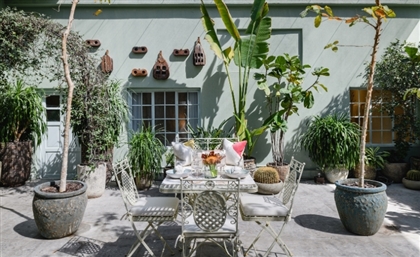
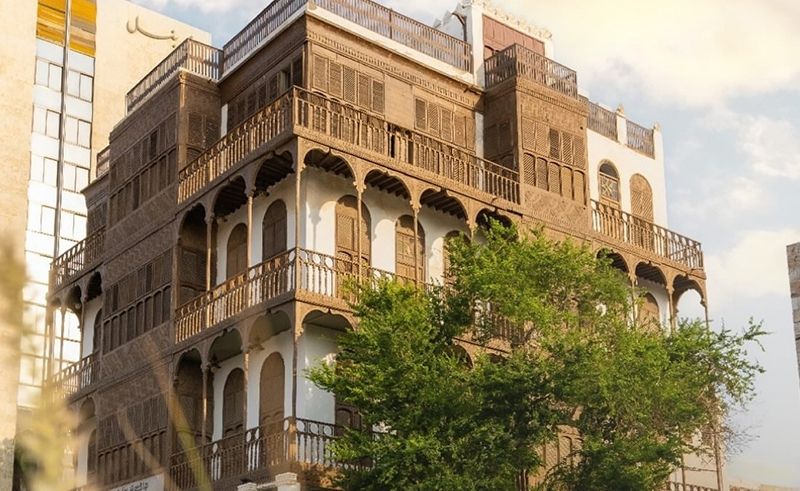
In Jeddah, Archive Place took shape through an intimate public program at Bait Alsharbatly Cultural House, where the building itself became an active participant in the dialogue. The site offered a framework to explore how architecture carries memory, and how physical structures can mediate ongoing conversations between cultural identity, the past, and the present.
The team has created opportunities for people to engage with the neighbourhoods. Examples of these programs include taking reflective walks, as well as having community-based interpretative dialogues rather than simply imposing an interpretation on people. While much of heritage discourse in Saudi Arabia has focused on preservation, Zamkana's research- and context-driven heritage work creates a space of balance between these dual objectives.
“History doesn’t exist in isolation,” Dr. Alkadi notes. “It lives within people, within places, within daily movement. Our responsibility is to translate that with care and credibility.”
This sensitivity becomes especially visible during moments when time itself carries another dimension. During Ramadan programming, Once Upon a Place, Zamkana tuned its engagement with the season's own temporal pace. Here, spiritual time was treated communally and culturally. “Spiritual time requires a different pace,” Dr. Alkadi reflects. “It calls for contemplation, connection, and shared presence.”
Throughout its work, Zamkana remains attentive to place as an active narrator. “We treat place as the main character,” Dr. Alkadi explains to SceneNowSaudi. “The stories are already there. Our role is to reveal what’s embedded.”