



The Anger of Egypt: Omar El Shoubashy Paints Faces Up the Nile
A year-long journey across Egypt reveals faces shaped by place, pressure and memory, as one painter turns fleeting encounters into layered portraits charged with emotion.
Egyptian painter Omar El Shoubashy wields his brush to discover the faces of Egypt and the emotions that unify them.
From Sallum to Sohag, Shoubashy takes mental screenshots of anger, fear and grit—how faces twist and turn and bear the weight of the society that bore them as they move through the mundanities of daily life. He searches in the depths of pupils and folds of foreheads and hollows of cheek bones. And when he arrives at his canvas, instinct moves in place of formal instruction. Despite graduating a couple years ago from the College of Fine Arts at Alexandria University, Shoubashy draws from self-taught sensibilities.
“It doesn’t matter who the person in the painting is,” Shoubashy tells CairoScene. “Faces are a means of communication, a way to express an opinion, freedom, anger towards society.”
The person in the painting could be his father or even himself, but they are not self-portraits in the traditional sense of the word. The face may have Shoubashy’s shape but is instead a patchwork quilt of the features he internalised on his travels. After university, he travelled for an entire year across Egypt.-4f57ecbd-f40e-4ccc-a842-05aabdd2f03c.png) Along the Libyan border in Sallum, the coastal scene departed completely from the one he knew in Alexandria. Women had disappeared from the streets and the tension of desert life bound facial features in novel compositions. He travelled from the western corner of Sallum and then down (or up) the Nile to Assiut and Sohag and Luxor, all the way to Abu Simbel. “They were all Egyptian, but each city had its own distinct culture,” he said.
Along the Libyan border in Sallum, the coastal scene departed completely from the one he knew in Alexandria. Women had disappeared from the streets and the tension of desert life bound facial features in novel compositions. He travelled from the western corner of Sallum and then down (or up) the Nile to Assiut and Sohag and Luxor, all the way to Abu Simbel. “They were all Egyptian, but each city had its own distinct culture,” he said.
Discovering new worlds inside his own country sparked a curiosity in the worlds outside of Egypt. He spent his free time reading, not only about art, but about various periods in world history. He watched films about World War I and World War II and witnessed suffering and death on faces with different features. He took inspiration from African and European art, how each style conceived humanity in a different way. But still, he was still drawn to the lessons of ancient Egypt.
When Shoubashy approached the twin temples of Abu Simbel, he looked up in awe at the scale of the statues that were carved out of mountain rock in the 13th century. The statues were nearly as tall as the temple itself, he marvelled. Sculpture worked its way into Shoubashy’s practice.
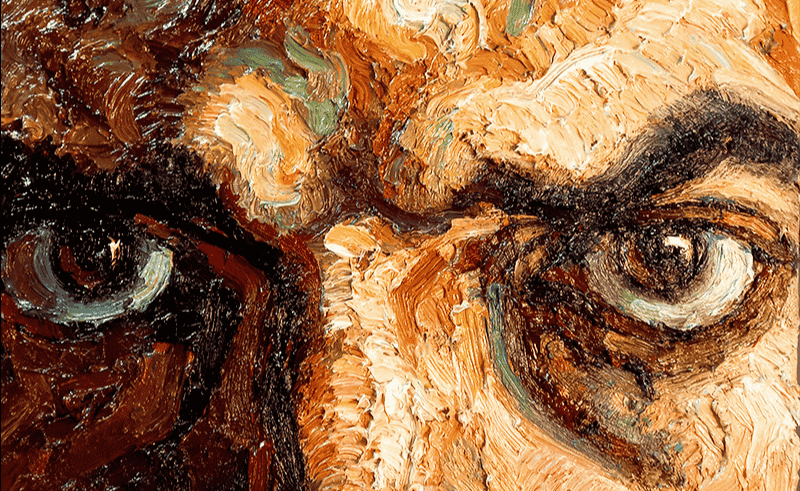
“I try to make my paintings feel like sculpture, as if the works contain many masses, like a carved piece,” Shoubashy said. His faces are textured, each stroke claiming a piece of the canvas in clearly defined strokes. Here, form becomes emotion; the face a vessel for layered experience, shared struggle, and the strength necessitated by war or crisis.
“I create a form that expresses strength and challenge—because that’s the nature of life. For a person to succeed, especially in Arab society, they need these qualities, whether they are rich or poor,” Shoubashy said.
The colour red is brightest in the background, but also melts into the skin, and rings around the eyes. Shobashy paints a gaze that pierces through the textured paint. Whether side-profile or front-facing, the eyes of each face stare you down.
“When you look into someone’s eyes,” Shoubashy said, “you know the truth without them speaking.”
In this recent series, Shoubashy is leaning into red to express challenge, anger and even death. He has been deeply affected by the genocide in Gaza over the past few years and uses the emotions in bodies and faces to object to attacks in the Arab world.
Shoubashy’s faces are currently on display at the Zahwa Art Gallery in Tahrir Square, Downtown Cairo, until April 23rd. The gallery is open daily from 11 AM to 8 PM, except Fridays.
- Previous Article Moxy Lazoghly Lets You Check Into Downtown Cairo’s Energy
- Next Article We asked 14 Artists What Makes Egypt’s Sandbox Festival Special