





Retrospective Traces Dr. Abdul Halim Radwi’s Legacy on Saudi Art
Mapping a legacy in motion, Zai Gallery Cairo pairs Dr. Abdul Halim Radwi retrospective with 30 prominent Saudi artists.

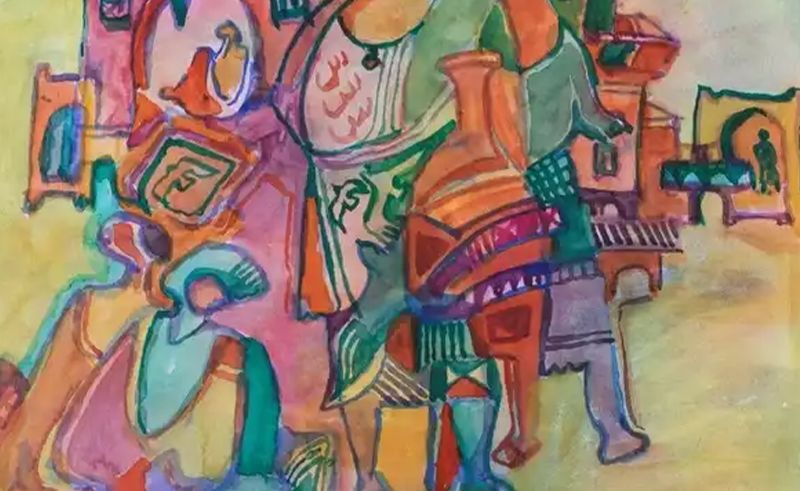
Saudi painter Dr. Abdul Halim Radwi is widely regarded as a pioneer of the Kingdom’s art scene—not only for what he produced on canvas, but for the cultural groundwork he helped establish for future generations. A new exhibition celebrates that legacy through a retrospective of his rich body of work. Set in conversation with pieces by 30 contemporary Saudi artists, it offers both a portrait of Saudi art’s foundations and a look at how those foundations are being revisited and reshaped today.
The exhibition opening at Zai Gallery was attended by Tariq Al-Koumi, President of the Egyptian Artists Syndicate, Saudi artist Shalimar Sharbately, and art critic Hisham Qandil. Running until December 28th, the exhibition positions Radwi not as a closed chapter, but as an ongoing reference point, especially in a moment when Saudi art is expanding in visibility, institutions, and experimentation.
Sharbately framed Radwi’s importance in terms that go beyond individual style. “Dr. Abdul Halim Radwi was not only an exceptional artist through his works, but also contributed to consolidating the status of Saudi fine art,” she said. “He opened new horizons for future generations.” She described how Dr. Abdul Halim Radwi insisted on art as a cultural language that can carry identity into the present. In the same breath, she elaborated the current lineup as proof of the Kingdom’s range: a scene “expressing multiple visions and styles,” and one that’s growing in confidence. Hosting the show in Cairo, she added, carries a particular weight, since Egypt remains a longstanding hub for Arab art, criticism, and exchange.
Dr. Radwi’s own story helps explain why he still matters to the region’s cultural memory. In 1961, he saved money from work as a wall painter to travel to Rome, becoming one of the first Saudis to pursue a formal art education abroad. He earned his BA from the Academy of Fine Arts in Rome in 1964, then later completed a doctorate at the Royal Academy of Fine Arts in Madrid in 1979. Those years shaped his visual language, he absorbed modernist currents such as Cubism and Expressionism, but his work consistently returned to Saudi specificity: desert life, folkloric scenes, traditional architecture, and religious symbolism.
Dr. Radwi believed Saudi artists needed to keep an eye on heritage as a point of departure and inspiration, rather than something left only on museum shelves. In his paintings, vibrant colour fields meet Arabic letterforms; modern composition sits beside familiar motifs.
The artist's impact wasn’t limited to the canvas. Upon returning to Saudi Arabia, he staged the Kingdom’s first public art exhibition in Jeddah in 1965, and went on to build infrastructure for others: he served as director of the Jeddah Centre for Fine Arts (1968–1974) and later as Director-General of Culture and Arts for the City of Jeddah (1980–1992). In other words, he helped shape the conditions that today’s artists inherit.
Related Articles
Trending This Week
-
-
-
 Sep 28, 2026
 -