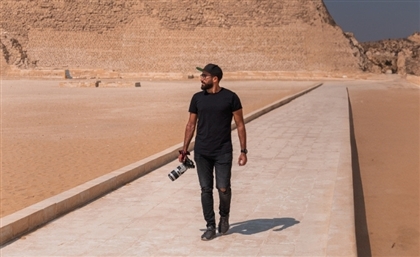






Photographer Hussein Mardini's Anger is His Engine
The 23-year-old films shaabi dance like ballet and its love stories like cinema, and the whole scene is watching.

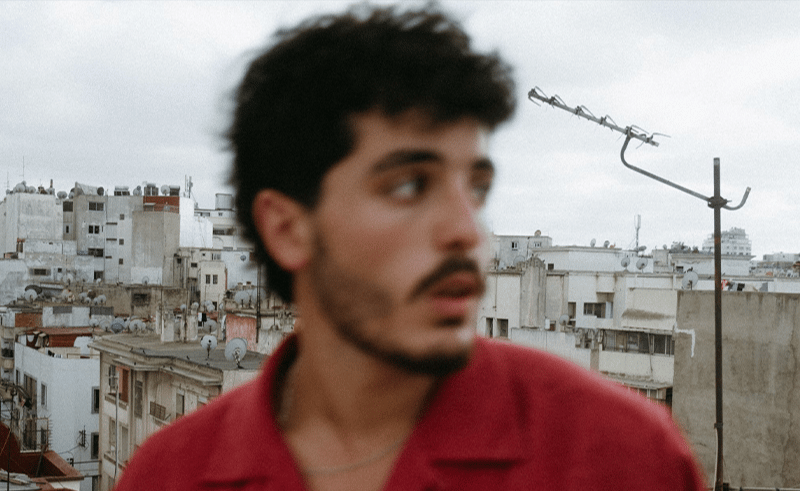
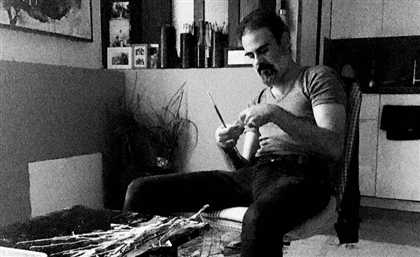
In ‘Ballet Du Caire’, shirtless men twirl knives to classical music in a dark room. The main instruction of this traditional ‘shaabi’ dance born out of Cairo’s working-class neighbourhoods is intuition. The 23-year-old director and photographer Hussein Mardini captures the choreography sensually, in high-contrast and slow motion. “This,” he says, “is our ballet.”
“When it's white skinny girls raising their legs, it's an art form, but when we dance, it's something low class, you know?” Mardini continues, punctuating his sentence with a: “Fuck you, saraha.”
Mardini is angry. He is angry that people do not see traditional ‘sha’aby’ dance as fine art. He is angry with the way Egypt is perceived by a western audience. And he is angry with the demands of social media algorithms.
Mardini also admits that he gets angry on set. “I'm like a toxic boyfriend with my ideas. Anybody who comes near, I'm like, ‘Shut the fuck up, please.’”
But today, among friends, his anger simmers below the surface. Mardini is shooting a commercial with a smaller group from the production house he founded a little less than a year ago, cleverly named ‘Unscene’. "I started it because of how fucked up the industry really is,” Mardini says. “Taking a production from A to Z is where you can have your autonomy and still get paid fairly.”-cfc93509-2863-4b62-b9ae-d729d05e78ce.png) On his recent commercial shoot with Egyptian brand Kotn and artist Wegz for a limited-edition World Cup t-shirt, he employed 200 people alone. “We’re going viral. People are like, ‘Who the fuck are these kids?’”
On his recent commercial shoot with Egyptian brand Kotn and artist Wegz for a limited-edition World Cup t-shirt, he employed 200 people alone. “We’re going viral. People are like, ‘Who the fuck are these kids?’”
Mardini only moved back to Cairo in 2025, but since then, he’s become one of the most well-known names in the scene. His portfolio spans photo and video, fashion and documentary, often in the same breath, from editorial shoots with Saint Levant for Vogue and Tul8te for GQ, to KOTN’s World Cup collaboration with Wegz on a limited-edition t-shirt. Mardini also has long standing contracts with international companies like Sony, where he films campaigns with their cameras in Egypt.
The commercial he is shooting in Alexandria today is one of those campaigns. It's about Egyptian love. On the rooftop of a restaurant at midday, Mardini sits on a couch in a pair of blue jeans and clean white t-shirt. He faces the eastern harbour of Alexandria, and the breeze that comes through an open window in place of air conditioning.
“People here express love way more openly than in any other city, especially by the sea,” Mardini says, looking out at the coast. “Egypt is pretty conservative, but I think our love, that suppressed love, is way more beautiful than the Western archetype of love. We don't need PDA on the streets to call it love, but that very discreet touching of hands, or very discreet leaning on each other—I think that has way more to say than open disclosure of intimacy.”
While Mardini is clear about changing outside perceptions of Egyptian culture, his audience also includes Egyptians themselves. Sometimes he feels like Egyptians don’t know Egypt. “I hate how everyone—from upper class Egypt and up—they don't even know their country,” Mardini says. “And same goes to even low-class Egypt. Everybody's in a bubble.”
For Mardini, media production is a way to build identity. In the age of social media, “anybody can make a film,” he says, “so let's get at it.”
The World Cup Kotn shoot with Wegz was an attempt to build Egyptian identity by putting it on screen exactly how it looks on the ground - in a neighbourhood game.
“I wanted to showcase street football culture in our way,” Mardini explains. “That favela culture in Rio was also built from media. Building our football culture will come from commercials like these.”-2342eac9-13b6-4da4-909d-d9cb741dccd2.png) Mardini just shot and released the campaign a couple weeks earlier, and Instagram hasn’t stopped buzzing since.
Mardini just shot and released the campaign a couple weeks earlier, and Instagram hasn’t stopped buzzing since.
The photographer has always been trying to capture scenes from different perspectives—starting with his tonsils at 12 years old. He would film his mouth, nose, and throat in awe. When he was looking for the money to buy a real DSLR camera, he went searching for the electronics in his house that nobody would miss—old DVDs, TVs, hard drives, USBs, headphones, even his PlayStation—to sell them off at the Serag Mall for used technology. “From then on, I shot everything,” he says. “Weddings, bars, food, anything to hustle.”
When Mardini moved from Cairo to London to study economics at Queen Mary University, he still wasn’t thinking of photography as more than a hobby. But suddenly it became a way to make extra cash in a notoriously expensive city. “And then I was like, fuck it,” he says. “I started shooting in the streets and posting every day.” Mardini went viral for the first time on a trip to Turkey in 2023, and his Instagram following skyrocketed.
This “badge of certification”, as he calls it, led to an opportunity with a travel company in Indonesia, where he moved for half a year, before receiving commissions for 10 documentaries around the world. Mardini travelled from London to countries across West Africa, North Africa, and Southeast Asia, including Egypt.
After his global tour, it was 2025, and Mardini asked himself: “Why am I still paying rent in London? Let me move back to Cairo.”
“And that was the best decision I have made,” he says.
Suddenly, Mardini was home. But a lot had changed since he left for university. At this point, he had established himself as a creative, and he had the Instagram likes to back it up, but he was struggling with the distinction between ‘content creator’ and ‘filmmaker’.
Mardini wanted to break out of the algorithm loop: creating content, posting content, waiting for the likes, comments, reactions, and doing it all over again. He pulls out his phone and scrolls back a couple years, to an era that is a bit less saturated, a bit less polished. “My numbers back then were way bigger than now. I was getting like 100 thousand likes.” Mardini keeps scrolling. “All of a sudden, I reflect on it here in the captions. I say, ‘Shit. I don't know. I haven’t been fulfilled by my social media presence’.”
The caption he refers to reads: “This year I won’t be posting just for the sake of being consistent, in a time where I’m urged to be creating more, I want to be more conscious of my creative process. I am a storyteller not an influencer…I want to tell the stories I am passionate about, and not recreate trends for the sake of being ‘consistent’.”
This unlocked a new era for Mardini, one of quality over quantity. It was in this era that he ventured outside of photo and video, and into direction. The first project he ever held the title of ‘director’ was a music video for Egyptian rapper Ilmond’s song (also known as Muhab) ‘Heya De Eldonya’.
“I didn’t know what directing was,” he remembers. Before he had the technical language to describe a shot, he simply listened to the music and described the scene in his head. “This is what I hear,” Mardini explains his thought process, “this is what I see.”
He kept following that instinct, gaining trust from the Egyptian arts scene to direct larger and larger projects. Now, Mardini is enjoying the influence he is able to have in Cairo, which is much easier to grow in than the UK. “Fuck London,” Mardini says with a straight face. “Fuck white people.”
When asked if he sees himself based in Egypt forever, he says: “Of course.”
In the next 10 years, Mardini would like to become a modern Martin Scorsese, and centre his identity as a Levantine Cairene like the American filmmaker did as an Italian New Yorker, starting with the man who inspires him most: his grandfather who passed Mardini his Turkish-Syrian roots. “He had a crazy temper. He's so generous, loving, and caring. He can shatter you, fuck you up, and come and just give you a hug. Nobody hated him,” he says. Now, Mardini opens up videos that he hasn’t posted on Instagram yet. Old-school family movies.
“Look at this.” The video plays, and the background is not Egypt, but New York City. But his attire would suggest otherwise. “I am inspired by my grandfather because he wore his identity on his fucking chest. He's in Wall Street wearing a galabeya. I'm obsessed."
“He didn't really care.” Mardini shakes his head. “And I don't either.”
- Previous Article Egypt's Annual Table Egg Output Reaches 16.5 Billion