


Amina Yahia’s Large Scale Paintings (Re)Invent the Archive
After shows in Paris, Dubai, and Kuwait, CairoScene visits the studio in Maadi where Yahia’s ambitious paintings come alive.
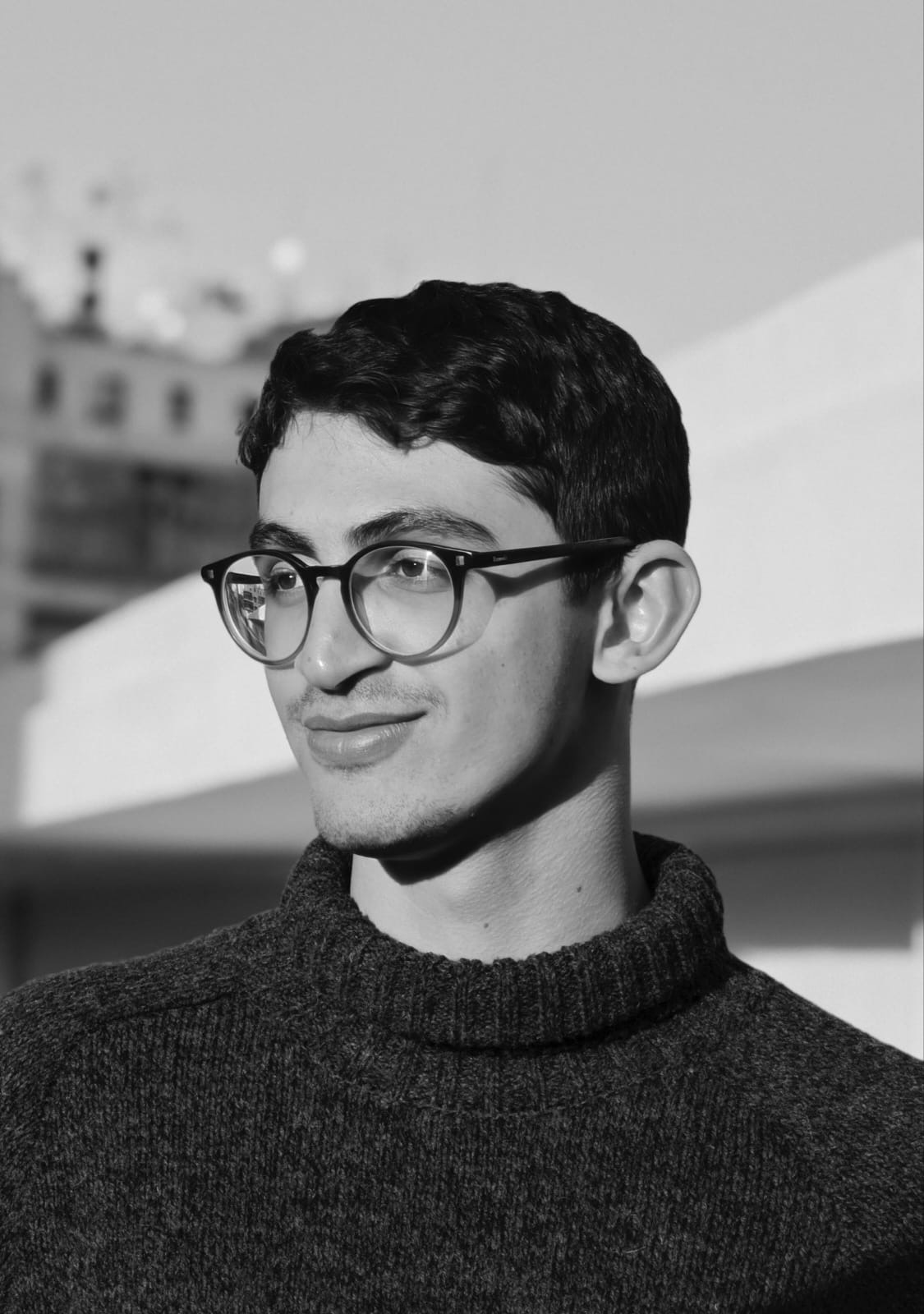
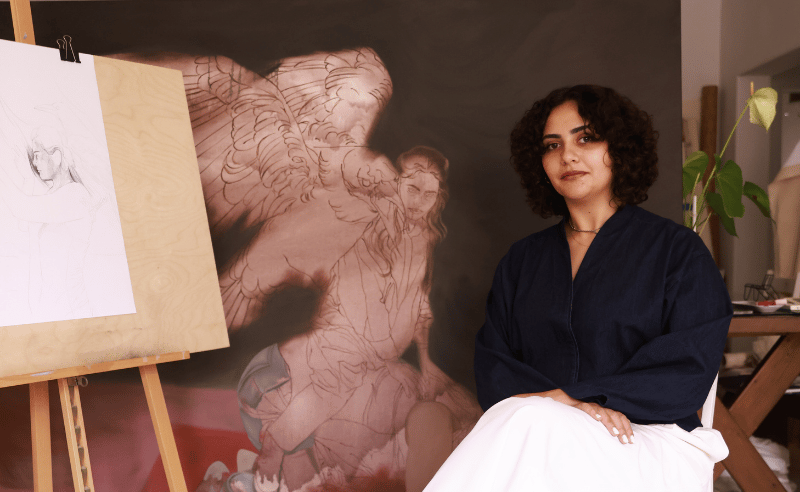
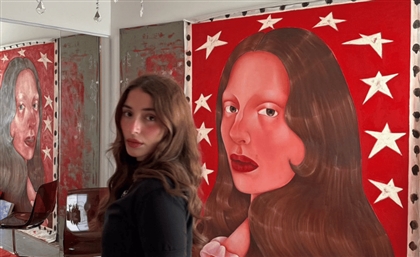
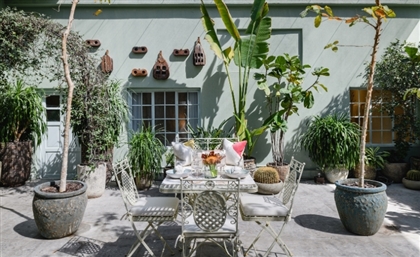
In her studio in Maadi overlooking the Nile (and, on a clear day, the Pyramids), a kind of rhythm takes over Amina Yahia’s day. Between the plants, the balcony, the books, and the empty paint canisters on which she sets her massive works-in-progress—paintings light in palette but heavy in subtext—Yahia’s process of creation gives an archivist’s treatment to the peculiarities of the present moment.
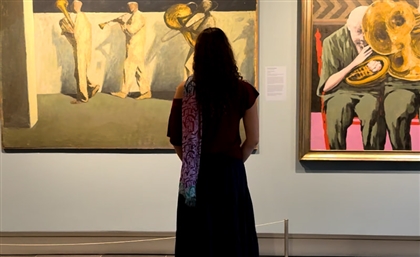
It’s fitting, then, that the first painting I wanted to speak with the painter and researcher about was one inspired by a photo from her family archives of her grandfather, whose home this studio happened to be. (After he passed away in 2020, Yahia, who spent much time here as a child, decided to move in.) That painting, Men and Boy Pose with Back in the Day Dancer, was created in 2022 and was selected by Hany Rashed for a group exhibition at AUC Tahrir the following year. Since then, the 26-year-old artist held her first solo exhibition and took part in several group exhibitions in Cairo, Paris, Dubai, and Kuwait, and enrolled in an MFA programme at NYU Abu Dhabi in Media and Art.
Yahia’s work, even when it’s not directly drawn from family or public archives or the research she did for the Mawrid Arab Centre for Art, and even when it leans into the folkloric and the fantastical, presents itself with the gravity of documentation. Subjects appear like cutouts, transplanted across time onto a sparse canvas where, just like the archivists intended, systems and patterns (of control, of gender and power and class) can be disentangled from all the noise, revealing broader truths about their moment.
In this interview, which took place in the artist’s studio, Amina Yahia speaks to CairoScene about the method and meaning to her work, the inspiration behind the title of her first solo exhibition, They Call Me Divine, and about how her career as a rising young painter has been shaped by the online world, the MFA process, and her own positionality as an Egyptian artist abroad.
-d6a5a457-a84b-438d-8b71-b4eb57367462.png) Men and Boy Pose with Back in the Day Dancer, 2022. Oil on canvas | 210 × 300 cm.
Men and Boy Pose with Back in the Day Dancer, 2022. Oil on canvas | 210 × 300 cm.
Can you introduce yourself?
I’m Amina Yehia, a contemporary visual artist and painter and researcher.
When you say researcher, what does that mean in the context of being an artist?
My work heavily relies on research and analysis, and during any project I’m working on I do a lot of research. I also worked remotely for a year from Cairo with the Mawrid Arab Center for Art, which is based at my university in NYU Abu Dhabi. We were digitizing the archives of modernist artists in Egypt like Ezzedin Naguib and other many prominent artists from here.
In your paintings, how might this research process appear?
For example, one of the two paintings I’m working on right now is about the story of an actual woman who, while studying medicine, acquired a real human skeleton. Later, she believed that she became possessed because of this decision. Both paintings have to do with the spiritual realm.
All of our cultural beliefs, or our belief system, aren’t included in the official archive because they’re not recognized by the colonial gaze, and at the same time they’re not tangible enough to have been recorded in a clear and academic way in history. Yet, at the same time, I’m recognizing that these beliefs have also refused to be dealt with in this way, because this way of recording history is very imperial in nature.
On the topic of belief systems, your solo exhibition at Hunna Gallery in Kuwait in November 2025 was titled They Call Me Divine. What’s the meaning behind this name?
The starting point for this exhibition for me was the structural shifts that Cairo was going through, and what this meant sociologically and politically and psychologically for the inhabitants of Cairo.
I was thinking about our relationship to the land. There’s this holiness to the land, and I began thinking how lots of actions in society are explained through sacredness and religious connotations and justifications. When we want to justify something as non-negotiable we tie it to religion. So the protagonist is the land, and it’s as if the land is saying, ‘I’m God’. It was originally called ‘They Call Me God’.
However, my curator was worried by that name and so we decided to title it They Call Me Divine instead, because it’s less blasphemous. I did not think it was blasphemous, but we have to abide by certain rules.
Having been based outside of Egypt for the past few years and displayed your work in several different countries, in what ways does your proximity or separation from home influence your work?
My work is always about Egypt. It’s about contemporary Egyptian society, no matter where I am in the world.
Can you talk to me about the colour palette you’ve chosen? Your paintings seem to have a light or airy quality to them, although upon closer inspection the themes that emerge are usually much heavier.
That’s a good observation because my previous work was not like this at all. Everyone who saw these paintings asked me, what’s happening to your palette? I think it’s a reflection of my emotional state lately.
But I’m happy that it’s not visually dense, because then it would be too much if the subjects are heavy and the painting is also visually heavy.
Your paintings are also typically on the larger side, including the two in your studio you’re working on right now. I’ve often felt that large paintings carry a different energy than smaller ones. How do you decide on the size of your canvases?
Since 2021, I’ve gravitated towards the large scale because you have to use your body in order to read the work. If you’re standing in front of a small painting, you mainly use your eyes. And since my work is figurative, the bodies [on a large canvas] are the same as your size or slightly larger. In a subconscious way, it pulls the viewer into the scene of the painting. It surrounds you, rather than it being an object that you’re looking at.
I also noticed that, in the same way, I’m also using my body while I’m working on these paintings. I still don’t understand what this fully means or implies, but my friends pointed it out to me—that my body becomes part of the work, going up and down the ladder, going left and right.
The first work I came across of yours, which I think might be your most well-known work, was the one of a dancer that you exhibited at AUC Tahrir for a group exhibition in 2023. Can you tell me the story behind this painting?
I know you like this painting a lot (laughs). I don’t like talking about it because it was during a time when I was still developing my ideas, so it has lots of gaps. My grandfather is actually in it, in a very funny way. He’s hiding a bit and has this Renaissance-like look. When people try to guess who he is they usually don’t see him.
But this painting is of an image from our family archives, and it’s a day that my grandfather was going out with his friends and we’re hypothesizing that the belly dancer in the photo is Soheir Zaki. I painted it because I was interested in exploring the archive and my family history, and also how the shift in the film industry in Egypt from old black & white films till today is culturally connected with our own views towards belly dancers. It’s a work about power dynamics and class systems and gender dynamics.
Why do you think it got so much attention?
To be honest I don’t know why it’s gotten a lot of attention from a lot of people. My theory is that it was the first painting of mine that was very massive, and people are affected easily by scale. It’s also kind of playful because there’s a dancer, and a lot of people outside the arts scene were attracted to it.
Why do you make the distinction, ‘outside the art scene’?
There’s many different standards by which to evaluate a work, but if you look at artistic literacy in Egypt, you’ll find most people judge a successful work as one that is realistic or aesthetically pleasing or simply matches their home decor, and not necessarily because there are layers to it that are contextually rich or conceptual.
Does your awareness of this affect your process or your work?
I generally try to let nothing influence my creative process because I believe the work is only good when it comes from an honest place, and for it to come from an honest place it can’t be affected by external questions like whether the audience will like it or not.
I’ve noticed that many young artists such as yourself are taking to social media to build a platform, showcasing their work from within the process. Does sharing an artwork with the world before it’s finished, as you had done with this painting, influence the art?
I don’t feel like I have to hide the work. I share it because I think it offers an interactive element where people see the progress and tell me they want to see more, or even sometimes give me feedback. Not all influences are good influences, of course, so I will just share everything on Instagram.
In this day and age social media offers so much more than just showing off. A lot of the exhibitions I was a part of I was invited to because of Instagram. So there is this kind of additional layer that the artistic scene shares on Instagram that inspires me to share for fun. And sometimes I get nice surprises, like when someone messages me and wants to see the work in person. The randomness of it is nice.
Do you think today the young artist has to be online?
Yes, but I don’t like to say that anyone has to do anything. Everyone can do as they please. But I think that a young artist who’s not active on social media will unfortunately miss out on a lot because this is where the world is going. You reached out to me on Instagram—you know what I mean?
-6ad51513-b56c-44ff-a9f0-8494a5f0684f.png) Te’rafy?, 2021. Oil on canvas | 150 x 150 cm.
Te’rafy?, 2021. Oil on canvas | 150 x 150 cm.
Maybe another way internet culture has influenced your work was in 2020, when you made a painting in response to the growing Me Too movement in Egypt. Can you tell me about that work?
This painting was inspired by the media uproar, or whatever you might call it, that happened during COVID in 2020 when everyone was at home and started talking about sexual harassment and the Ahmed Bassam Zaki case.
This might have been the first painting where I talked about gender dynamics, and how women are perceived in society. In the painting I wanted to visually fragment the body to express how women’s bodies are seen by society: looked at as body parts, as if you’re butchering the body and dissecting it, the way anyone would if they’re looking at the body in a sexual way.
How was the response to this work?
At this time most of the exhibitions I were getting had to do with feminist artists, which felt to me like I was being put in a box because my work goes beyond feminism. As a woman, I’m very passionate about women’s rights, but my work is not just about that. So I wanted to show with time that yes women are integral to my work—most of the bodies in my paintings are female-centric—but the issues I tackle move beyond women’s rights and feminism.
Like what?
Control is a major theme, but also dreams and imagination. It’s all connected: who has power and who doesn’t have power, who gets to dream and who not.
Dream is a key word because in the past couple of years I began to integrate my dreams into the work. Either I paint a dream as is, or I find that when I dream, I’m dreaming of a painting, and then it evolves in the dream and influences decisions I make when I wake up.
You frequently paint familial scenes. Besides your grandfather, do you paint people from your own family?
Yes, another layer is family dynamics, which is connected to power dynamics and control systems—how within a family structure there is a hierarchy, and how this is a reflection of the state and its connection to the people.
I paint my younger sister a lot. With time I realized that I like to paint people, and I enjoy painting people I have a good emotional connection to. My sister is one of them, but my friends also. Most of the figures in my work are people I know.
-7df0a8ec-98d9-4c49-8e9b-5c8baa28169e.png) Witness, 2025. Oil on canvas | 95 x 67 cm.
Witness, 2025. Oil on canvas | 95 x 67 cm.
Do you paint the way they look, or are you painting their characters?
Both. I think I choose the person based on the painting. I choose the person based on what they represent to me and what I think they represent in the world in general.
For example, there is this portrait of my sister that I titled Witness—
This was the painting in all red? I had noticed it for how intense it is—it’s the only red painting in They Call Me Divine in the midst of a completely different palette.
Yes, you described it as intense due to its colour, and that intensity is there because of its colour but also because Malak to me represents intensity, and that’s why I painted her the way I did. She’s my younger sister, my baby sister, which I associate with innocence. It felt natural to title it Witness.
As an Egyptian in the UAE, how did it happen that your first solo exhibition took place at Hunna Gallery in Kuwait?
Hunna is the gallery that represents me. They used to be nomadic, and they were registered in the UAE and most of their exhibitions took place there, and that’s how I met my gallerist, Océane Sailly. We developed a friendship and she started representing me, and after a year or two she moved to Kuwait and opened a space in Kuwait.
And, more broadly, how are you navigating the world of galleries and the commercial side of art?
I feel like in this stage for me it’s more about trial and error, and trying to understand how all these different things work.
In Egypt things work in a certain way and abroad in a certain way, and at some point I thought everything is supposed to work one way but I realized it’s a lot more dynamic and depends on where you are. So I guess this stage is really inspired by whatever comes, I’ll learn from it. I’m approaching it with a lot of flexibility because I know I’m young, so I have to try to learn.
What about navigating academics? I’m curious in what ways being an MFA student affects your work.
The program has been really wonderful. A major part of my programme is theoretical—studying society basically, studying how the world is and how our region in particular is, and how our work is affected by life.
It’s great because I feel it’s kind of a responsibility for us as artists to always have awareness about what’s going on in the world. I can’t imagine how one’s work is not connected to their society and to the world and to people, so it was a conscious decision to go because I felt I needed to anchor myself in something that pushed me to keep on learning more and evolving my practice in a way that is connected to other disciplines and not just my own.
But how do you navigate the formal aspects of artistic training with your own creative processes?
That’s a really good question. Most MFAs are based on research-led practice rather than practice-led research. In undergrad I felt this was limiting because I had to do research first and then come up with a composition, and it felt liberating coming back to Egypt after I finished undergrad [at NYU Abu Dhabi] and talking to artists here and learning that their approach was very different. It felt liberating to break out of this system.
Finally, besides the work you’ve shown me, can you tell me what might be next?
I’m working on my largest painting yet right now, but it’s on pause because I couldn’t bring it back to Egypt with me—it’s larger than the outsize cargo of the plane.
It’s 2.5 x 3.5 meters, and the painting has to do with a few experiences I’ve had in Egypt over the summer, about how labour gives the working class in Egypt access to art when most ordinary Egyptians don’t have access to it through the art scene itself or through galleries or museums. So that’s the topic I’m currently researching, and I’m making a piece about it.
- Previous Article French-Moroccan Label Casablanca Takes Its AW 26 Campaign to Egypt
- Next Article El Dabaa Nuclear Plant is Getting Two Additional Reactors