



Yassin El Mahgoub Doesn't Think Comedy Comes With a Script
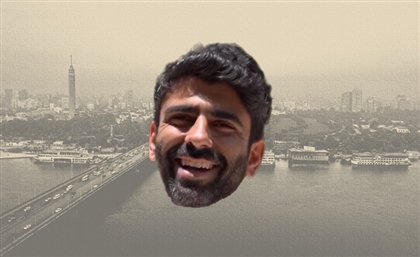
The Cairo resident doctor's hospital sketches have made him one of Egypt's most-watched comedians. Some of the first videos he made were about his father, who died when he was 14.
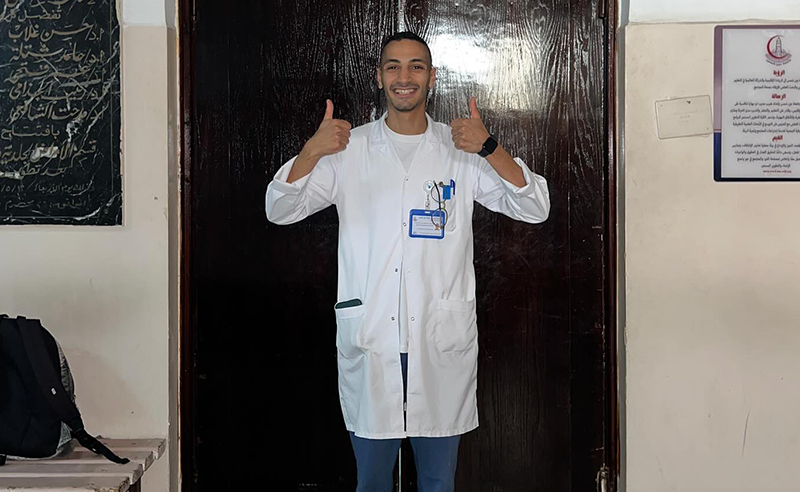
I had been sending Yassin El Mahgoub's videos to my sister for the better part of a year before I had any real reason to call him, usually with no caption at all, because most of them did not need one.
He is a resident doctor who has, almost by accident, become one of the funnier people on the Egyptian internet and, if his comments section is anything to go by, one of its most swooned-over. His bits about difficult shifts travel well beyond anyone who has ever set foot in a Cairo teaching hospital.
That was not what caught me off guard when we finally spoke. I already knew he was funny. What I had not expected was how much weight sat directly underneath it, arranged so carefully that most people scrolling past would never guess it was there.
We spoke over a call that dropped 4 separate times, both of us in pyjamas in an identical shade of burgundy, which he found the funniest coincidence of his week. It set the tone early.
"In the past there were no boxes. There were no medical schools, none of all these things," he says. "People were free to just experiment and try. Then we institutionalised everything. We made everything into a box. You cannot just be great. You have to be great at that."
Ask most Egyptian doctors in their twenties why they chose medicine and you'll hear some version of the same line: I like helping people. Yassin used it too, on anyone who asked, for years.
The truth arrived when he was 14. His father died, and a doctor stood over him afterward, fielding his questions.
"I remember asking the doctor a lot of questions," he says, "and they didn't have the answer, they were very cold in the way they talked to me."
He does not remember their name. He remembers everything else about that room.
-ac1778fa-2d76-4719-9fb7-a516bceeae18.png) A year later, across the table from his mother, he told her he wanted to pursue medicine, and watched her go quiet with surprise. She told him something he had never known: his father had hoped, before he died, that his son would become a doctor, and it was part of why he'd named him Yassin.
"I don't want a day when a kid asks me about his dad and I don't know how to answer him," he says. "So why don't I try helping."
The comedy started on a whim. Scrolling through other people's videos one pandemic evening, he decided he could write a funnier line himself, and filmed one.
Nothing happened for months. Then a video he filmed one afternoon in his hospital lab took off overnight, and he woke up on pages he had never heard of, credited with jokes he had made half asleep.
It isn't only comedy that travels. In 2022, a clip of him rescuing a disabled parrot, which he later taught to walk, was covered by Newsweek and Upworthy and shared by Viola Davis, who still has it on her page.
He chose his 23rd birthday to try stand-up properly and has done 10 or 15 shows since, almost entirely for small groups of friends. He has never once announced a show on his main page.
"It is intense to stand there for 10, 15 minutes, even an hour, and carry the entire stage," he says. "I don't think you can polish comedy. I don't think it comes with a script." He is only now considering doing it publicly again.
Some of what followed became confessional in a way he had not planned. The videos he made processing his father's death, he tells me, were ones he never expected anyone to see.
"They were confessionals of how I just wanted to turn something that's very traumatic into humour," he says.
He tells you all of this because it's true, and because somewhere along the way he learned that the truth, properly placed, can be funnier than any joke.
Egyptian medicine has not always returned the favour of his honesty. He describes being consulted on rotations by colleagues who had clearly watched his videos and decided, on that basis, what kind of doctor he must be.
"They think of me as a dumb blonde," he says, "because they've seen my videos, and I hate the stereotype. I don't need you to explain the medicine to me. I need you to answer my questions so I can do my job."
He graduated summa cum laude from New Giza University in January 2024, third in his class.
The wider culture, he says, treats anyone with a visible life outside the hospital as a kind of threat. "This is the number one enemy to any medical student," he says, "or anyone that has a life beyond their field of work. What they don't know. It scares them."
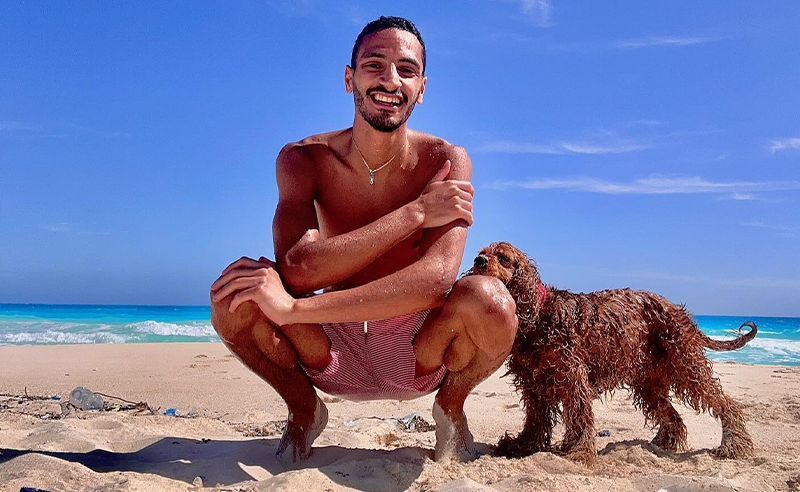 Medicine, he says, has a way of making a person feel very small. He tells me, almost as an aside, about the towel he was once asked to hold in place during a colonoscopy for 35 minutes so a patient would not pass gas mid-procedure.
It is a detail so undignified that he had never told anyone before, not even his closest friends, let alone put it in a video.
Some of what he told me arrived as a list. At 14, his father died. At 16, he held his childhood dog in his hands as she died.
At 19, his mother had a stroke, and he turned the hospital upside down to get her seen properly. At 24, he was the one who had to tell his own aunt she had cancer.
At 25, his sister diagnosed his niece with a genetic disorder, and it fell to him to explain what that meant to a family already exhausted by bad news.
"People see me as this fun, goofy character," he says, "and they think I have not a care in the world."
He had the chance to build his career in the United States, a competitive dermatology residency and all. He chose Egypt. He says he simply has not exhausted what he wants to build here yet.
"I hope I never get to the point where I have to leave to survive," he says. "Because I love my country. I love my family."
Near the end of the call, once the wifi had settled, he brought up a quote he attributes to John F. Kennedy, about a country being less a melting pot than a mosaic of everything that built it. The line is more often traced to Jimmy Carter.
He thinks about it often, he says, applied to a single life: that you are the sum of everyone who has passed through you, arranged into something that only looks whole from a distance.
"I want to be remembered with an open heart," he says.
The day after his 9-year-old niece's surgery, he drove to her house with a sparkly ruby red wheelchair. She had told him she did not like the look of the black one.
- Previous Article Tarabband Map Fear, Control & Feelings of Inferiority on ‘Hub o Harb’
- Next Article Saudi Internet Usage Reaches 99.6% in 2026
Trending This Week
-
 Oct 28, 2026
-

-

-