


Daraq Collective's New Alternative Underground in Palestine
We sat down with the Haifia-born crew to uncover their story, how they started, and what keeps them running.
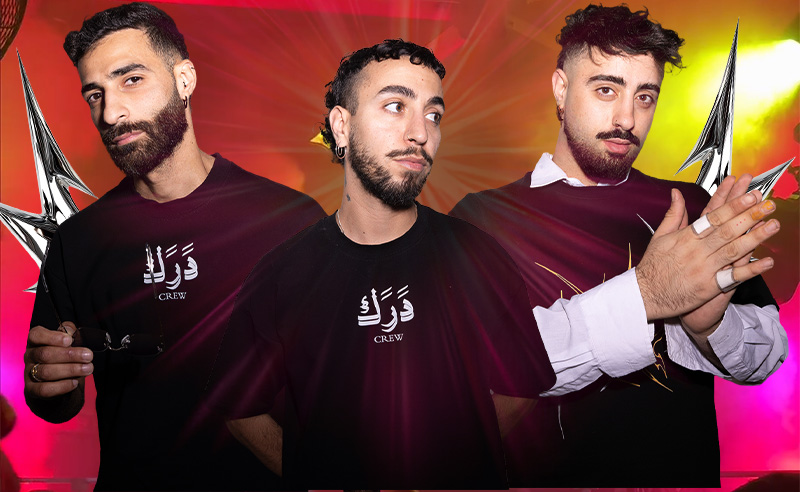
Daraq wasn’t born out of a big artistic mission or a grand statement in mind. It simply came when three friends in Haifa, Sari, Ashraf, and Fadi, realised they had nowhere to go that made sense for who they were. A working-class group of Queer, Arab, Palestinian creatives. Every scene around them seemed to require a version of themselves they couldn’t, and didn’t want to, perform. So they made a space where they didn’t have to.
“It didn’t start with ambition. It started because we needed to breathe. There were parties, but none that looked like us. There were platforms, but none that could hold us. So we did what we’ve always done, we built our own underground.” Daraq tells SceneNoise. “It took dragging speakers up broken stairs at midnight. Arguing with venue owners who were scared of the words “queer” and “Palestinian”. Working day jobs and then going straight into all-nighters, sewing looks, building installations, editing videos on dying laptops.”
Their backgrounds didn’t match what people expect from a cultural collective: a pole dancer, a plumber, a fashion designer. But that mix shaped the foundation. Sari understood bodies and presence, Ashraf knew how to build things from scratch, and Fadi carried a visual language built from years of working with texture and form. What they lacked in conventional credentials, they made up for in lived experience.
The name they chose, Daraq (درك), came from the vocabulary of everyday life, holding cells, lower levels, the word people use for the police. They picked it because it felt accurate, not symbolic. “It’s a word with weight. We wanted to reclaim something that was used to define us from the outside and make it ours.”
The moment they realised they were building something bigger came during one of their earliest nights. Some cried, some leaned into conversations that had clearly been waiting for the right conditions. “We understood then that it wasn’t merely a party we’re organising. People came in carrying a lot of load, and somehow the room made it easier to let some of that out.”
Being queer and Arab made them feel too visible in some spaces, utterly invisible in others, and out of place in most. No one place held all their identities without expecting them to tone down some parts of it. “To be queer, Arab, and Palestinian is to carry contradiction as inheritance. You’re always too much, too loud to be safe, yet too silent to be seen.” They explain. “You’re told you’re the problem; then punished for not being the solution. Daraq was the first space where we didn’t have to split ourselves.”
The escalated genocide in Gaza sharpened this sense of purpose they had. “Watching what’s happening, seeing how the world reacts, or doesn’t, changes how you step into any room.” They explain. Their events didn’t become political at the time because they already were to begin with. Yet, the urgency behind them intensified. People weren’t looking for escape. They were rather looking for somewhere they could show up with everything they were carrying.
For Daraq, sound became their means of returning to places they couldn’t always physically reach, the backbone of how they shaped the space. They were drawn to rough, unpolished techno, the kind that is entirely deconstructed, but jagged enough, with fragments around the edges. They talk about sampling vocals, stretching them and distorting them, not to mimic the past, but to reimagine parts of it forward. They like tracks that sit slightly off-center, that feel like pressure, and a constant push-and-pull of tension, rather than chill, meditative comfort. “It’s what made sense to us. It’s a way of keeping our memory of Haifa alive. But we also wanted sound that matched the intensity of how we live.”
When they talk about the underground in Palestine, they make it practical. It’s not a scene, they say, but an ecosystem people build because they need to. Gatherings that shift locations, adapt to restrictions and survive despite and within occupation because there is simply no other choice. “These nights aren’t planned months ahead. They’re built quickly, cautiously, and with the understanding that they might not happen at all.” They explain. “So, when people come together here, it means something different. It’s not simply nightlife. It’s connection.”
Their process is loose, collaborative, and sometimes messy. They describe it as intuitive and often chaotic, but grounded in the trust they have in each other. Each member plays a clear role: Sari’s knowledge of movement shapes the physical atmosphere, Ashraf handles the structural logistics that keep the night alive, and Fadi builds the visual language. None of this was learned in clubs. It was learned through a constant cycle of trials and tribulations in building the project.
Inside a Daraq night, the room somehow doesn’t feel choreographed. People settle into pockets of energy; some dance, some talk, some watch. But intimacy is a priority. They were often approached by attendees afterwards, sharing with them how the space allowed them to feel something they didn’t realise they were missing. “Those small, quiet reactions mean more than loud ones. We want people to feel like they can show up as they are. That gets harder the more visible you become.” And though they’ve had to navigate skepticism, misconceptions, and outright discomfort from people inside and outside their circles, none of it has stopped them from going forward with the project.
Their record label grew out of the same desire: to document what rarely gets recorded. In Kunt Treed, by their resident Cyber Witch, was their first release because it summed up the tone they’d been building. Raw, direct, emotionally heavy without being theatrical. They wanted a track that didn’t introduce Daraq politely. Yet, despite their pure passion and clear vision, international artists would usually keep their distance and avoid collaborating with them out of fear of “political complications”.
“People say it’s complicated, but the complication isn’t for them. It’s for us.” Still, they’re looking outward, hoping to tour, collaborate, and carry their sound beyond borders. Now, a year later, after the Hammam night in Jaffa, the Spring Break takeover in Kabareet, the “Daraq bel Qasr” infiltration of Soho House, their first art exhibition, and the Cyber Witch release, their initial question shifted to “What are we actually doing to people once they enter?”
The crew recall the first-ever night they hosted an event, “It was in Wadi Salib in Haifa, and we were obsessed with one question: 'Will anyone even come?’. We were checking the door every two minutes, praying the power wouldn’t go out and obsessively counting every ticket.”
“People sometimes have to cross checkpoints, lie to their family, spend money they don’t really have, plan their whole week around a Daraq night, that’s a huge responsibility,” Daraq tell SceneNoise. So, they remain thoughtful about the places they host their events. Yet, it remains constrained by the everyday political reality of living in Palestine, where the journey between Haifa and Jaffa isn’t fun or adventurous like some might think. It’s a constant spiral of permits, gentrified spaces, and the constant stress around “who is allowed to be here, and under what conditions.”
“Throwing our Daraq Bel Qasr inside a place like Soho House wasn’t just aesthetics; it was about inserting our crowd into a space that was never built for them and dealing with the tension that it creates. The art in this context is not separate from logistics. A broken speaker, a late bus, a closed checkpoint, all of these shape the creative outcome just as much as a synth line.”
If everything disappeared tomorrow, they want the memory to be simple: that they created a place where people like them didn’t have to negotiate their existence, but also a launchpad for emerging artists who share the same dream. Their main goal is that someone out there remembers feeling seen—in Arabic, in queerness, in complexity—and knows that the feeling mattered.
“We don’t want to be the face of queer Palestinians. We want to be one voice in a big, loud chorus.”
Related Articles
Trending This Week
-
-
-
-
 Aug 31, 2026