





Why Egypt's Taxis Are Different Colours in Every City
It started as a low-tech solution, with each governorate choosing its own colour to distinguish legal cabs from the chaos.

Egypt’s first car was said to be driven by devils. At least that is what the crowds believed when they gathered to stare at Prince Aziz Hassan's new machine. In 1890, the prince —grandson of Khedive Ismail— returned from his studies in Germany with a De Dion-Bouton, French-made, shipped across the Mediterranean and unloaded onto land that had known only the clop of donkeys and the creak of wooden wheels for thousands of years. With no horse, no mule, no camel propelling it, the machine rolled forward by some invisible will. So it was natural that the crowd would whisper amongst themselves, spreading rumours that it was driven by demons and goblins...
In 1904 the prince drove from Cairo to Alexandria in his Dion-Bouton, a journey that took over ten hours. Ten hours of dust and uncertainty, ten hours of engine noise startling donkeys and chickens and sending children running to the edges of fields. There were no roads to speak of back then, no bridges, just the long flat expanse of the Delta and a prince at the wheel of something no one had seen before. The prince and his two companions spent the trip reimbursing farmers for crushed crops, scattered cattle, and the damage of the future arriving unannounced. It was, by all accounts, a costly adventure.
By the end of 1905, Cairo had 110 motorised vehicles and Alexandria had 56. The first taxi company formed in Alexandria in around 1907 or 1908, running Unic cars. Today, there are ten million licensed vehicles in Egypt, more than three hundred thousand of them are taxis. They are everywhere, we see them, hail them, ride them. They are the background hum of the city, they are so ordinary that you forget you ever found them strange.
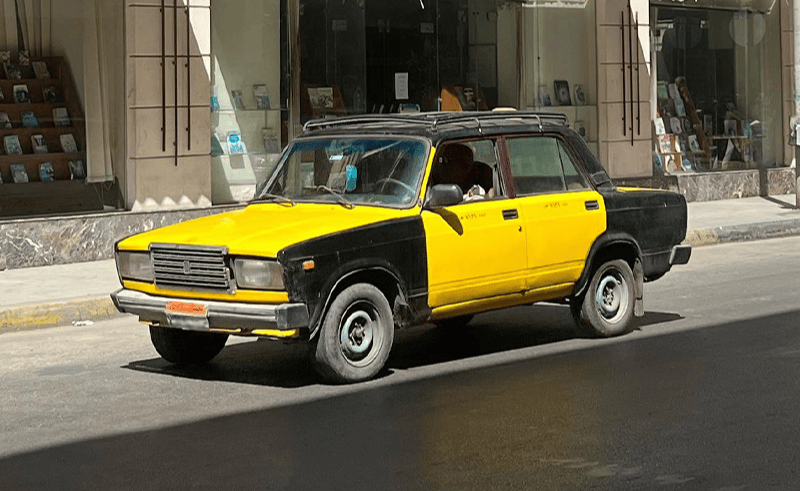
When I came to Egypt as a child for summers and holidays, the taxis were different everywhere. In Cairo, black and white. In Alexandria, yellow and black. In Damanhour, green and white. I asked why and got answers that made no sense or answers that contradicted each other or answers that trailed off into that's just how it is.
Later, when I came to live here, the colours stopped being strange, but rather became information I processed without thinking. A code tucked in the periphery of my brain readjusting to whichever governorate I am in, but I still never found out why it was the way it is.
The paint first started as a low-tech solution to a high-friction problem. The colours an invisible administrative stamp signalling that a vehicle belongs here. Taxi licensing in Egypt is governed at the level of the governorate. Each local authority registers, regulates, and monitors its own fleet. With that authority came the freedom to choose a colour, regulate fares, distinguish legal taxis from the flood of informal transport that had always moved people through Egypt.
Distinct colour schemes made enforcement easier long before GPS tracking or centralised databases. So, if a taxi licensed in Matrouh began operating routinely in Cairo, it was immediately identifiable. Colour functioned as a visual boundary, a form of territorial clarity in a country without internal checkpoints.
In 2015, pink appeared because a UN study reported that more than 99% of women in Egypt had experienced sexual harassment. Pink appeared because someone decided that women driving women, in cars painted entirely in pink, will create safety. Pink was the first time in Egypt that a taxi colour was chosen for its social meaning rather than its administrative function.
Taxi livery is hardly unique to Egypt. In cities like Mexico City, taxis are painted pink and white to distinguish them from vehicles registered in other states, while across Morocco, each city assigns its petit taxis a distinct colour —red in Casablanca, blue in Tangier, beige in Marrakech— to reflect local licensing jurisdictions. In China, taxi colours vary by municipality, visually signalling the authority under which they operate. A consistent logic: decentralised governance produces decentralised fleets.
The colours were never meant to be symbols, but identity happened to them anyway. Photographers, film directors and creatives capture a yellow and black Lada that worked the coast for years, when they want to tell you, without dialogue, that the scene is in Alexandria. Now the Hyundais and Kias arrive in the same colours, because repainting is expensive and because the visual language has already been set.
Cairo is beige and brown and white and, in certain lights, gold. But the old black-and-white taxis painted the city in memory. They were everywhere for so long. The Peugeot 504s, the French Lion, produced from 1968 to 1983 and still populating the streets decades later. The Fiat 128s, ‘ma'shouqet el-gamahir’, the beloved of the masses, easy to fix, parts everywhere, fuel-efficient. You hailed one, negotiated before the door closed, submitted to whatever came next: cigarette smoke, driver's opinions, and the detour only he knew. The new taxis are solid white, air-conditioned, and metered— a reform, the government said. A break from bargaining and chaos. The white taxis signal Cairo moving towards modernity and sleekness. But you still hail them, negotiate before the door is closed, and submit whatever is next.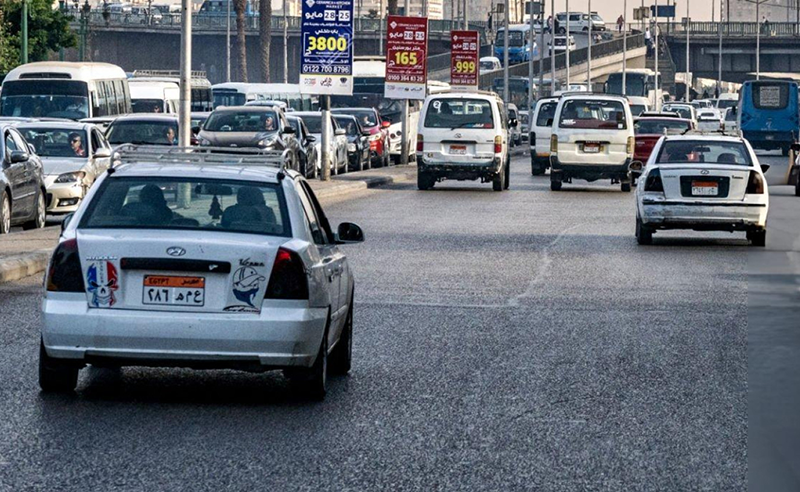
In Sharqia, the taxis come in two schemes. Red and white, or burgundy and white. Both are official. Both operate simultaneously. Ask why and you get different answers. Maybe one scheme is older. Maybe they indicate different license types— city versus village, perhaps.
In Beheira, white and green. In Monofeya, green and yellow. In Kafr El-Sheikh, yellow and white. In Marsa Matrouh, white and sky blue. In Ismailia, orange and white. In Sohag, navy and white. In Qena, purple and white. In the Red Sea governorate, orange and black.
Now ride-hailing apps are not so slowly taking over. There are ninety thousand drivers in Cairo alone, their cars indistinguishable from private cars. You look at the screen, watch as the little car moves toward your dot. You do not look for colour any more, you scan car plates for letters and numbers.
Traditional taxis have declined. From 383,423 registered in 2017 to 310,255 in 2023. A drop of nearly 20 percent. The relationship is now mediated by a screen, by ratings, by algorithms that set the fare so you do not have to bargain, but we still hail a cab when the traffic is too awful and we cannot afford to wait for an uber which is 10, 15, 20 minutes away.
The prince in his Dion-Bouton, 1904, ten hours through the Delta, paying for every crop he crushed. He could not have imagined any of this— ten million vehicles, three hundred thousand taxis, a code of colours written across the country. He could not have imagined that the machine the crowds thought was driven by devils would one day be hailed through a screen, summoned by an algorithm, arriving in any colour at all.
But he would have understood the bargaining. He did it himself, farmer by farmer, crop by crop. The future is expensive, even now.
- Previous Article Everything You Need to Know About the 2026 Al-Rawi Awards
- Next Article Chef Karim Abdelrahman Hosts Mother’s Day Pop-up in Sheikh Zayed
Related Articles
Trending This Week
-

-
-
 Mar 14, 2026
 -