






The Sailors Building a New Community in Egypt's Red Sea
Red Sea Sails is forging a new community of Egyptian sailors, and showing the world why the Red Sea is a perfect place to sail.
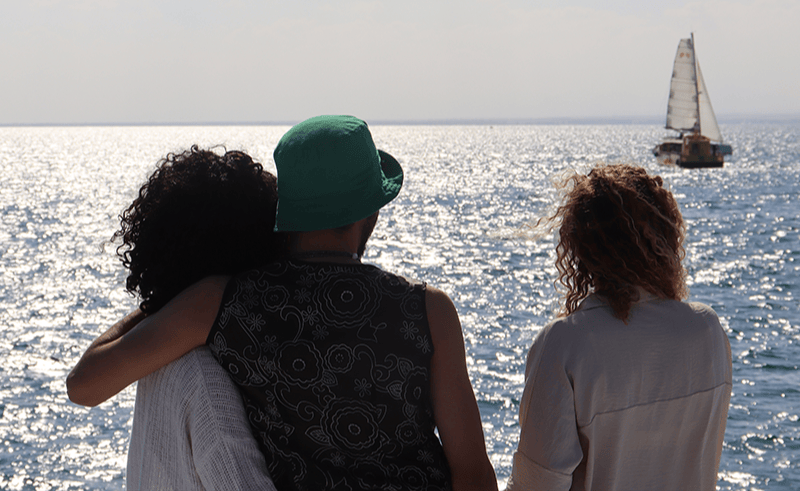
On the top deck of a spectator boat, about an hour away from shore, we were watching sailboats dance around the starting line as judges began the ten-minute countdown to the start of the race. The huge masts of the sailboats, some as tall as five-storey buildings, strained against the power of the wind which filled their sails and propelled their hulls through the turquoise waters. Watching the action were sailing enthusiasts, curious tourists, photographers, and family and friends coming to support the sailors on the water. More than just a race, the three-day regatta demonstrated Red Sea Sails’ vision of introducing a new kind of community to the Red Sea.
“Red Sea Sails started in 2015 to bring a sailing community together, and not just to introduce sailing to the Red Sea but to bring the world to sail in the Red Sea,” explains Faisal Khalaf, the founder of Red Sea Sails and its older, diving-oriented sister, Red Sea Explorers. Since their founding, Red Sea Sails have organized twenty regattas, or sailing races. But the 2nd edition of their flagship event, the Red Sea Sailing Regatta, was their biggest one yet.
Held from December 10-13 in El Gouna, the 2nd Red Sea Sailing Regatta brought together seventy participants from across Egypt for three days of intense racing. Fifteen sailing yachts were registered for the event, ranging from Khalaf’s own 1961 wooden sloop, Seaspray, to giant, glitzy catamarans that look like behemoths in comparison. The event also attracted participants from thirteen other nationalities, and sailors from the Alexandria Yacht Club and Cairo Yacht Club. Because the racing happened a few kilometres offshore, Red Sea Sails organized a spectator boat for those who wanted to watch the regatta from the heart of the action.
There was a different atmosphere on each of the three days I was aboard the spectator boat, mirroring both the activity that was happening on the water and the guests who were watching it. The first day was relaxed, with funky blues playing over a loudspeaker, and casual chatter permeating the decks. The second day, travel agency Stamps Tours brought aboard a group of young travellers and a DJ, turning the top deck into a full-blown party. On the third and final day, which also happened to be the windiest, there was no music and no partying: the focus was solely on the racing, and who would be crowned winner that night at the closing ceremony.
But the real attraction were the things that could not have been planned by Red Sea Sails. Though it was December, El Gouna’s skies were bright and blue, its waters warm enough for a quick swim, and the marine life gorgeous. There was plenty of wind for sailing, and yet the waves were low and the sea was not rough. From the spectator boat, you could see all kinds of reef fish swim by, and on two of the three days of racing, a huge pod of dolphins made an appearance.
“Sailing the Red Sea is magical,” says Mo Hammoud, regatta organizer at Red Sea Sails. “It is unlike sailing anywhere else in the world. The Red Sea environment, especially this area around El Gouna and Hurghada, is very sheltered. We’ve got wind 300 days of the year, and when you’ve got good wind in a sheltered area, you get very small waves. This makes the sailing very smooth. It’s an experience that cannot be missed.”
While many water sports have found a dedicated community in Egypt in the past decades, the sport of sailing has only recently begun to take root in Egypt’s Red Sea. In 2021, Red Sea Sails became the first sailing school in the area certified to train skippers and crew for recreational yachting, when Head of Education Sigrid Moors, or Sigi, joined the team. Since then, Red Sea Sails has certified more than 150 sailors, slowly building the community from the ground up.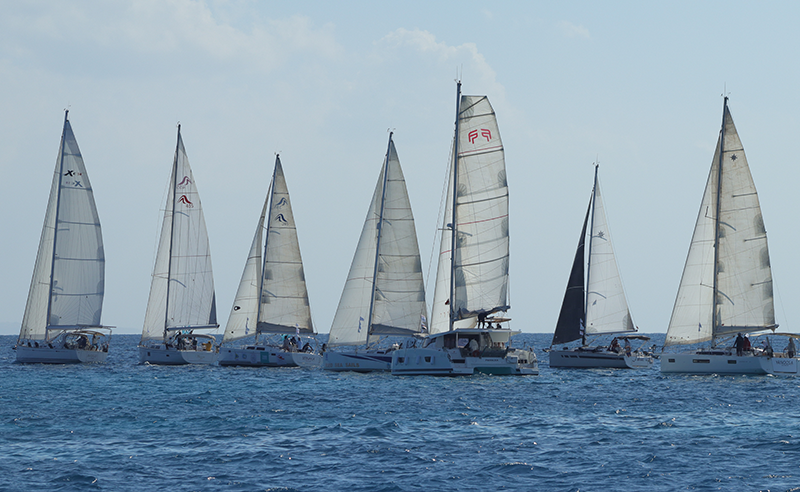
Nevertheless, as Khalaf pointed out at the regatta’s opening ceremony, sailing is not new to Egypt. “The pyramids exist because the ancient Egyptians were able to sail the rocks from Aswan.” The oldest surviving depictions of a sailboat come from Egyptian jars made over 5,000 years ago. Sailing was in the very language of the Egyptians, whose hieroglyphic phrase for traveling south including a boat with sails raised, propelled along by Egypt’s prevailing southward winds. (In contrast, the phrase for traveling north featured a boat without sails, carried by the Nile’s north-flowing waters.)
Today, however, yacht sailing has all but disappeared from Egypt. Egypt’s marinas are filled with motorized yachts and speedboats, rather than sailboats. The sailing communities that do exist in Alexandria and Cairo are tiny, but they play an important role in the keeping the sport alive: rather than yacht sailing, which is ultimately an expensive sport, they are focused on the more accessible (but technically challenging) dinghy sailing—small, open boats used in the Olympics and in most sailing competitions around the world. In El Gouna as well, the El Gouna Sailing Club offers dinghy sailing courses and rentals. Red Sea Sails comes in at the other end of the spectrum, training sailors for large boats that could circumnavigate the globe if they wanted to—or go out for a fun day of cruising without breaking a sweat.
Part of the vision is also to bring the sailing communities that exist elsewhere in the world to come to Egypt, starting with those of the Mediterranean. “We believe that the Red Sea can become an extension of the Mediterranean sailing community,” says Khalaf. For this regatta, Red Sea Sails partnered with FX Yachting, a luxury yacht charting company operating out of Greece who are planning to extend their operations into the Red Sea. “We're hoping their collaboration with us will show the world how pleasant it is to be here, especially in the winter.”
Red Sea Sails also partnered with Felix Maritime Agency, a veteran in Egypt’s yachting industry whose services helps yachts smoothly transit the Suez Canal. This partnership demonstrates Red Sea Sails’ forward thinking: agencies like Felix will be essential to connecting the Mediterranean and Red Sea sailing communities, which are inevitably separated by the Suez Canal.
Luckily for Red Sea Sails, the Egyptian government is similarly eager to expand yacht tourism across the country. The regatta was held under the auspices of several governmental bodies, including the Ministries of Tourism, Youth and Sports, and Transport, and the Egyptian Sailing & Water Ski Federation. In recent years, Egypt has begun aggressively expanding its marina facilities along its Mediterranean and Red Sea coasts, and has recently streamlined and digitized the permit process for foreign yachts entering the country’s waters.
On the other side of the sea, Saudi Arabia is also beginning to dip its toes in the waters of sailing. Less than two weeks before the regatta put on by Red Sea Sails, Saudi Arabia hosted the second edition of its own Red Sea Classic Sailing Cup, in which 14 traditional dhows and 95 sailors took part. In 2023, Saudi Arabia hosted a preliminary regatta for the America’s Cup, the world’s premiere yachting event and the oldest international sporting trophy in existence. The America’s Cup is not exactly a communal event, but rather is on par with sports like Formula 1 in terms of its talent and cutting-edge technology, with sailboats reaching speeds of up to 100 km/h on the water.
While there has not yet been a collaboration between Red Sea Sails and the Saudi Arabian side, Hammoud sees it as only a matter of time. “Next year we’re looking to have a bigger racing fleet and a bigger luxury fleet, spectating the event. Along with our partners, we’re carving the way for Mediterranean and Saudi yachts to attend and participate.”
In the meantime, Red Sea Sails remains committed to creating more sailors here at home. “The community has been fantastic. They’ve been with us, growing every year. More and more sailors have been joining our courses and getting certified, and then joining our regattas and having a really good time,” Hammoud says.
Khalaf is similarly optimistic. “What will happen to sailing in the Red Sea and El Gouna is what happened to kite surfing. The future is going to be much bigger than what we saw in this regatta.”
Related Articles

Trending This Week
-
-
-
-
 Dec 16, 2025