



Plestia Alaqad is Moving Away from Headlines
For the past two years, 24-year-old Plestia Alaqad has been learning how to report on Gaza from afar, while also discovering who she is beyond journalism.
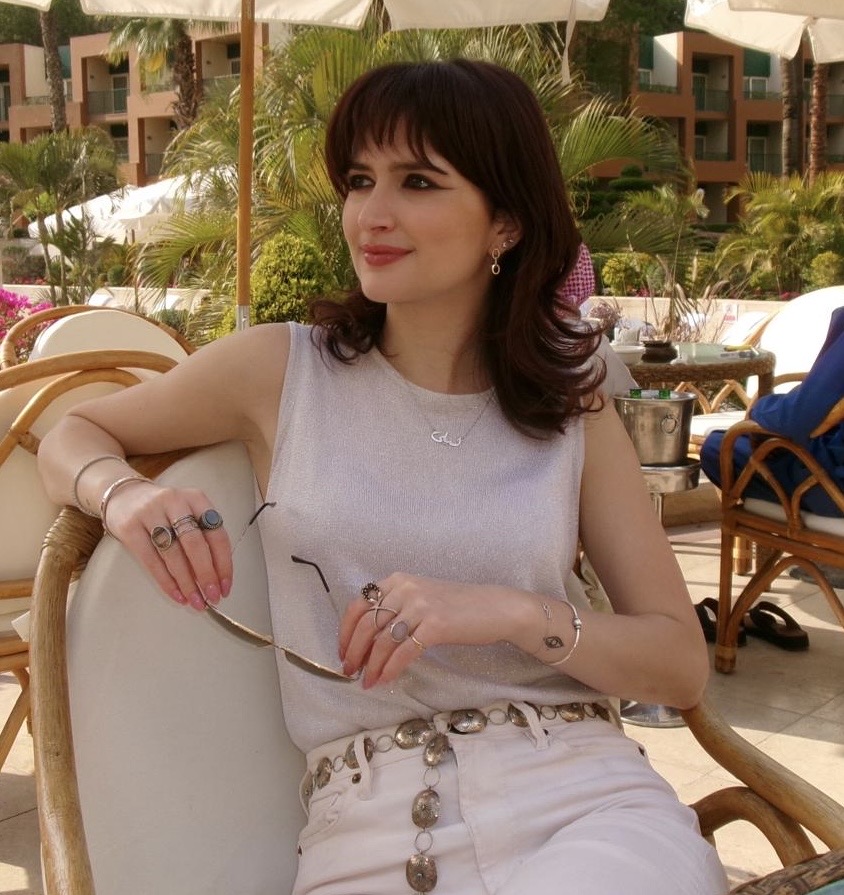
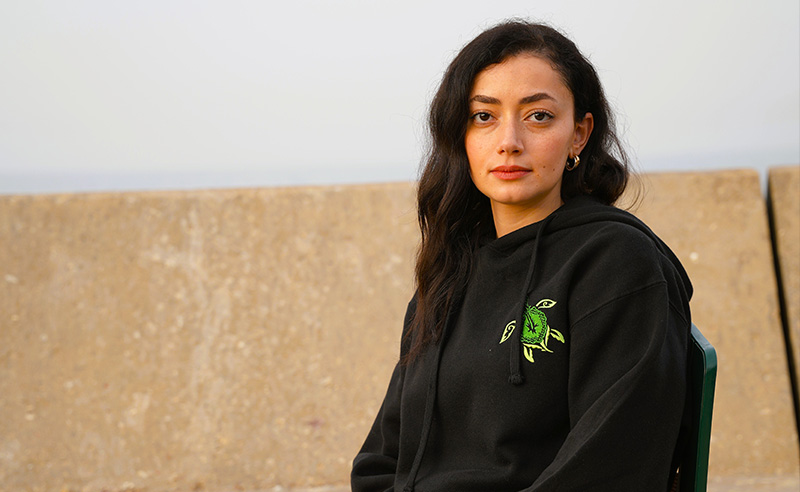
Palestinian journalist and author Plestia Alaqad became a public figure overnight. She remembers her first Instagram post that went viral on October 9th.
“During war times,” she explains in the video, “all the neighbors leave their doors open so you can just enter your neighbor’s house…they’re gathering all together in a place far away from the windows—” a series of explosions cuts her off, and her jaw drops. After a moment of silence, she closes her mouth and continues. “I was trying to explain things, but I think you can hear them now.”
Plestia reported on the ground in Gaza for the first 45 days of the genocide. She gained a following as she posted news updates almost daily on Instagram, often more than once a day. Plestia also shared human stories—the stories of people evacuating on bicycles, families sheltering in UNRWA schools, a young girl named Lulu celebrating her birthday in a refugee camp, and of herself drinking tea with colleagues in a car that became like their home.
Plestia’s videos, name, and face went viral—she realized the weight of her platform when she saw her picture in the hands of protesters around the world. She was only 21 at the time, a fresh graduate with a degree in media and journalism. She wanted to report on the ground eventually, but not under the circumstances that launched her career.
“I was proud that the stories I'm reporting on are getting millions of views, people are getting to see Palestinians through Palestinians' eyes,” she says. “Yet it's a huge responsibility, and I always ask myself, ‘What can I do with this platform and how can I help more?’”
Since fleeing Gaza two years ago, Plestia has been navigating this tension between using her platform to amplify Palestinian voices and discovering who she is outside of that role.
“I like to think of myself as a turtle who's patient and carries home with her wherever she goes,” she says. Plestia has carried home from Gaza, to Egypt, to Australia, and now, to Lebanon—where she is getting a master’s in media studies at the American University of Beirut through the Shireen Abu Akleh Memorial Scholarship. But there is weight to the shell she carries.
“When other people leave their countries for a better job or life opportunities they are called an inspiration,” Plestia says, “but when a Palestinian from Gaza flees a genocide just to survive, they are criticized.”
“The turtle is a symbol for how Palestinians are living and rebuilding,” Plestia continues, adding that “the message this turtle sends to the world is that there are a lot of ways to talk about Palestine, and it doesn't always have to be through news.”
Plestia just released a turtle-inspired clothing line with Wear The Peace—a Palestinian-owned brand that donates every purchase to a humanitarian cause, and has raised over 2.4 million USD for water, food and medical aid in Gaza alone. One hundred percent of proceeds from Plestia’s collection will go to the Ghassan Abu Sittah Fund which provides medical care to injured children from Gaza in Lebanon.
“I made sure to make this turtle as Palestinian as possible,” she says. It is adorned with traditional embroidery, a shell shaped like a poppy, Palestine’s national flower, and bordered in a keffiyeh pattern. The two items in the collection—a black sweatshirt and light green t-shirt—read the same line: “Carry on. Resist. Return.”
Dr. Abu Sittah’s foundation was a personal choice for Plestia. She first met Dr. Abu Sittah when she interviewed him in Gaza at the beginning of the genocide.
“I've seen Dr. Ghassan on the ground when he's busy trying to treat injured people and save their lives, yet he always makes time to talk, to speak to journalists and raise awareness,” she says.
The interview Plestia conducted with Dr. Abu Sittah is one of many that only Gazan journalists can access. Since October 2023, Israel has barred international journalists from entering Gaza, save for a few controlled cases. Journalists like Plestia were, and continue to be, some of the only sources to understand the reality on the ground in Gaza.
Through a self-run, autonomous news platform on Instagram, Plestia is able to share the stories that so many global media outlets cannot and do not. Abroad, she continues to report on everyday life in Gaza by staying connected to her community back home, reaching out to people through social media, and following up with the stories she was reporting on before she left—like an old lady who, with only five minutes to evacuate her home, refused to leave her birds and turtle behind. Plestia collaborates on Instagram posts with people like artist Nour Al-Saqa, journalist Hind Khoudary and doctor Sara Al-Saqqa who share what life looks like in Gaza today.
To report, she must work around Gaza’s collapsing infrastructure. She asks doctors like Al-Saqqa to send her WhatsApp voice memos between patients—or whenever they can. And if Plestia can get on a video call, she turns the camera on, so that, despite shaky WiFi, she can connect with the person face-to-face. “Just think of this as a conversation,” she reassures them, “not questions and answers.”
And she knows that even if she sets a date and time, nothing is guaranteed.
“The other day, I was supposed to interview my colleagues, Muhammad and Hatim, for a collaboration post,” she gives an example. “We agreed to talk tomorrow. But when tomorrow came, it was raining heavily and their tents drowned.” They couldn’t talk anymore, she says, because they were “busy trying to survive.”
“Most people in Gaza are living in tents right now,” she continues. A lot of Plestia’s work involves correcting dangerous narratives circulating the media about Gaza, including claims that the genocide has ended. Since the ‘ceasefire’ took effect on October 11th, 2025, Israeli attacks have killed over 600 Palestinians and injured 1,600 more. “How is it really over when there isn’t a house to go back to?” she asks.
“It's getting harder day by day to report or tell stories,” Plestia says. While people used to say yes to her interview requests right away, they’ve become more hesitant. Palestinians in Gaza are getting tired of sharing their stories without an end to the bloodshed and horror. Plestia does not pressure anyone to speak with her, but she also explains that change won’t happen overnight. “And even though it's exhausting and frustrating,” she says, “we don't have an option but to keep going.”
Plestia just published her first book ‘The Eyes of Gaza: A Diary of Resilience’. Sometimes Plestia looks at her book and diary side by side in awe of how the latter became the former—and an international best-seller.
“I know this book will be history one day,” Plestia says. “I wrote it for future generations—to know what happened in Palestine through our eyes.”
When choosing the words to describe herself, Plestia lands on ‘journalist’ and ‘author’. But like the people whose stories she tells, she does not want to limit herself to a singular label. Recently, she stepped into the role of ‘actor’ for the first time. She is playing a Palestinian lawyer named Nabila in filmmaker Rolla Selbak’s horror feature ‘The Visitor’.
Plestia has always been passionate about storytelling, but now she wonders if she chose journalism out of necessity—to ameliorate the misrepresentation of Palestine she saw in global news coverage growing up in Gaza.
“Sometimes I think, what if Palestine was free and it wasn't occupied?” Plestia ponders aloud. Maybe if she wasn’t Palestinian, she would have chosen to study theater. “Maybe I would not feel that my major has to come from a sense of urgency and purpose.”
When asked what she is looking forward to this year, Plestia pauses.
“I hope to see Palestine making news headlines,” she says, “but rather with the stories about how we're living and coping, not how we're getting killed.”
Related Articles
Trending This Week
-
 Mar 13, 2026
 -

-
 Mar 14, 2026
 -