




Ex-UNRWA Teachers Bring Palestinian Children Back to Class in Cairo
The Fikra Initiative is restoring in person education to displaced Palestinian children in Cairo after two years without school.
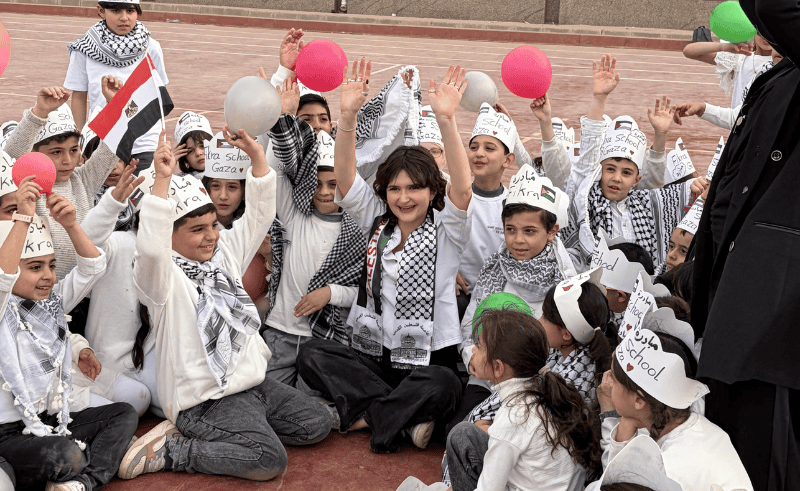
In a Cairo suburb beneath an afternoon sun, 70 students lined up in eight neat rows on a basketball court. They wore paper crowns with the words ‘Fikra Initiative’ drawn next to a Palestinian flag, keffiyehs draped over their narrow shoulders.
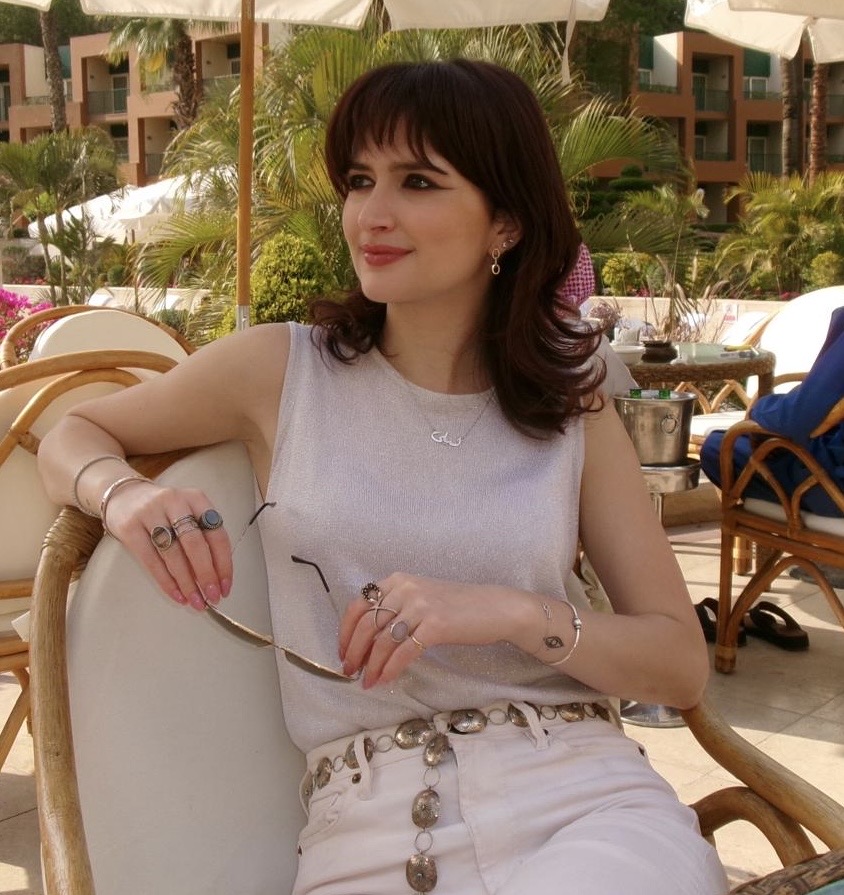
Fatima Herzallah, head of Cairo-based education initiative Fikra, blew a series of whistles to which the students responded in coordination, clapping, marching and stretching their arms out like wings. They sang the Egyptian national anthem, and then the Palestinian, ‘Fida’i’—which loosely translates to ‘the one who sacrifices himself’. Another series of children’s songs and choreographed routines was followed by a more sombre performance. “Give us a childhood,” the children sang together in Arabic. Then they switched to English—“Give us a chance.”
In January 2026, the UN’s Palestinian refugee agency (UNRWA) laid off 600 staff members, some of whom, like Herzallah, are teachers displaced from Gaza living here in Egypt. After 15 years, UNRWA dismissed Herzallah over email after a year of ‘unpaid vacation’. The agency has faced major funding deficits amidst ongoing targeted Israeli defamation campaigns that threaten vital services to hundreds of thousands of Palestinian refugees across the occupied Palestinian territories, Jordan, Lebanon, and Syria.
In September 2025, Herzallah joined fellow UNRWA teachers from Gaza to launch the Fikra Initiative. The five women now volunteer to provide free educational support to displaced Palestinian children in Cairo. Fikra collaborates with professors, students and philanthropists at American institutions, like the Massachusetts Institute of Technology (MIT), who provide them with physical materials and English curricula. They focus on the foundational years, serving 70 students across grades 1st through 4th. The volunteer teachers simulate the classroom experience, instructing alongside the Palestinian curriculum in subjects such as math, art, Arabic and religion.
Many of the students at Fikra have missed over two years of schooling due to displacement and bureaucratic barriers that bar their enrollment in Egyptian schools. The Palestinian Authority runs online classes for students on Microsoft Teams that follow the national curriculum, but they do not serve as a replacement for in-person schooling—especially for children in primary school. Online school, Herzallah said, cannot teach kids the basics of how to hold a pencil or read a book.
“It was impossible for us to see our children here without proper schooling and do nothing,” she said. “So we responded by drawing on our skills as teachers.” The women-led team developed their pedagogy with love for the children and for education. When the students first started at Fikra, Herzallah said, they were shy, they couldn’t express themselves, and they couldn’t even draw.
But now, first graders like Ahmed have made leaps and bounds in less than six months. “With online school,” he said, “I didn’t know how to read or write.”
“But now?” I asked him.
“Now I know how to read and write!” Ahmed looked up at Herzallah, who was standing next to him. “Thank you,” he said.
Kareem, a fourth grader at Fikra, is happy to be back at school in person, learning face-to-face.
“The lessons at Fikra are much better than when we were learning with Microsoft Teams,” he said. “I would just open my computer and not pay attention.”
Another fourth grader, Jenan, said that when she was studying online, she didn’t have any friends. “But because of Fikra,” she smiled, “I have made so many new friends.”
The five teachers arrived in Cairo in the first half of 2024 with their children—and without their spouses. Many of the displaced Palestinian families in Cairo are in a similar situation, where the mother is the sole caretaker; usually, her spouse either stayed behind in Gaza or was recently killed. Most of the Fikra students have recently been separated from their fathers or have been orphaned by Israeli attacks.
Second-grade teacher Dina Al-Banna said that after so many months of online learning, it was hard for students to get used to being back in a classroom. And for many students, it was their first time in a classroom at all, having fled Gaza when they were only three or four years old. So, before the lessons on reading and writing, they had to cover sitting still in a chair.
“We don’t use formal instruction at all,” Al-Banna explained. “Instead, we play. We apply every topic we teach using games.”
In each class, grammar and math lessons transform into plays and songs. During our visit, students took turns standing at the front of the classroom to present a lesson or lead an activity.
“Who wants to come up to the front and read me this word?” one fourth grader asked his classmates in clear, formal Arabic. Every single student raised their hand. He chose Emad, who read the word ‘school’ with pride. The room erupted in applause.
This is called the ‘Little Teacher Method’, first-grade teacher Soha Al-Hindi explained. “When students stand in front of the class, they learn to lead. It builds their confidence and helps shape them into leaders in society.”
“Play is what really makes the lesson stick,” fourth-grade teacher Amani El-Khatib added. “Our goal is to keep developing new teaching methods for our students and to expand Fikra to more grade levels, because our children deserve a real education.”
Before the genocide, the literacy rate in Gaza was at 98%. Herzallah hopes to continue Fikra in Gaza when they return.
“Fikra is not just restoring education for our children,” she said, “it is restoring their childhood.”
Related Articles
Trending This Week
-
 Apr 17, 2026
 -
-
 Apr 13, 2026
 -