


Egyptian-Designed Electric Motorcycle Debuts at Cairo Design Week
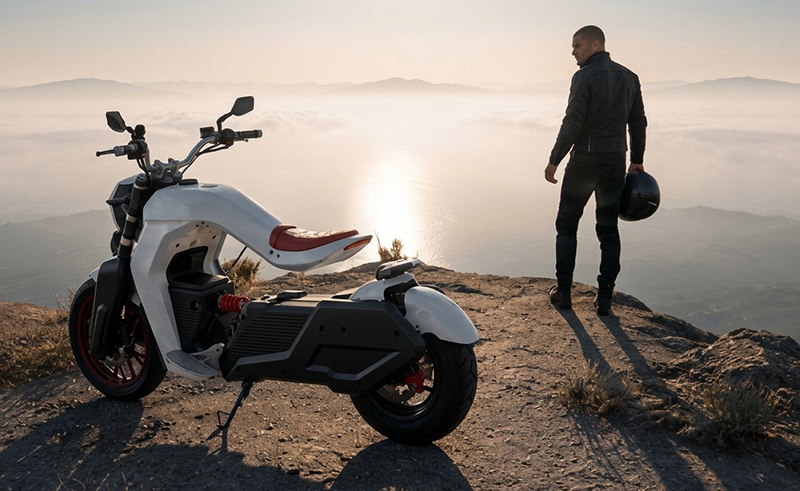
Developed in Egypt using 3D printing and computer-controlled tools to shape its parts, Natives tests how far a local team can take an electric motorcycle from design concept to working prototype.

Ali Hossam Ali has spent 20 years designing worlds for film. The Egyptian production designer has worked across local, regional and international features, building spaces that have to convince an audience for as long as the camera is looking.
A vehicle has asked something different of him.
Natives, the electric motorcycle prototype he developed with Creative Districts and a team of local collaborators, is the result of a long-standing ambition to design one himself. It will make its public debut during Cairo Design Week 2026.
Ali sees the motorcycle as one small test of a much larger possibility: whether the design and engineering skills already present in Egypt can eventually support more locally developed vehicles.
"I believe we have the skills in Egypt to develop things of our own, and this project is a way to show that," he says.
The idea began with the experience of riding itself.
 Ali designed Natives with experienced bikers and people who have never ridden a motorcycle in mind. Safety became one of the priorities from the beginning, along with a riding experience built around control and ease.
"I wanted to design a bike for bikers and non-bikers, and challenge the idea that motorcycles are inherently dangerous by making one with safety in mind," he says.
The electric powertrain also suited the type of motorcycle he wanted to develop, with the emphasis placed on a measured ride rather than outright speed.
Ali named the motorcycle Natives around an idea of reconnecting with yourself. Its motto, "A Ride Back to Yourself", describes the stretch between departure and arrival as time spent away from the pressures of everyday life.
Giving that idea a physical form proved much harder than drawing it.
One of the motorcycle's most distinctive elements is its seat, which Ali wanted to appear as though it were floating above the body.
The team created a supporting frame using CNC machining, a computer-guided process for cutting and shaping parts with precision. The motorcycle's body was produced through 3D printing.
Both processes came with trial and error.
"We succeeded in so many aspects, but also failed in so many aspects. Both taught us a great deal," Ali says.
Those failures are part of where the project currently stands.
Natives remains an early prototype and still needs considerable engineering development before anything resembling production. Ali has begun speaking with research and development laboratories, including PHOTONX, about what would be required to take the motorcycle further.
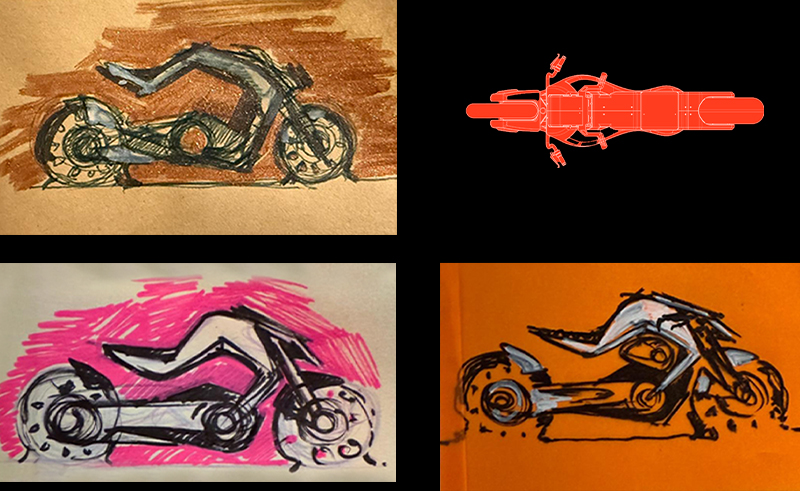 That unfinished stage is also part of the reason he wanted to show it at Cairo Design Week.
Visitors will see a project in development, with its design decisions, manufacturing experiments and unresolved engineering questions still visible. Ali hopes that makes the process of developing a vehicle in Egypt feel more tangible.
The motorcycle also brings together skills that rarely sit under one name.
Ali developed Natives with a team including engineers Waleed Fouad, Amr Shalaby, Saeodi Abdelrahman and Menna Ahmed, alongside Ahmed Kerez, Tamer Abdel Salam and Ibrahim Ali.
Their prototype becomes one piece of a wider conversation at Cairo Design Week through inMotion, a new programme dedicated to mobility, vehicle design, engineering and emerging technology.
Hosted at Sultan Hussein Kamel Palace in Heliopolis, inMotion brings designers, engineers, researchers and students together around the question of how movement is designed and how those ideas reach production.
The programme also includes Reimagining Ramses, which revisits one of Egypt's earliest locally produced cars through new design concepts, as well as university work in robotics, electronics and electric mobility.
Natives enters that conversation from a very different point in the process: one designer's ambition becoming an object that can now be examined, tested and improved.
The motorcycle in Cairo Design Week is not a finished consumer vehicle. It is evidence of the steps between wanting to build something locally and learning what it actually takes to do it.
Ali hopes those steps eventually lead somewhere much larger.
- Previous Article Egypt’s Entrepreneur Awards Reveal 2026 Finalists
- Next Article 31 out of 4,510 School Bus Drivers in Egypt Test Positive for Drugs
Related Articles

Trending This Week
-
-

-
 Nov 08, 2026
-
 Nov 09, 2026