






REVIEW: ‘The Stories’ That We Must Tell
The photograph with President Nasser, formerly a source of pride, becomes a persistent reminder of unachieved dreams.

My father [Egyptian journalist Riad Tawfik] greets Egyptian president Gamal Abdel Nasser with a handshake. Standing nearby are Vice President Anwar Al Sadat and Al Ahram’s editor-in-chief Mohamed Hassanein Heikal. The black-and-white photograph was captured at Al Ahram newspaper headquarters in Downtown Cairo’s Al Galaa Street during President Nasser’s historic visit on February 13th, 1969.
On that day, Nasser reportedly toured the newspaper’s building, meeting with the editors, leading writers, and a new generation of journalists. Among them appeared my father, then a young reporter who had just joined the paper.
For decades, this photograph was accorded a prominent place in the display cabinet of our family home. Wherever life took us in Cairo, the photograph travelled with us. It captured a defining moment in the life of a young journalist who had just joined one of Egypt’s, and the Arab world’s, leading newspapers. It was a time when my father was filled with immense ambition, for himself, for the profession of journalism, and for the future of Egypt.
From one political era to another, my father remained hopeful that his time would eventually come. Over time, he established himself as one of Al Ahram’s pioneering journalists, yet the ambitions he had carried in his youth remained out of reach. Beyond signifying his success, his photograph with President Nasser became a persistent symbol of the ambitions that history and fate had left only partly fulfilled.
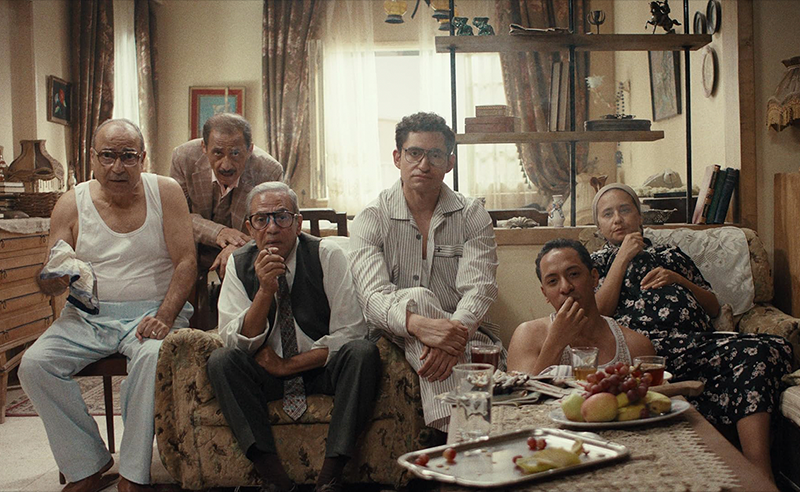
As I watched The Stories, the feature film by Egyptian-Austrian filmmaker Abu Bakr Shawky, I couldn’t help but think of this photograph. The 111-minute feature, written and directed by Shawky, follows a middle-class Egyptian family in the 1960s through the 1980s. Their lives play out against the major social, political and economic transformations that overhauled Egypt during those volatile decades.
The film rests on two recurring ideas: The first is that we must tell our stories (“because if we don’t tell them, did they really happen?”). The second is that dreams are realised at their own time, because any delay carries within it a blessing (kol ta’khira w fiha khira).
The film follows the journey of Ahmad, vividly brought to life by Amir El Masry, as he lives with his parents and two brothers. A gifted young musician, he dreams of becoming a concert pianist.
His father, Ragheb, brilliantly played by veteran actor Ahmed Kamal, is a civil servant at the Ministry of Agriculture. Like my father, he proudly keeps a photograph of himself with President Nasser. Because of this photo, he is hopeful about the future. But life intervenes. During a live television program, Ragheb mistakenly utters the word ‘corruption’. From then on, he lives in constant fear, convinced that the state would come after him. The photograph, formerly a source of pride, is transformed in meaning. Hanging on the wall of the family home, it becomes a persistent reminder of unachieved dreams, and of the single moment on live television that came to define Ragheb’s life.
But if Ragheb’s photograph came to signify unattained potential, the opposite is true for Shams. Played by Karim Kassem, Shams is an opportunistic musician who builds his entire career on a photograph of himself with the same president. Ahmad’s colleague, or, more accurately, his rival, Shams does not miss an opportunity to mention the photograph. For Shams, the photograph carries him from one opportunity to the next.
The motif of the photograph continues throughout the film. It resurfaces when Ahmad, determined to fulfil his dream of performing the great nationalistic songs and symphonic works popular at the time, receives a scholarship to study in Austria, where Shams is also studying.
There, Ahmad finally meets with his pen pal, Elizabeth, gracefully played by Valerie Pachner. Invited to Liz’s family home, he is shown the family’s photo gallery by Liz’s mother. Naively, Ahmad asks whether it is easy to get a picture with the president “because I have a friend who built his entire career on this.”
Her response is strikingly telling. She gives Ahmad a camera, as if encouraging him to create his own photographs rather than rely on a photograph with a powerful figure for recognition.
When the 6th of October War breaks out, Ahmad’s brother is martyred, prompting him to cut his scholarship short and return to Egypt. From that moment on, his life is punctuated by one obstacle after another, as history repeatedly disrupts his dreams.
In Europe, he handles the racism he experiences as an Arab student just as his dream of becoming a concert pianist feels closer than ever. Then comes the devastating loss of a family member, which brings him back to Cairo. In Cairo, the day of his long-awaited debut concert is eclipsed by the 1977 Bread Riots, leaving him unable even to reach the concert hall. Later, when he becomes “a public employee like my father and his father”, Ahmad expects a promotion, only to lose it at the last moment, upon the return of his rival, Shams, who is granted the promotion instead. As he sits in his new office, Shams proudly displays his picture with the president.
Throughout the film, Egypt’s volatile political climate and wide-ranging economic and social transformations do more than frame the story. Rather, they violently stand between Ahmad and the ambitions he wants to fulfil. In this light, this lack of a photograph with the president seems almost symbolic, another sign that recognition or power may never arrive. The question that looms is whether it is too late for Ahmad. Can he still be the concert pianist he has always dreamed of becoming?
As the film draws to a close, Ahmad finally gets his photograph with a public official, who also applauds his performance. The greater victory, however, is that the concert takes place. The camera that preserves the moment is the very one Elizabeth’s mother once gave him in Austria. One imagines that the photograph will now sit on a wall in Ahmad’s home for years to come, emerging as a symbol of belated recognition. But is it really that? Because Ahmad always mocked this very idea of a photograph with a senior official as a marker of success. Yet, he celebrates finally getting his own. It’s a paradox that many of us share with him.
But yes, the photograph does capture a ‘moment’ of success that unfolds after years of waiting. But how much struggle does it conceal? I think of this whenever I think of Ahmad, my father, and the many brilliant men and women who never received their due. The least we can do, as Shawky reminds us, is to tell their stories.
- Previous Article Independent Homeware Brands Worth Setting the Table For
- Next Article The Intricate Beauty of Ben Youssef Madrasa
Related Articles
Trending This Week
-
 Oct 06, 2026
 -
-

-