






ThrowMeNot Turns Supermarket Food Waste Into Profit
Founded in 2025, the Dubai startup redistributes near-expiry groceries through a marketplace where suppliers recover value from excess stock and consumers access food at reduced prices.


In this edition of NextGen, our series highlighting rising entrepreneurs across the region, we speak to ThrowMeNot, an Emirati startup tackling food waste.
Nearly 40% of food produced or purchased in the UAE is wasted every year - a staggering volume of edible goods that equates to millions of tonnes of food discarded and an estimated AED 6 billion lost to the economy. It is against this backdrop of environmental and financial urgency that ThrowMeNot has built its business, operating on a simple but disruptive principle: good food should be eaten, not discarded.
The challenge has become significant enough to attract national attention, with the UAE committing to halving food loss and waste by 2030 through several initiatives. Founded in 2025 by UAE-based entrepreneur Archie Rudyuk, ThrowMeNot enters the picture with a marketplace model built specifically around what happens before food reaches that final point of disposal.
“We’re a redistribution marketplace where suppliers offload near-expiry stock instead of disposing of it, and consumers buy it at a fraction of the retail price,” ThrowMeNot said in its explanation of the platform. The result is a model the company describes as mutually beneficial across the supply chain. “We found a win-win-win model: suppliers reduce losses, consumers benefit from affordable food, and the UAE advances towards its national objective of halving food loss and waste by 2030,” the team shared.
Rudyuk boasts over a decade of experience across digital commerce, fintech partnerships, and growth strategy in emerging markets. His background includes senior regional roles in international technology companies, where he worked on expansion efforts across the Middle East and helped build partnerships with banks, telecom operators, BNPL providers, and global brands.
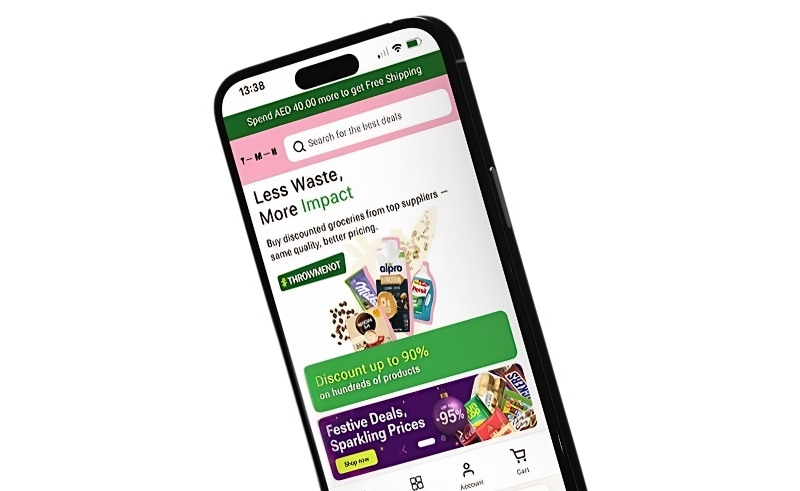
That experience now feeds into a company structure designed to stay lean. Operations teams manage packaging and delivery processes, while marketing focuses on positioning the platform and communicating its value to consumers. Separate teams handle supplier acquisition and onboarding, ensuring the marketplace continues to expand its inventory, while customer support manages the day-to-day experience of users on the platform.
Even with the operational framework in place, the company says its biggest hurdle lies elsewhere. “The biggest challenge for us is to normalise buying near-expiry products,” the team told StartupScene. Part of the difficulty lies in perception; expiry dates often shape consumer behaviour in ways that leave little room for nuance, even when products remain perfectly safe to consume. “Today, many consumers still associate near-expiry with compromise,” ThrowMeNot said.
Changing that association has become central to the company’s strategy. The aim is to reposition the purchase as a practical decision that blends cost savings with sustainability, rather than a last resort. For ThrowMeNot, the long-term ambition extends beyond clearing excess food from the supply chain; the company describes its future in broader terms tied to shifting consumer behaviour.
“Within five years, success means becoming the No. 1 regional sustainability ambassador across the MENA region by building and leading a broad ecosystem of sustainability-driven products, services, and initiatives,” the company said in comments shared with StartupScene. That vision suggests the marketplace may be only the starting point. Food redistribution, in this framing, becomes one example of a larger pattern: everyday consumption redesigned around waste reduction and smarter purchasing habits.
- Previous Article Title 2026
- Next Article The Ancestral Resilience of Omar El Farouk’s Fayoum Home
Related Articles

Trending This Week
-

-

-

-
 Jul 23, 2026