





The Story Behind the Trees that Turn Cairo Red Each Summer
The tree that turns Cairo red every June isn't from Egypt. Its story spans Madagascar, Paris and a Khedive's grand obsession.

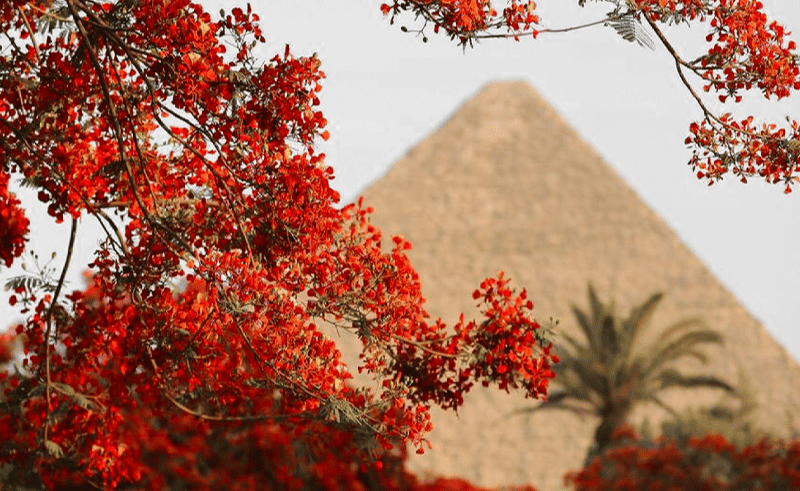
At the end of each spring, like a glaring symbol that summer is fast approaching, the streets of Cairo turn red with the flowers of the Flame Tree. Trees erupt in striking colour, dotting the ground with fallen petals that wash the city in shades of orange and crimson.
Known formally as the Royal Poinciana or Delonix Regia, and colloquially as the Flamboyant Tree, the Flame Tree has served as a rubicund harbinger of early summers across Cairo for over a century. For much of the year, the tree provides excellent shade with its quiet and unsuspecting fern-like leaves. When temperatures rise, however, they blossom with fiery red flowers. But this yearly flame, reliable as it has become, has not always been here.
The tree first came to Egypt from the dry forests of Madagascar in the 19th century, where it grew largely unknown to the outside world until the 1820s, when an Austrian botanist encountered it and brought it to Mauritius. From these islands, its seeds and saplings travelled the world - carried along colonial routes - to India, the Caribbean and Brazil, collecting new names and meanings in each new home. Eventually, the Flame Tree reached Egypt, thanks to a partnership between Khedive Ismail and a French gardener.
Ismail Pasha, who came to power in 1863, was heavily influenced by France throughout his life. Having completed his education in Paris, he watched as Georges-Eugène Haussmann tore open the French capital with grand boulevards and sweeping parks. Later, as the ruler of Egypt, he embarked on massive architectural campaigns to transform Cairo into the ‘Paris of the East’.
As a result, much of the architecture of 19th-century Khedivial Cairo is European in design and style. But Ismail’s transformations went beyond what he could build with stone and brick - he wanted to remake Cairo's green spaces with the same European hand.
To do so, he brought in Jean-Pierre Barillet-Deschamps, the chief gardener of Paris itself, who had designed the Bois de Boulogne, the Parc des Buttes-Chaumont, and the great green lungs of the Second Empire.
Barillet-Deschamps spent the last years of his life in Egypt, laying out parks and gardens for the Khedive across Cairo. Most notable was the Azbakeya Gardens - the only green space in the Khedivial plan - complete with a lake, a bandstand, gas lamps, and winding paths. As a horticulturist, Barillet-Deschamp worked with Ismail to line the garden’s walkways with exotic trees from India, Australia, Cuba, Brazil, and Madagascar, which is where the story of the Egyptian Flame Tree took root.
Elsewhere in the world, the tree has acquired a weight of meaning. In India, where it's known as the Gulmohar, it is the unofficial signal that summer has arrived - its red canopy appearing in poetry, in painting, and as an exciting symbol that the end of the school year is in reach. In the Caribbean and across Latin America, it lines colonial plazas and is woven into the visual identity of entire cities. In parts of Southeast Asia, it marks university campuses, and its bloom season is bound up with exam time and the bittersweetness of graduation.
Here in Egypt, we call the tree the Boansiana. While their annual blossoms only last around a month or two, overtaken by the approaching summer heat, the trees they emerge from have watched generations of Egyptians grow beneath their shade. They have also witnessed the end of the Khedivate, a British occupation, and six presidents - blooming each year faithfully with a few weeks of red.