


Roeqiya Fris Sells Prints Worldwide but Has Never Shown Work in Egypt
She taught art in a Dutch secondary school, ran a workshop company for six years, then went out on her own. Roeqiya Fris talks about colour, Arabic script, and the country she has never exhibited in.
Idyllic. Nostalgic. Warm. Transportive.
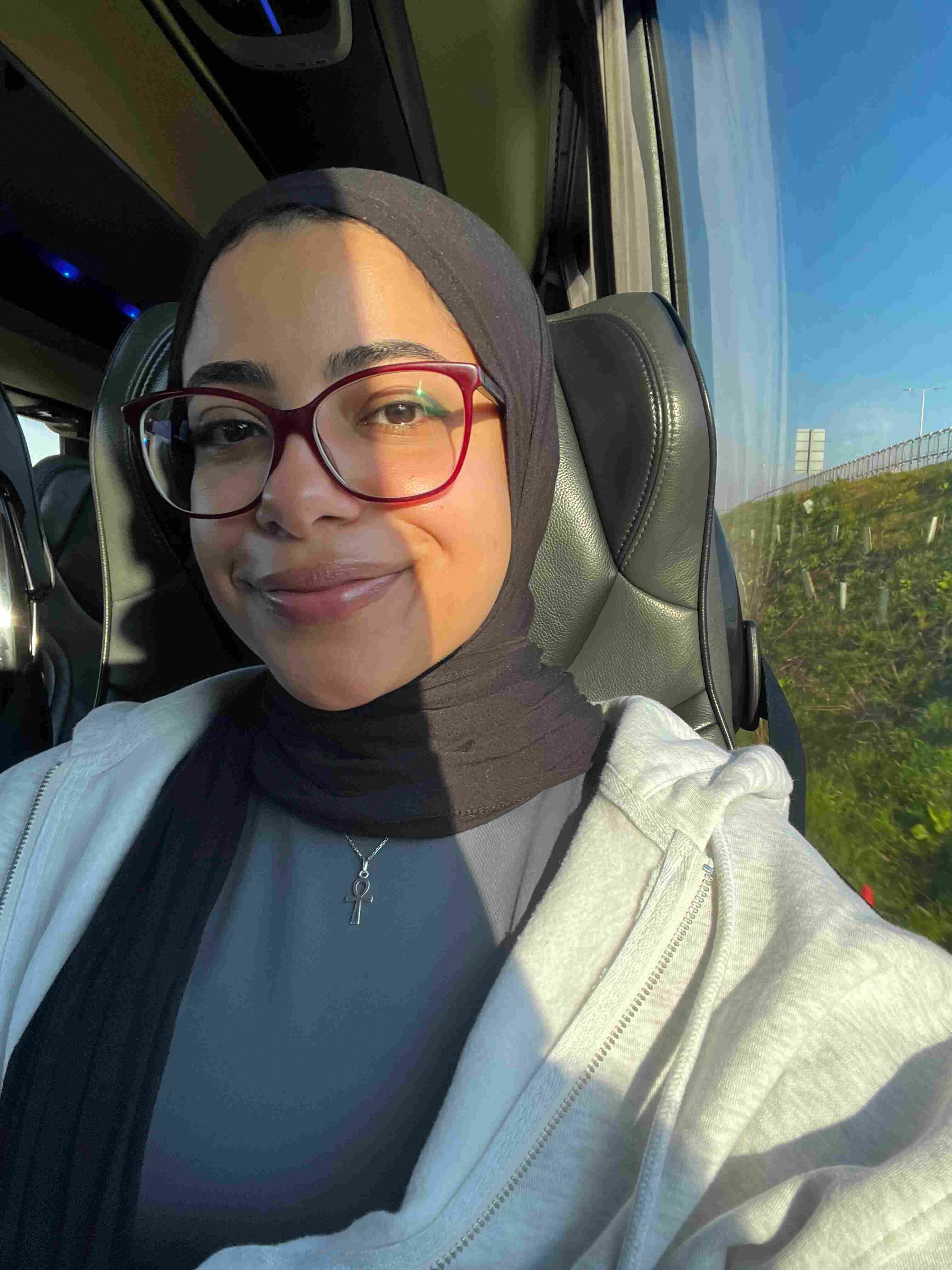
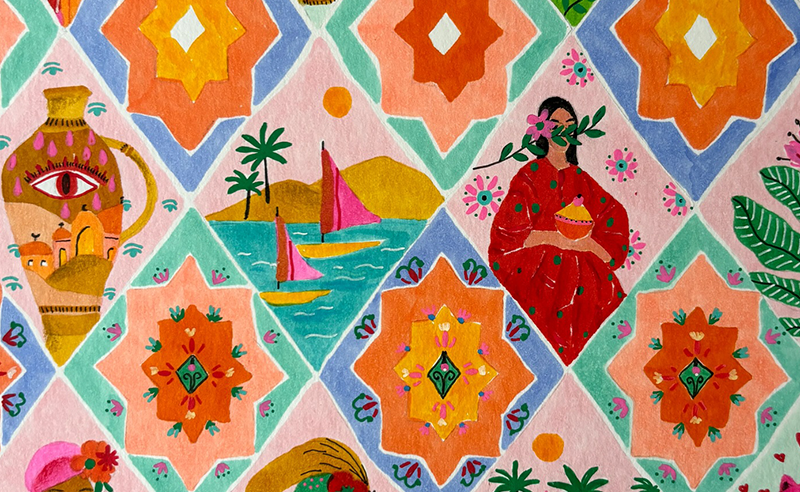
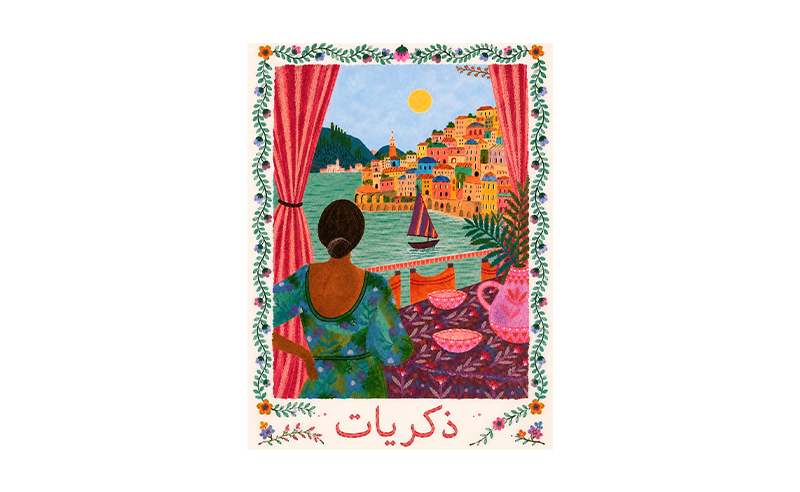
These are some of the words that surface when trying to describe Roeqiya Fris's artwork, depicting dreamlike scenes in layered ink, gouache and pencil, filled with soft, composite women, gardens, boats and Arabic script.
The Rotterdam-based Egyptian-Dutch artist illustrates what could be, offering those who come across her work the freedom to transport elsewhere, to a memory, a dream, an imagined destination.
"I want the viewer to feel warmth, wonder and maybe a little escape," she says. "Like opening a small window to another world."
Fris has only worked as a full-time illustrator since 2018. Before that she ran Fris Projecten, a creative workshop company, for six years. Before that again she taught art at a secondary school, and stopped for a period to care for her son.
"During that period, I began drawing again, and this time I never stopped," she says.
"I think painting has always been something I needed as a way to express myself and to feel grounded, although I did not always listen to that need," she says.
"Looking back, I think art helped me reconnect with a part of myself that I really needed," she added.
Her relationship with art began with a feeling, cultivated long before she had the language to name it. Her father took the family to museums often, and something about standing in front of those paintings stayed with her. "I remember being really impressed by the colours and the atmosphere," she says.
A high school art trip to Paris, Florence and Venice solidified it. Encountering the work of Monet, Gauguin and Picasso in person was, in her words, the moment she began dreaming about becoming an artist.
-b8fe66e0-9fdd-4c40-83d5-044222d2a9ce.png) She went on to study at the Willem de Kooning Academy and later worked as a fine art teacher. Getting to a style took time.
At secondary school she filled large sheets almost entirely with faces that didn't always look very happy. "I was searching for my identity at the time," she says, "and trying to understand myself."
Flowers, cars and aeroplanes came next, then altered photographs of her sisters, each phase a little closer to the style she'd eventually land on.
For Fris, it always comes back to colour: two brightly coloured cars parked side by side, flowers spilling over a garden wall, a stranger's outfit glimpsed through a shop window. "Colours just make me happy," she says.
It's an inheritance as much as an instinct. Her Egyptian mother filled their home with colour long before Fris picked up a brush, in fabrics, prints and interiors, never anything quiet or minimal.
"There was always colour, music, food, textiles." Colour was never decoration in that house. It was warmth made visible.
 Born in Cairo to an Egyptian mother and Dutch father, Fris spent part of her early childhood in Saudi Arabia before her family settled in the Netherlands.
For a long time she felt more Dutch than Egyptian, simply the culture she'd grown up closest to. It was painting that gave her Egyptian side room to grow.
"I discovered how deeply rooted that part of me really was," she says. "I could continue creating Arabic and Mediterranean scenes endlessly; they are still the subjects that excite me most."
Now she carries both, two temperaments folded into one. "The Dutch part is maybe more in my way of thinking: practical, down-to-earth and structured.
The Egyptian part is more in my heart: emotional, warm, expressive, connected to music, food, dancing and being together with family." It's this duality, she says, that sits at the heart of everything she makes.
"My work is really about connection: between cultures, between people, between memory and imagination, between the everyday and the magical."
That same connection threads through her use of Arabic script, tucked into corners of her work. Arabic was the first language her parents taught her, and her father, an Arabist by training, taught her to read and write it before she started school.
"Adding Arabic words feels like folding a part of myself back into the image," she says.
Even where the script doesn't appear outright, something of the language lingers in the work's feeling: its warmth, its humour, the sense of a story hovering just outside the frame.
"My pieces often feel a bit like little stories too," she says. "I like the idea that something happened just before the moment you see, or that something might happen afterwards."
Women appear again and again across her work. Not portraits of any one woman, but composites gathered from her mother, her sisters, her friends, women glimpsed in passing on a street or lingering in a film.
She paints them soft, elegant, intuitive and free. "I don't see softness or sensitivity as weakness at all," she says. "There is a lot of strength in being open-hearted, creative, caring and connected to beauty."
Nature moves through the paintings with that same rhythm: flowers, trees, birds, fruit, animals, gardens. It works less as backdrop than as belief, a vision of paradise where people, animals and nature exist together in soft harmony.
-cde8be53-443e-4b67-812a-4b1bbc860d3b.png) Much of that atmosphere traces back to Egypt itself: the heat, the sound of the streets, the smell of food drifting from open windows, the Nile catching the light. "It felt like a feast for the senses," she remembers.
Those memories rarely surface literally in her work. They sit in the background, colouring everything without announcing themselves.
Because of her son's care needs, Fris was unable to return to Egypt for many years. "When I finally went back a few years ago, I was surprised by how closely the country still matched my memories," she says. "To be honest, it felt even more beautiful than I had remembered it."
For all the dreaminess of the finished image, the process is patient and tactile. Fris works almost always on paper, layering coloured ink, markers, gouache and pencil. It begins with gathering: images of women, plants, architecture, textiles, colours that carry the right feeling, before she moves into a rough sketch.
Once she begins the final artwork, a piece usually takes six to eight hours. She prefers to complete it in one sitting where she can, because staying in the flow keeps her connected to the feeling of the piece. What she's chasing isn't really planned.
"I am searching for the moment when I surprise myself, when something appears that I could not have planned or imagined beforehand," she says. "Painting is not a completely rational process for me, and that is what makes it so special."
One piece still holds particular weight: '4 Sisters', showing her and her sisters in front of a large, warm pink house, a car placed just within the frame.
The car represents freedom towards something rather than away from it, the ability to decide for yourself where to go and when. "That freedom is not necessarily about escaping from something," she says, "but about moving towards new experiences."
-2e58ebb3-5aff-430d-ad92-7de6a64924fa.png) Her work has travelled further than she expected, into homes across countries she may never visit. "It still amazes me that people from all over the world have my prints in their homes," she says.
Visibility carries its own weight, too, and with it the temptation to chase what performs. "I try to stay close to my own intuition and keep making work that feels honest to me."
Egypt is one country her work hasn't reached. She has never exhibited there, though she thinks about it. "I would love to exhibit my work somewhere in Egypt where both local people and visitors could see it," she says.
She's careful not to overstate what that would mean. "I don't feel responsible for representing an entire country or culture. It's a personal interpretation rather than an attempt to speak for Egypt or Egyptian people as a whole."
Looking ahead, she feels the pull towards something more personal still: autonomous work, made with fewer constraints, following threads that have always mattered to her: Arabic words, women, nature, patterns, memory. And printing more of it, so more people can carry a piece of that world home.
- Previous Article Here's What's Changing Under Saudi Arabia's New IPO Rules
- Next Article European Film Festival Returns to Riyadh for Fifth Edition