




Inside Gaza Was Built From Footage Shot Under Fire
A behind-the-scenes interview with the makers of Inside Gaza, as Hélène Lam Trong and Mohamed Abed talk about filming under siege and turning survival into a documentary record.

In 2018, Naftali Bennett, then Israel’s defence minister and later prime minister, made a long-standing Israeli military logic explicit; “He who does not mow the grass, the grass mows him.”
For decades before October 2023, Gaza had been discussed in the language of landscaping. “Mowing the lawn” was the phrase Israeli strategists used to describe periodic military assaults devised not to resolve the conflict, but to manage it through repeated, controlled destruction, short operations meant to “cut back” what was framed as militant capacity, even as civilians and the infrastructure of daily life were repeatedly pulled into the blast radius. An entire population made organic and disposable, expected to grow back only to be cut again.
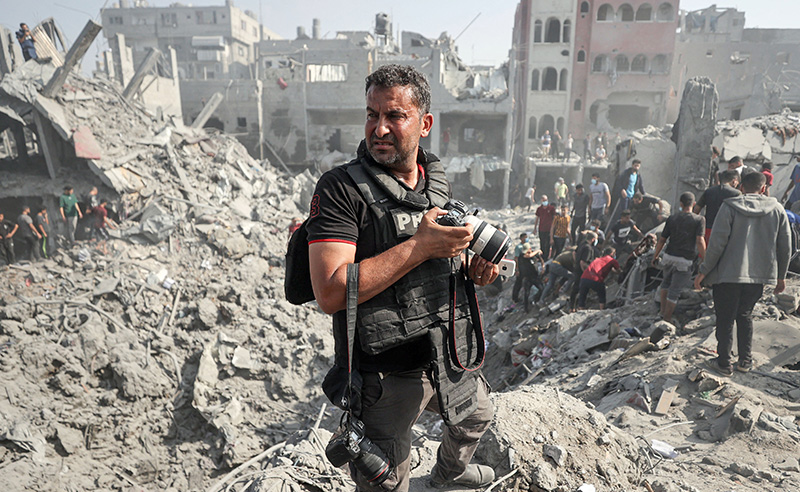
7th October ruptured the systemic calendar. By 6:30 that morning, AFP photographer and videographer Mohamed Abed was awake and by 9:30, his nephew, also a journalist, was dead. “It was one hour,” he says. “There was no time to process what kind of war this would be. One moment there was sleep, and in the next, death had already arrived.”
A split has happened inside him almost immediately. “The first split is as a journalist,” he says. “You keep working, you become sad, but the enzyme that makes you cry stops working. The tear ducts shut down.”
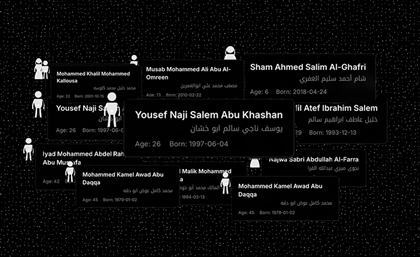
The days and years that came next are now most often told through numbers: tens of thousands killed, almost everyone displaced, hundreds of thousands living under plastic sheets or in the open. Those numbers matter but they still don’t capture why so many people instinctively reach for the word genocide rather than war, or mass killing. Genocide aims to end a “we.”
This attempted killing of that “we” – social death – is being recorded, in real time, by a shrinking circle of journalists. Inside Gaza is a documentary built entirely from the work of Palestinian reporters from within the Strip, capturing daily life, loss, and survival.
The documentary follows a small circle of Gaza-based AFP journalists and editors, including director Hélène Lam Trong shaping the film from Paris, photographer and videographer Mohamed Abed reporting from the ground, field reporters Mai Yaghi and Adel Zaanoun, and photojournalist Mahmud Hams, as they document life, death, and disappearance while Gaza is reduced, from afar, to a shaded polygon on a breaking-news map.
In conversation, Hélène Lam Trong and Mohamed Abed spoke about how Inside Gaza was built from inside a sealed war zone, the targeting of journalists, the politics of verification, and what it means to document a place while being denied exit.
“All the protagonists are full-time employees of Agence France-Presse,” Lam Trong tells CairoScene. “The images and photographs used in the film are those produced by AFP photographers and video journalists in the course of their work for the agency.” She built the film almost entirely from photographs and video the Gaza team had already transmitted: morgues, schools, streets, tents, seaside, ruins. “The articles from Adel Al Zaanoun and Mai Yaghi, the images, were all available on the AFP wire for all other media outlets,” she says. “Very few, however, chose to pick them up.”
In law, the word genocide follows a cold discourse anchored by specific acts carried out with intent to destroy a national, ethnic, racial or religious group as a group. Philosophers go further arguing that what distinguishes genocide from other mass atrocities is not only that many die, but that a people’s social existence is attacked.
That “we” lives in schools and universities, in local newspapers and radio stations, in hospitals that carry medical histories across generations, in mosques and churches that record births, marriages and burials, in archives, libraries and the small neighbourhood routines through which a society recognises itself and remembers that it exists.
Destroy enough of this, methodically, and a population can remain biologically alive while being propelled towards social death; alive, but without continuity, visibility, institutional memory, political existence. That is what makes the work of the remaining press in Gaza so central.
The Agence France-Presse (AFP) operates on the world's largest global news operation, as well as having rigorous protocols for ensuring each piece of news that is published goes through an extensive multi-level fact-checking process, 1st in Cyprus by the editors then in Paris. Locations are cross-checked, time stamps confirmed, clips compared with other sources. “The reporters working on the ground in Gaza are extraordinarily meticulous,” she says. “Before anything is published, their dispatches, photographs and videos undergo several layers of verification.”
From Paris, Lam Trong watched the staff work under bombardment, knowing that every photo might be their last, and that many colleagues had already been killed. AFP’s Gaza City bureau itself was destroyed by an Israeli strike. The agency was incessantly negotiating, unsuccessfully, with Israeli authorities to evacuate its staff. “We had no idea what would happen to them, whether they would be killed or survive, or whether Gaza’s closure to foreigners would continue,” she says. “Had the border reopened, I would have gone myself. But it never did.”
Lam Trong never asked them to film “for the film”. They were already working around the clock to feed the wire, and stealing whatever off-hours they had to find shelter, food, water, a place to sleep for their families. “From Paris, I was not going to ask them to take on additional work while they were already overwhelmed and living under constant threat,” she says. “I decided to make do with what already existed. It was also, I believe, the best way to pay tribute to the quality of their work.The only people who truly took risks were the Palestinian reporters in Gaza, I was perfectly safe in France.”
Later, when most of the permanent staff had finally been allowed to leave, she met them in exile – Doha, Cyprus, London, Brussels – and documented their lives there. Those scenes ended up taking very little space in the final cut. The film stays with Gaza itself, and with the footage - some of which are seen for the first time- that was shot while there was no guarantee anyone would ever see it.
For the journalists who stayed, the camera was a bet that being seen still mattered in a world where international law looked increasingly rhetoric. It was also, as Abed puts it, “a fragile line of continuity.”
Abed remembers waking up some mornings after the bombardment began with stunned disbelief. “You would wake up and think: I started a new morning,” he says. "Every day felt like something that should not have happened." “In those first days,” he says, “civilians were not yet fully in shock; they were tense, stunned, pulled tight between fear and disbelief.” The shock settled later, as the scale of loss grew and grew and the horizon shrank. “Death is something I cannot count,” he says now. Numbers stopped being meaningful long ago.
Abed did not think of documentation as his first priority in the abstract sense of “telling his story”. “Documentation was not number one,” he says. “I wanted to record the scene more than my own life.” For weeks he moved from Gaza City to Khan Younis and Rafah, trailed by displacement, destruction, and rumour. “I kept filming for the archive,” he says. “For international courts, for the global archive.”
Abed explains how the war has redrawn the line between different kinds of journalists. On one side are the professionals, those who have been working for years. “The experienced journalist becomes like a crime-scene photographer,” he says, “Precise, detached, trained to register details others avert their eyes from.” On the other side is a new “second generation” of war reporters who emerged as foreign media were banned and experienced teams were killed or evacuated. “The war produced citizen journalism,” he says. “After the others left, a second generation took over: completely different, instinctive rather than intellectual.”
These are people who film their own neighbourhoods on phones while running, crying, shouting into the microphone. Their work builds a growing archive of images that denies the limits conventional media places on what is considered too graphic to be seen.
Working from Paris, Lam Trong confronted her own constraints, deciding what could be shown and how to assemble it. She went through everything: “Every photo and video shot by the team, every dispatch written by the AFP Gaza reporters between October 7th and the end of May 2024.” What she saw, she says, is Almost impossible to look at without turning away.” People now tell her the film itself is extremely violent, hard to watch. “But on a scale from one to ten,” she says, “I’d say the film is only a three compared to what actually happened.”
She made the film following a simple rule that governs much of European journalism; images must not violate the dignity of the people they show, alive or dead. That rule, she knows, comes from a particular cultural place. “Bombings and collapses can devastate faces in unbearable ways, sever bodies, crush human flesh,” she says. “If the integrity of a corpse is gone, if it has been horribly mutilated or left naked, we consider that showing it harms its memory, the image the family held of their loved one, and therefore their dignity.”
“It’s not about hiding reality,” she adds, “but about fulfilling a duty to inform while still respecting the dignity of the victims.”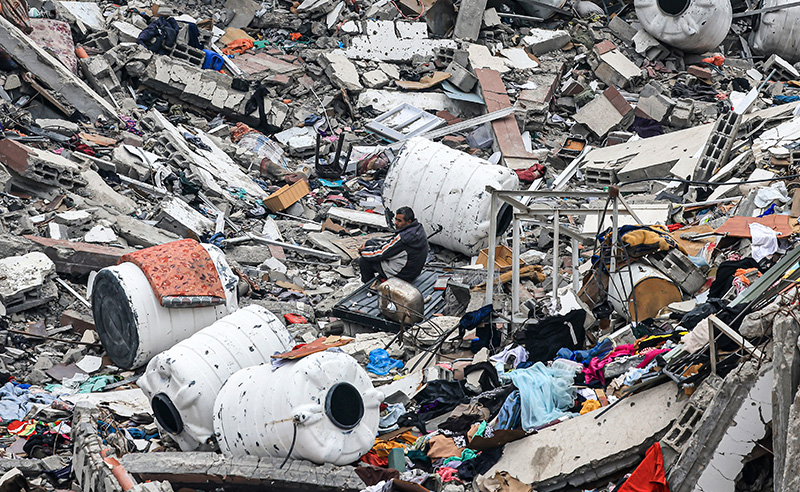
She also had to think about duration. “On social media, people can swipe away the moment an image becomes too much. In a seventy-five minute film, the viewer is held” she explains. If she had placed the most extreme images in the opening minutes and followed them with constant horror, the documentary would have been unwatchable for most people and likely never broadcast in prime time, when families sit together in front of the screen. Blurring the worst scenes might have made it technically acceptable, but she felt that would “completely dehumanise” the people inside them.
She opted for a different structure, placing only a handful of the most devastating videos – by Belal Al Sabbagh and Yahya Hassouna – at carefully timed intervals, while still photographs, particularly those by Mahmud Hams, Mohamed Abed and Said Al Khatib, carry much of the film’s emotional and documentary weight. “Photography plays a major role in the editing because I believe it forces the viewer to confront reality,” she says, “sometimes even more than video does.”
The film also raises a question about neutrality. When social death is enacted through the destruction of a people’s record, neutrality toward that destruction ceases to be neutral. “I don’t believe in journalistic neutrality. Every journalist brings their own history and worldview to the work, which is why press freedom matters across the political spectrum,” Troy explains.
There is a well-worn narrative about people - especially Palestinians - who survive atrocities in which they are cast as moral exemplars, resilient and dignified and forgiving, as if their response itself somehow redeems the horror, a story outsiders are often comforted by because it suggests that even if we watched and did nothing, the victims themselves have already purified the violence through their grace. “People under bombardment owe no one composure or forgiveness, only the right to exist, to grieve, to be angry, to demand justice, and if any moral obligation exists, it falls upward on states, institutions, and publics that choose to move on,” Abed, now based Cairo, says.
He keeps count of violations in ways others don’t. Hundreds of breaches during brief truces. At least 250 journalists and media workers were killed without legal consequence. “The failure to prosecute Israel for that number of journalists,” he says, “is like a pardon, a blank cheque.”
At times, Abed describes guilt moving in a different direction. Survivor’s guilt, of relatives who did not make it out, of a ninety-year-old mother who spent years searching for food. He recalls, in passing, the moment his children were permitted to cross and he was not. “They erased my name and approved my children,” he says.
Inside Gaza exposes this inversion of obligation. The journalists in the film carry a grotesque double burden: they must find food and water, move their families from one place to another as neighbourhoods are flattened, try to sleep under the sound of drones – and at the same time, keep filming so that, later, no one can say, “We didn’t know.”
Lam Trong has spent much of her recent career telling stories that sit in that gap between law on paper and law in practice. In ISIS: The Ghost Children, she followed thousands of children born to jihadists, held for years in camps in northern Syria and Iraq. They were, in legal terms, innocent but in practice, they were treated as a permanent underclass, punished for their parents’ choices.
“Incarcerating innocent children is strictly prohibited under international law,” she says. In another documentary, she filmed the Syrian city of Raqqa after it had been reduced to rubble in the war against ISIS. It had been the first city to free itself from Assad in 2013. It was then chosen by ISIS as its capital, and bombed accordingly. “The international coalition reduced Raqqa to ashes,” she says. “Bombing jihadists and civilians indiscriminately, even though part of the civilian population was held hostage.”
“In Gaza, the population has no possibility of escape,” she says. “The vast majority of victims are not fighters but unarmed civilians. The international press has been banned, and hundreds of journalists, as well as humanitarian workers, doctors and paramedics, have been killed with impunity. We are witnessing the gradual death of international law.”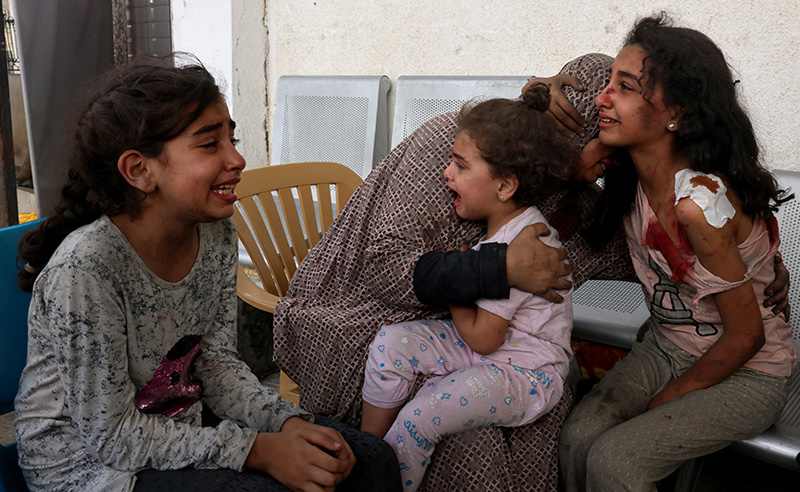
Trong was worried after she finished the film that it would be misaligned on both sides: too violent for Western audiences, too restrained for those living the war from the inside. “What has truly struck me over the past few months is the intense emotion that follows every screening – in Europe, the Middle East, Asia. I believe these screenings allow them to remember that their work as journalists is important and deeply valued,” she says.
Finding a broadcaster had been the hardest part. “In France media coverage of Gaza failed,” she says. The October 7th Hamas attacks, and the personal ties many French citizens have to Israel, “clouded judgment”. Emotion is human, she says, “but it is not a reliable guide. It weakens our intellectual and moral defences.”
Part of the media sphere became porous to Israeli propaganda. Military spokespeople were given air time without much challenge, even after some of their statements were revealed as false. Reports filmed “embedded” with the Israeli army inside Gaza were broadcast without making it clear that no foreign journalist was allowed to move freely, meet Palestinians, or verify anything independently.
“Clearly, part of the profession showed a lack of solidarity with Palestinian journalists. And this has only deepened the public’s loss of trust in our profession. I fear we will all pay dearly for it.”
- Previous Article Halfpipes Under Siege: The Skateboarding Scene in Gaza & the West Bank
- Next Article Rap of the Week | Dec 9 -15