





'Once There Was a Tram' Archives the Faces of Alexandrians in Transit
Before the tracks came up, Fatma Fahmy documented the ordinary lives that passed through Alexandria's tramways.

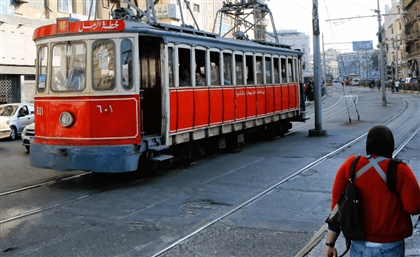
Years before it morphed into a heritage project or a casualty of urban development, Alexandria's tram carried workers to shifts, students to universities, and entire families to the sea. For more than a century and a half, generations of Alexandrians passed through its blue and yellow carriages. Today, the tram survives in photographs, postcards, archives and nostalgic recollections on Facebook - but the people who rode it are harder to find.
I stumbled across Egyptian documentary photographer Fatma Fahmy's work while searching for evidence of documented ordinary life inside Alexandria's oldest moving space. Like many Alexandrians, I have a vivid memory of the tram. My grandparents lived in the area of Sporting, in a building overlooking the tracks, and I remember the vibration that rattled through the building whenever a tram passed below. I remember errands becoming journeys, journeys extending into afternoons. I also remember sitting by the window, watching the city through scratched glass clouded by years of use, and the thin strip of rust that collected where the window slid open and shut.
What I recall most, though, are the people. The old man who always sat in the same corner, the conductor squeezing through crowded aisles and the women carrying shopping bags, their conversations bleeding into my grandmother’s.
For me, Alexandria was the temporary community assembled inside a tram carriage.-54b87a95-3b23-48bf-8db6-4777ecd30cde.png) Fahmy's month-long 'Once There Was a Tram' project stems from the same intuition, coming to it as an outsider. "I am not originally from Alexandria," she tells CairoScene. "I grew up in Saudi Arabia, and we only came here during holidays. The project began during a workshop in 2019 organized by the French Institute in Alexandria, where participants were tasked with producing a documentary series about the city. The tram was the one thing I associated with Alexandria.”
Fahmy's month-long 'Once There Was a Tram' project stems from the same intuition, coming to it as an outsider. "I am not originally from Alexandria," she tells CairoScene. "I grew up in Saudi Arabia, and we only came here during holidays. The project began during a workshop in 2019 organized by the French Institute in Alexandria, where participants were tasked with producing a documentary series about the city. The tram was the one thing I associated with Alexandria.”
The project predates the current developments in the area, in an era when plans for revamping Alexandria's tramway system were nothing more than rumours. Alexandria's tramway was founded in 1863 and is perhaps the oldest working tramway system in the world. This pre-dates not only the Egyptian republic, but automobile dominance and even the city itself, since large parts of Alexandria have been built around the tram. Areas developed around the tramway and whole generations have planned their lives based on its schedule. Yet history alone does not explain why the tram occupies such a disproportionate place in Alexandria's imagination, or why photographs of it summon grief. Cities contain countless forms of infrastructure, none of which inspire the same kind of nostalgia or affection reserved for the tram.
For much of its history, this vehicle functioned as one of the few places where Alexandria could see itself whole. Office workers sat beside schoolchildren, families returning from visits shared space with university students heading the other direction and strangers spent thirty or forty minutes together before dispersing back into separate lives. Modern urban life was defined by fleeting encounters and their residue.
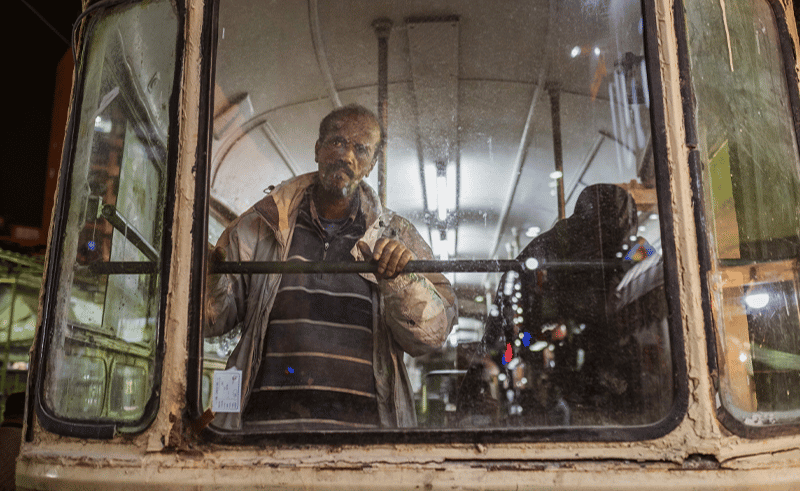
What Fahmy understood, after weeks of riding the same routes, was that this invisible ordinariness produced an extraordinary archive. She began researching the tram's history, hunting through books and old records for route maps, eventually finding one and following it obsessively. "I rode the tram every day," she says. "Usually at the same time, but on different routes. One day I'd go to El Wardian, another to El Amriya, another to Raml Station. I wanted to understand where the lines went." Every day brought the same tracks but different passengers, the same stations but different lights, the same routes but different conversations. “Over time conductors began recognising me, drivers grew familiar with my presence and regular passengers stopped paying attention to the camera,” Fahmy says.-52b502c6-ceca-40e0-ae8d-e9a401322bc4.png) "In the tram, everyone seemed to be living inside their own world. My photographs return again and again to people suspended in thought, looking out windows, waiting, resting, existing in that strange mode where one is simultaneously alone and surrounded by others.”
"In the tram, everyone seemed to be living inside their own world. My photographs return again and again to people suspended in thought, looking out windows, waiting, resting, existing in that strange mode where one is simultaneously alone and surrounded by others.”
One of the people Fahmy remembers most vividly from her months on the tram was a mute man with whom she communicated entirely through notes written on a piece of paper. "I still have the paper," she says.
Many of her photographs depict moments that would be considered quite little by conventional photographic logic. “I was not looking for THE moment, you know, the peak of action, the fraction of a second. I didn't want people to pose," she says. "I wanted it to feel like a moment from their lives."
Fahmy's method was all about patience. She disliked the idea of raising a camera and immediately beginning to photograph. "I didn't like having the camera in my eye all the time or making people feel like they were being photographed," she says. "Sometimes I'd sit and talk to people for a long time before taking a picture. After a while, they forgot I was there."
Many of those lives remained largely inaccessible to her. Others revealed themselves through conversation. Fahmy often spoke with passengers about their relationship with the tram, asking what it meant to them and how they felt it had changed over the years.
"When I made the project, I wasn't thinking about documenting something that might disappear," she says. "I was interested in the people, the journeys, and what the tram meant to those who used it every day. Only later did I realise the photographs had captured something that perhaps will no longer exist in the same way. Maybe that's why the idea of it disappearing feels painful for so many people. When we lose a place tied to our collective memories, it can feel like we're losing a part of ourselves."
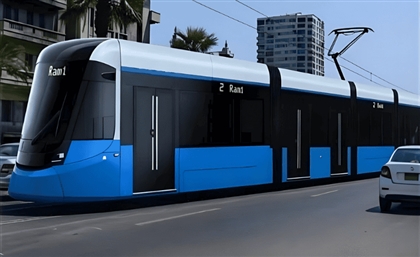
Nowadays, the tram that passes through the photographs taken by Fahmy does not exist anymore. Gone are the blue and white cars - the tracks are being dismantled as we speak, and many of the trees that once framed the journey have been removed as the network undergoes its most radical transformation since the 19th century.
- Previous Article SceneNoise x Amsterdam Dance Event Present CROSSFADE: Egypt
- Next Article Saudi GDP Reaches USD 1.31 Trillion as Non-Oil Economy Expands