




Moist Paper Party: Turning Dubai’s Hidden Corners into DIY Dancefloors
Ahead of its 4th anniversary, we speak to the masterminds behind the party series on how they grew it into one of the most vital grassroots movements in Dubai's underground electronic scene.
In a recovering post-COVID Dubai, inside a hotel bar wearing faded wallpaper and the scent of old cigarettes and spilled whiskey, two DJs from completely different backgrounds stumbled into a moment that would revitalise the spirit in the underground clubbing scene.
Cyrill Reaidy from Lebanon and Kirill Zhan from Kazakhstan had already spent years orbiting the city’s electronic music circuit, playing parties, collecting records, and drifting through after-hours gatherings until sunrise. But their friendship clicked almost instantly, rooted in a shared obsession with musical discovery and a growing frustration with the predictability of the metropolis's nightlife. This bond sparked a series of private house sessions, sowing the seeds of what would later become known as the Moist Paper Party.
“At some point, we were outgrowing house parties,” Zhan tells SceneNoise. “We wanted to bring the atmosphere we created in our personal spaces into a public setting and offer something refreshing to the city. Across the region, there’s a lack of bravery and experimentation in nightlife. This project came from curiosity and pushing that curiosity forward.”
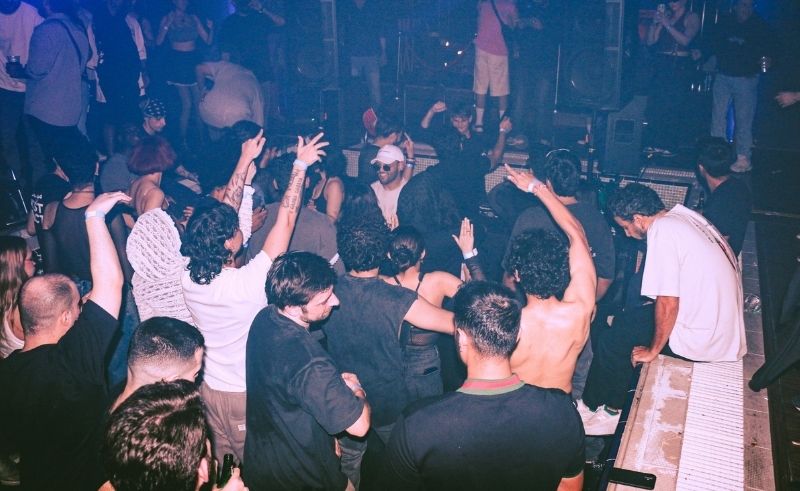
Moist Paper Party is a defiantly DIY party series that has, over the past four years, evolved into one of the most vital grassroots projects in Dubai’s electronic underground. Equal parts rave, social experiment and urban exploration exercise, the party has built a cult following by throwing marathon parties in forgotten corners of old Dubai: emptied-out pools, Goan restaurants, hotel backrooms and spaces most people would walk past without a second glance.
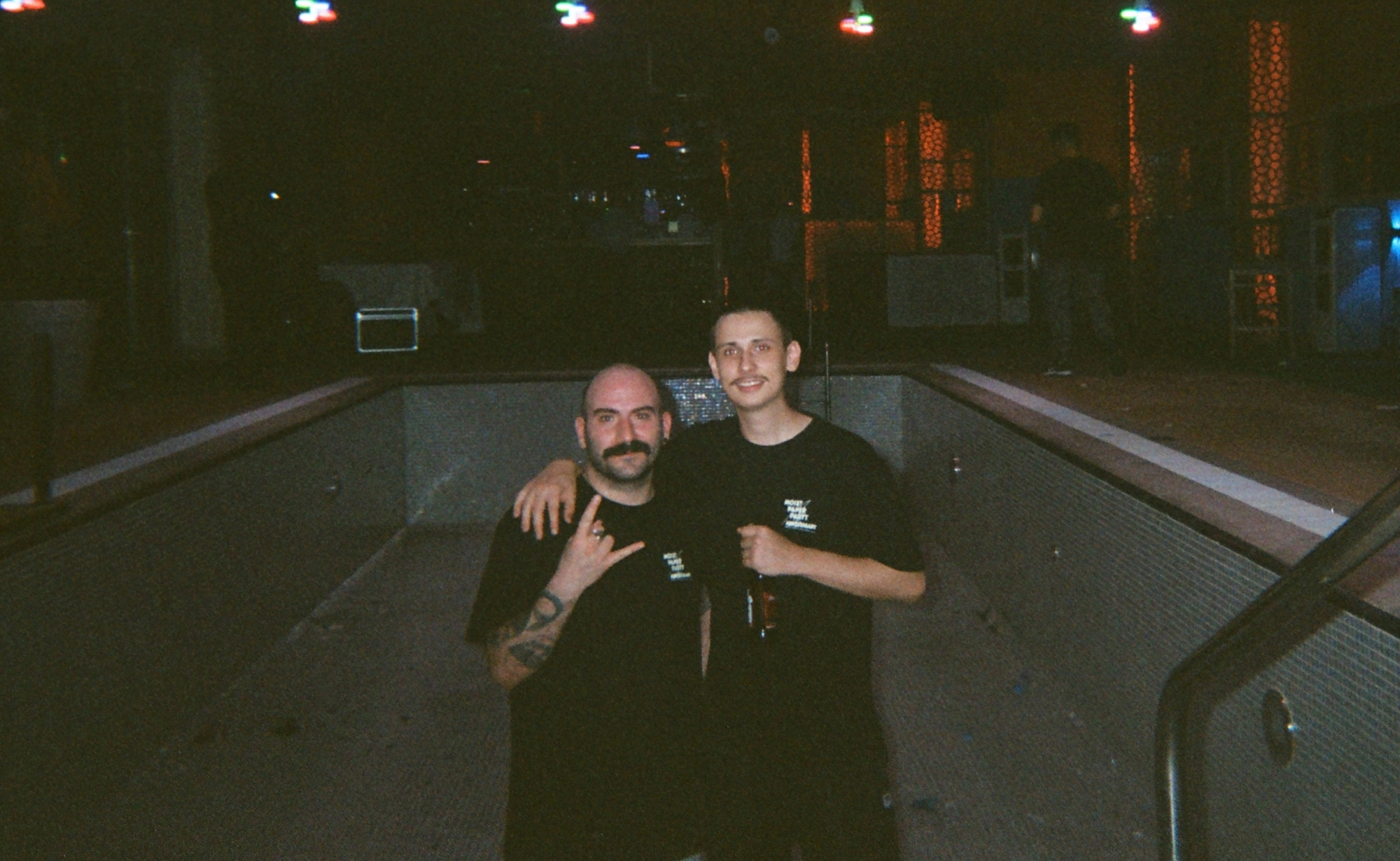
Long before Dubai’s nightlife became synonymous with mega clubs, luxury tables and influencer spectacle, smaller communities were carving out spaces for music heads on the city’s fringes. Moist Paper Party exists in conversation with that lineage, but with its own distinct energy - playful, chaotic, and deeply rooted in a community of like-minded people. “We never had a straightforward dance floor,” Raeidy explains. “It’s all about finding new places to create new experiences and introduce new music.”
The name - Moist Paper Party - emerged with the same spontaneity that now defines the project’s identity. During one of their venue-scouting missions through Bur Dubai, the pair wandered into an ageing hotel bar warped in bizarre floral wallpaper that somehow looked ‘moist’. Somewhere between laughter, drinks and sleep-deprived exhaustion, the phrase ‘Moist Paper Party’ stuck.
“We started this thing out of passion and curiosity,” Reaidy is quick to point out. “We put a lot of love and effort into what we do. We face challenges but learn a lot from them, and most importantly, have fun through it all, especially on the dancefloor with everyone.” That sense of looseness became foundational to the collective’s philosophy. Moist Paper Party rejects rigid music policies and formulaic club structures in favor of long-form sonic storytelling. Their parties rarely follow the conventional pacing of club nights. Sets drift between ambient experiments, breakbeat, techno, jungle, hyperpop edits and obscure regional sounds, often over the course of six or eight uninterrupted hours.
“We wanted to push ourselves and the artists we booked to bring something new to the table,” Zhan says. “Not just musically, but in the way a night unfolds. Our direction is just to start slow and gradually build the speed and energy through the night. Everything else is subjective.”
Moist Paper Party’s venues are as much a part of the storytelling as the DJs themselves. The duo spend hours driving through older neighbourhoods, walking into random hotels and restaurants, chasing spaces that feel spiritually aligned with the project rather than technically convenient.
“We don’t look for plug-and-play venues. We search for places that spiritually fit the project.” Reaidy clarifies. Subsequently, the experience they have managed to create with Moist Paper Party feels radically different from Dubai’s polished entertainment ecosystem. One of the collective’s earliest parties, which was held at an empty pool, began as a logistical nightmare before eventually transforming into one of the collective’s defining signatures. “We had moments where everything fell apart hours before the party. And we had to physically drain another pool ourselves just hours before doors opened physically.”
By the time guests arrived, the founders were still drenched in sweat, wiring speakers and fixing lights between tracks. “That’s part of the beauty of it. Most of the work is just finding solutions to problems.”
That chaos is precisely what gave Moist Paper Party its edge. Unlike highly commercial nightlife experiences designed for straightforward consumption, the party thrives on imperfection and spontaneity, embracing unpredictability as part of the experience - a philosophy increasingly rare in a global nightlife culture driven by algorithms, aesthetics and VIP exclusivity.
“We call ourselves a people’s party. We want anyone who’s curious to experience another side of nightlife in Dubai,” Reaidy says, pointing out that accessibility remains central to the project. Tickets typically hover around AED 50, a deliberate rejection of the city’s increasingly expensive club economy.“ We don’t care about attracting the wrong crowd. We’re not trying to create exclusivity. If you come, you either connect with it, or you don’t,” he adds.
That openness has allowed Moist Paper Party to bridge generations within Dubai’s underground scene, attracting everyone from veteran crate-diggers and longtime promoters to younger creatives searching for alternatives to the city’s commercial nightlife machine. “There are always communities cultivating alternative scenes everywhere in the world. We’re just a continuation of that spirit.”
And while Dubai’s underground often exists in the shadow of assumptions about luxury and spectacle, Moist Paper Party reveals another side of the city entirely - one shaped by migration, cultural overlap and DIY survivalism. -07970633-9e81-4a83-8c45-ca20fa0a0ec8.jpg)
The collective’s aesthetic mirrors Dubai itself: multilingual, hybridised, and constantly shifting. Arabic collides with Cyrillic typography. Western club music bleeds into regional sounds - Russian, Lebanese, Kazakh and Emirati influences coexist on the same dancefloor.
“It reflects our backgrounds and where we are in the party scene,” the duo explain. That cross-cultural fluidity has also made the Moist Paper Party part of a broader movement across the Emirate. The founders point to parallel scenes emerging in Beirut and beyond, communities built not around institutions, but around independent promoters creating ecosystems from scratch.
Today, Moist Paper Party has become more than a rave series. It has evolved into a cultural node within Dubai’s independent music ecosystem, championing local talent, supporting experimental sounds and helping redefine what club culture in the Gulf can look like. Still, despite the growing recognition, the core philosophy remains unchanged from those early house parties and accidental discoveries in Bur Dubai. “At the heart of what we do is having fun. We just want people to get in on it.”
And in a city constantly obsessed with what’s next, Moist Paper Party’s greatest achievement may be its ability to make people feel present; sweaty, disoriented, slightly lost and fully immersed in the moment. A feeling they’ll be chasing again on June 20th, as they gather to celebrate their fourth anniversary.
- Previous Article SceneNoise x Amsterdam Dance Event Present CROSSFADE: Egypt
- Next Article 'Dreams of Dendara' Gives Voice to a Forgotten Lineage of Women