



Photographer Sara Younes on Working With Breast Cancer Survivors
Breast cancer survivors stitch surgical thread onto their own canvas portraits, exploring the body as a site of illness, endurance, and lived experience.
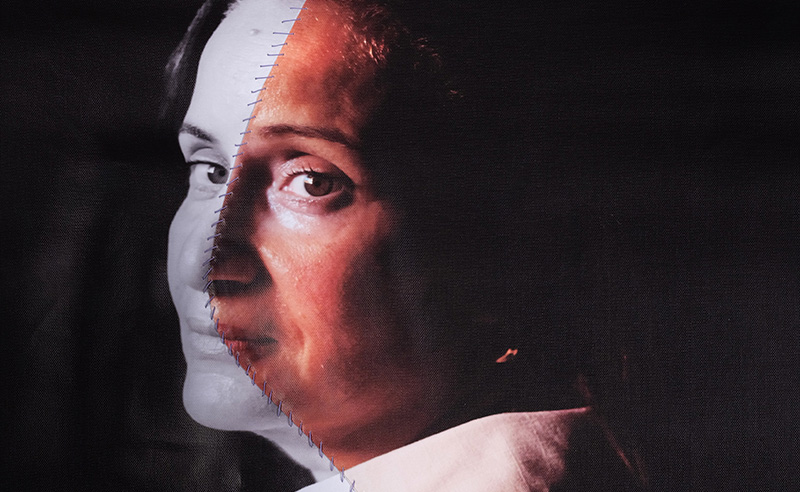
What happens to dissolvable surgical sutures outside the body and outside their usual sterile packaging? Inside the body, we know they are designed to disappear, to be absorbed by tissue and time. Outside of it, no one can say for certain how long they last, when they weaken, or how they disintegrate completely. That uncertainty about endurance, fragility, and time sits at the heart of Fighters Face-to-Face, a project by Egyptian photographer Sara Younes that questions the body as a material reality inflicted by illness, intervention, and survival.
Developed through extended interviews, workshops, and one-on-one sessions with breast cancer survivors at Baheya Hospital, the project unfolds through portraits printed on canvas and stitched directly by the participants themselves using surgical sutures, the same material once used inside their bodies. Removed from the operating room and placed onto their own images, the thread continues to hold, bind, and mark, albeit uncertain for how long. The project culminated in an exhibition, curated by Melania Partman, at Darb 1718 in December 2025.
In this CairoScene interview, photographer Sara Younes speaks about how the project took shape, how trust and time became central to its process, and how cutting, stitching, and material choice emerged as ways of thinking through illness, memory, and survival.
Let’s start from the beginning. When did Fighters Face-to-Face start?
The project began through an open call connected to the Czech Republic through the Czech Embassy. I applied because I’ve always had a strong interest in illnesses, especially illnesses that affect the body and how it looks, since I am a Bell’s palsy survivor myself.
Can you walk me through the project’s timeline?
Initially, the project was: I meet breast cancer survivors and create portraits with them. It was supposed to last two months, but I felt that wasn’t enough. If I only met them twice, I wouldn’t really know them, and I wouldn’t be able to photograph them based on who they are, what they’ve lived through, and their experience. So I asked to extend it. I honestly don’t know how they agreed, but they did, and we extended it beyond the original two months into a full year.
Before the visuals, you started with individual interviews with the survivors. What did that look like?
I interviewed 16 women. Each session was about an hour and a half to two hours, and overall I ended up with around 26 hours of recorded sound.
At first, my questions were focused on the illness: how they discovered it, whether there were signs or not, how they went to get checked, the diagnosis path. Most of them were in their late thirties onward. The youngest was 39, and it went up into the sixties.
Then I started asking about the people around them: how others treated them, what their partner’s reaction was. Some women had very tender experiences, like a partner telling her she looked even more beautiful after chemo, even after hair loss. But another woman’s partner mocked her, and even left the house during the time she was receiving treatment because he didn’t want the responsibility.
And beyond the medical story, what else did you want to explore?
I asked about how their relationship with their bodies changed; how their view of their body shifted. Every woman had a different feeling. One woman told me that after the surgery, after the mastectomy, when she saw her body for the first time, she felt like she became “a little girl again,” like she returned to being young, like “nothing had been touched.” Someone else had a completely different response to her body. We don’t all come out of the same experience with the same relationship to our bodies.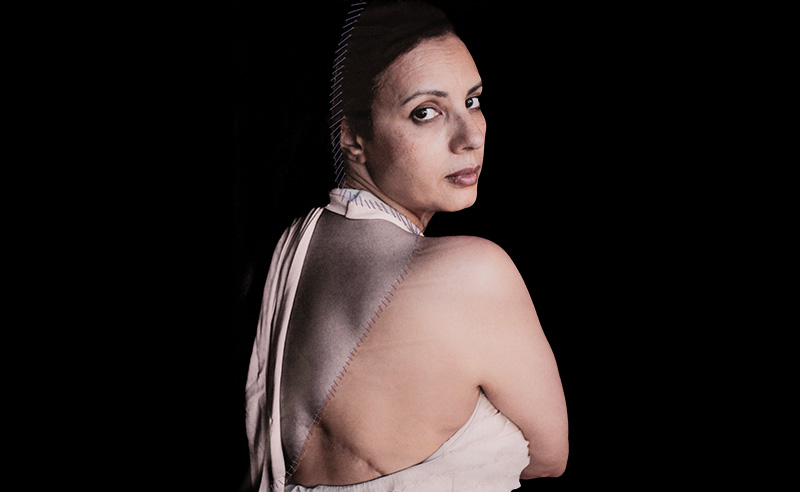 How did you build trust with the participants, especially when your subject is so intimate?
I’m the type of person who says what she feels. And I think that’s one of the things that made us close quickly. From the first day, I was sharing my own experience with my body. I told them: I’m recording you and photographing you because I have my own experience, different from yours, but I’ve been through something that changed my relationship with my body. So I want to ask you, and I want us to talk.
They shifted from feeling like they were “a case” being studied into being the ones holding the stronger position, supporting me. They’d tell me, “It doesn’t show on you,” “Your face is beautiful,” and the barriers broke quickly.
How did the rest of the workshops go?
After the audio interviews, I did workshops with them. The structure was the same each time. One exercise was: I asked them to write letters to themselves ten years in the future. Almost all of them reacted the same way — “Ten years? Will I even live ten years?” The letters were full of sentences like: “If you live another ten years, I hope you’ve achieved this,” “If God gives me life, I hope I get to see this.” I decided I would actually send those letters back to them in ten years. And we also did creative exercises.
Like what?
One major exercise focused on colour. I asked them to choose a color for each stage of the illness: the moment of diagnosis, the period of chemotherapy and treatment, and the stage they are in now, after everything they’ve been through. Sometimes chemotherapy was described as black, which felt expected, but there were surprising choices too — someone writing “black” in white, or surrounding it with other colours. One woman didn’t choose a colour at all; instead, she drew a maze.
There’s a story that really anchors the project: Sanaa and her daughter Yomna. Can you tell me more about it?
I photographed Sanaa with Yomna, but Sanaa didn’t want Yomna’s face in the images for privacy. So I went to photograph them at home. That day, Yomna happened to be home, not at school, because she was helping her mother.
We were photographing on the balcony. Sanaa kept looking inside, worried about Yomna. I suggested letting her stand with us for a moment. She agreed. And as the sun was setting, the sunlight created a reflection, so Yomna appeared in the photo as a shadow/reflection on Sanaa’s clothes.
If I hadn’t done the process this way — if I hadn’t sat with her, listened, understood that Yomna is the core, if I hadn’t respected her boundaries and still stayed present, she would never have trusted me enough to let me into her home. And without going to her home, I wouldn’t have gotten that image.
Why did you choose sewing and cutting as the main form of participation on the portraits?
I knew I wanted them to interact with the images I photographed. At first, I thought maybe they’ll paint or color, because I’ve worked with drawing and collage in another project. But when I got to know them, I realised most are housewives, and many sew at home for their children or themselves. And I also learned a big part of them were already involved in sewing workshops at Baheya.
So I felt their relationship with thread and needle was stronger than their relationship with colour.
And why printed portraits on canvas?
I tried different fabrics first, but canvas felt right because it’s not skin, but it resembles skin in texture: it’s thick, it has pores like the surface of skin.
How did they approach stitching?
They choose where to place the stitches and what form they take, sometimes a line, sometimes a shape, based on how they relate to their experience and their body. The stitching becomes a personal mark added onto the portrait, something each woman decides for herself.
You landed on surgical sutures for the stitching process. How was this decision made?
My first idea was honestly to sew with pink thread, because pink is the breast cancer awareness colour. But that would have been a shallow choice linked to awareness branding, not to their lived experience.
Then the surgical thread idea popped into my head. I asked the participants: what colour were the surgical threads you remember? Their answers varied: someone said gray, someone said purple, someone said black, someone said “no colour.”
I went to the medical supplies market and asked about different sutures. I learned there are three types. The type I used is the type used in surgeries; it dissolves in the body after around a week. But outside the body, sealed in its box, the expiration can be up to five years, as long as it’s sterile and stored properly.
I tried to understand: outside the box and outside the body, how long would it last? Nobody could answer. Shopkeepers would ask me why I was asking such a strange question, because no one uses it like this.
But that uncertainty itself resembles what the body feels like during illness: you never know how long your body will hold, or how long it will live. So I wanted the portraits to carry that same uncertainty.
Even now, after finishing the portraits, I’m still monitoring them: will the threads break? When? How? Will they all break at once or piece by piece? The fighters themselves started giving opinions: one says it’s strong and will last, another says it’s weak and could break if pulled.
The portrait becomes like the body; nobody can guarantee how long it will endure.
When you direct the portraits, do you “pose” people, or does each portrait choice come out of the stories?
Each portrait choice came from the survivor’s own story. Like with Sanaa: I wanted to photograph her with Yomna, but Sanaa had boundaries. I was there, present, and something like fate created the solution , the daughter appearing as reflection/shadow, without showing her face.
And with Nahed, she told me a story early on about being at the beach with her son. Her scar on her back was visible, and an older woman panicked, tapped her husband, and tried to pull him away, shocked by the scar. Nahed told her son, “We’re happy in the water, we’re not leaving. If someone doesn’t like the way I look, they can leave.” But afterward, even though she was strong in that moment, she admitted it changed her. She started asking tailors to close the back of her dresses for weddings and occasions. She didn’t used to do that.
That’s why I photographed her the way I did, because of a specific story she told me, and because I wanted the portrait to carry what the story carries.
Your previous work (The Peter Pan Project) focuses on movement as liberation, while Fighters Face-to-Face feels like the body under siege. How do you stay consistent across those extremes?
The connection is still the body. In Peter Pan, I was thinking about how we move through the body, movement, flight, reaching for the sky.
But personally, I can’t do Peter Pan now. I did it then because I had that desire to fly. Now I’m more occupied by illness and death. While I was working on the project, my father passed away during the workshop stage. I started the project three weeks later.
Before that, my questions were mostly about my own relationship to my body. After his death, I became consumed by what happens when the body stops. He was fine, then sick for exactly twelve days, then gone.
Watching that happen pushed me deeper into questions about the body: how it holds life, and how suddenly it can let go. Peter Pan was about a body that can fly. This project is about the body that brings us back to the ground. I don’t know what comes next. I follow the questions that burn inside me.
- Previous Article KSA's Hiring Landscape in Numbers
- Next Article Saudi Inflation Remained at 2% in 2025
Related Articles
Trending This Week
-
 Jan 18, 2026
 -
-
-