




Whispers from Inside Egypt’s Art Buying Ecosystem
Prices are rising and tastes are diversifying in the world of Egyptian art, despite complaints of conservative collectors and calls for baking a bigger cake.
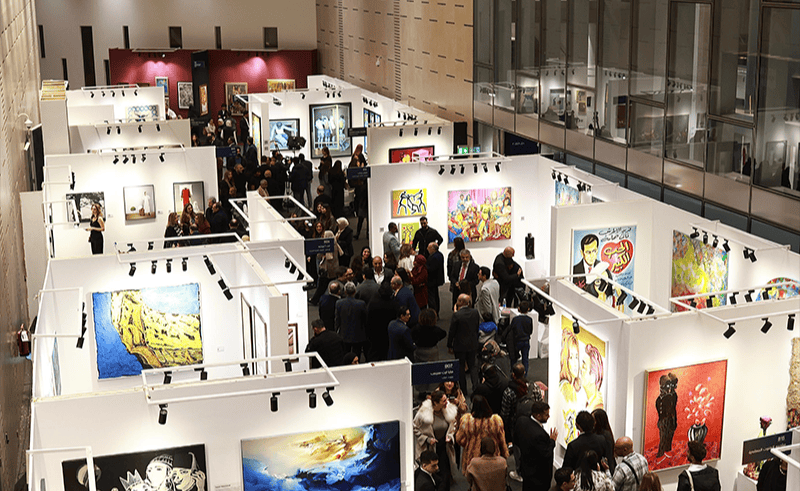
In one corner of Art Cairo 2026, which concluded on January 26th at the Grand Egyptian Museum, a visitor asked a gallerist how much one of the displayed works was, and the gallerist replied that it was 10,000 USD. The visitor, clearly shocked, returned to his wife, and the pair carried on browsing other art.
With a confident smile, the founder of Art Cairo, Mohamed Younis, tells us that the most important investment in life is investment in art. After all, last year’s Art Cairo edition saw more than USD 1.2 million in sales. But beyond rising sales and rising prices, there’s more happening beneath the surface of Egypt’s bubbling art ecosystem.
In the background, collectors are renewing their collections, international art fairs are descending upon neighbouring UAE and Qatar, and still more galleries are sprouting up in Zamalek and Downtown Cairo’s crowded arts scene.
We spoke to the artists, galleries, and collectors forming Egypt’s art ecosystem to get a better understanding of where the market stands, and where it's headed. Here's the picture:
Prices have been rising in recent years, and there’s no sign of slowing down.
Nearly all those we spoke to at Art Cairo agreed that prices have risen considerably in the past years, with no sign of slowing down. For art collectors and artists, this can be very good news. For galleries, it’s a mixed bag: while the increase in price can be commercially beneficial, it also limits the potential customer pool and works counterproductively to the mission of many galleries, which is to bring art ownership to a wider audience. On the other hand, for galleries looking to platform emerging artists, an increase in prices across the board also means collectors are now looking to expand their collections through the works of new, rather than established names, as they are typically much more affordable.
Rasheed Kamel, a lawyer and one of Egypt’s most prominent art collectors, said, “I'm an advocate that Middle Eastern art prices are on the rise. There’s lots of growth happening in the region in terms of art, art institutions, and wealth, so I would say definitely buy Middle Eastern art now.”
Now is still a good time to buy art, though—and maybe buy emerging, or regional.
Many people we spoke to shared Kamel’s sentiments. Arne Everwijn, Middle East Business Development Director at Christie’s, drew particular attention to why collectors should invest in emerging artists. “I one hundred percent think there are artists from the region who will soon take their place in the international art world. You see Art Basel Qatar and Frieze Abu Dhabi coming. There will be an increase in exposure, and with that comes more people who are vying for the same thing, and with that the price will increase. In turn, that makes it more interesting for collectors who are speculating to invest in emerging artists from the region.”
Mohammed Younis agreed that it’s a good time to buy. “There’s lots of buying and reselling going on among collectors at the moment, and now many collectors are renewing their collection, selling older works to buy new, bigger works.”
One gallerist, Randa Ghajar, from Beirut-based KAF Art Gallery, said that she had just sold a masterpiece to a Bahraini collector. Several other foreign gallerists added that Egyptian collectors are also displaying a growing appetite for art from the wider region. “We were always a bit scared of coming here and bringing our artists,” says Ghada Kunash, founder of Dubai’s Fann À Porter gallery. “They are mostly from the Levant area, so we thought maybe we won't be able to sell here, but we found the Egyptian collector is quite interested in other Arab artists.”
The reverse is also true. Ali Taher, a Lebanese haematologist and art collector, told us, “I've been collecting art from Egypt over the past 20 years, over 100 works, whether paintings or sculptures. I'm very happy with emerging artists from Egypt and Cairo.” In Taher’s view, their prices are still affordable, and galleries have done much to uplift their artists over the years.
A clear theme that emerged among exhibitors, domestic and foreign, was that Egypt’s art market remains relatively conservative. This judgement reflects more on the tastes of collectors rather than the work of the artists. There is a clear preference towards colourful, figurative art over abstract or conceptual art, and while exhibitors safely displayed sculptures knowing there existed a wide appetite for them, there was hardly any installation art and no photography to speak of.
According to some gallerists, this conservatism also means an aversion to supporting new artists. “Collectors here are very conservative, generally speaking,” says Stefania Angarano, director of Mashrabia Gallery of Contemporary Art in Downtown Cairo. “They like to invest in big names that are already very well known. They don't want to discover something new.”
However, according to collector Rasheed Kamel, this may be changing. “I’m starting to see now that collectors are starting to pursue art that appeals to them rather than just buying from the usual suspects. Egypt was mostly about conservative, modernist art, but there’s now more interest in contemporary art, and this interest is created by fairs like Art Cairo.”
For their part, Art Cairo tried to work within that balance. “Some of the exhibitors asked us for advice about which artists they should exhibit,” said Juliette Jabet, Art Cairo’s Exhibitor Relations Manager. “Generally, we advised them to display more figurative and colourful work, things that are not too abstract, but of course, we also made sure there was diversity in the fair.”
However, Art Cairo’s founder, Mohammed Younis, sees that it's only a matter of time before the region picks up on global trends “A global audience is now going towards abstract. Figurative is still there, of course, but abstract art is growing more and more each year.”
There's much room for growth in the secondary market—but beware of forgeries.
The idea of art as an investment is incomplete without a functioning secondary market, where the resale of artwork occurs. In Europe and the United States, auction houses function as a main pillar of the secondary art market, creating an arena where art collectors can battle it out. In the absence of auction houses in Egypt, however, private galleries take up that role.
“When a customer wants to sell a work from their collection, they can ask us to sell it for them, for a commission,” a representative from Zamalek Art Gallery told us. “We price the work based on the current market value of the artist, and we typically sell directly through our client network, rather than exhibiting it publicly. Forgeries are also a big problem here in Egypt, so we prefer to deal only with the works of artists we are familiar with, like Gazbia Sirry, because then we can properly authenticate and price the works.”
For Zamalek Art Gallery and many other galleries in Egypt, however, the secondary art market represents only a small fraction of their work. Some galleries, like Mashrabia, avoid dealing in the secondary art market altogether.
To read the future of Egypt’s art market, look towards the galleries—of which we have many.
More than just a place to exhibit one’s work, art galleries are the foundational block that create a demand for art and keep the art machine well-oiled. In a sense, it’s the gallery that builds the artist, or at least the value behind their work.
Along with the fact that Egypt boasts the region’s oldest art faculties and museums, having a high number of galleries has also meant that its artists have historically enjoyed a unique positionality in the region. Speaking on a panel, Rabie Besiso, a Jordanian businessman and art collector, put it more bluntly: “If it wasn't for galleries in Egypt, I don't think Egyptian artists and art would be where they are now. It has its unique place because of the role galleries play and do. They are market makers.”
According to artist Marwan Sabra, whose solo show was being exhibited by Cairo-based ArtTalks throughout the duration of the fair, “Galleries are the most important piece of the cycle. Art is an industry like any other, and galleries have to cater whatever the artist is producing to a specific audience.”
And more are sprouting up each day.
According to Karim El Hayawan, a visual artist and interior architect, the proliferation of galleries in Egypt is now leading to more differentiation among galleries, a net positive. “What I'm seeing is that there’s starting to become more calibration, meaning that in the past five years, people are being exposed to more art and starting to better know their tastes. Because there are now so many galleries, it’s time for each one to specialise and form an identity to differentiate itself from its neighbours.”
Nadya Shanab, managing director of Zamalek-based Ubuntu Art Gallery, agrees. “Everyday you hear of a new art gallery opening, but what’s sad is when you hear the galleries are exhibiting the same artists. There needs to be a better effort to find more artists because the country is full of them. Instead of trying to take a slice from the cake that already exists, let’s make the cake bigger.”
So what does all this mean?
Shanab’s concerns are shared by many. Yet, there’s a prevailing optimism that as the ecosystem’s many moving parts begin to communicate more closely with one another, including through institutions like Art Cairo, we’re heading towards a more mature art market, which may ultimately provide more opportunities for new artists, galleries, and collectors to emerge.
As galleries continue to open, they can begin diversifying, giving emerging artists more opportunities to showcase their work. The demand for new voices will only increase as foreign art fairs come to the region and the body of modern Egyptian art is acquired in its entirety, and becomes unaffordable, even for Egypt’s wealthiest art patrons.
At the same time, changes are also happening within this growing body of art collectors, guided by voices from within the community. Many anticipate (or otherwise call upon) changes in the way decisions in art-buying are made by their fellow collectors, perhaps easing the concerns of gallerists who feel that there exists a large disconnect between this wealthy class and the work of Egyptian contemporary artists, laying forth an opportunity for emerging and established artists to claim their stake in Egypt’s growing art scene.
Related Articles
Trending This Week
-
-
 Sep 10, 2026
 -
 Sep 10, 2026
 -